

A cluster of research, events, and initiatives on loneliness, exclusion, and community. Based at @WCCEH, @UniofExeter. Tweets @Charlotte_Sheff & @drfredcooper.
- Tweets313
- Following406
- Followers499
- Likes272




ALT A large pink heart, slightly frayed at the bottom and overlaid with comic-book style dots of orange and black, with "the beat of our hearts" written in a white shape at its centre. The heart is overlaid on a picture of a beautiful sunset with a silhouetted horizon at the bottom of the picture. Here we see the shapes of trees, a house, a bench, a flock of birds and five flags flying. The central flag, the Progress pride flag, is seen in full colour.


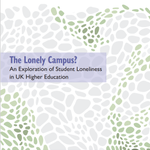
ALT The front cover of the report. At the top is the University of Exeter logo and the Wellcome Centre logo. Underneath it reads: The Lonely Campus? An Exploration of Student Loneliness in Higher Education. October 2021. Dr Richard Vytniorgu, Dr Fred Cooper, Dr Charlotte Jones, Professor Manuela Barreto, Professor Mark Jackson. In the background are abstract grey and green shapes.

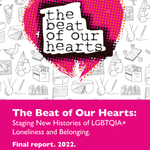
ALT Cover of The Beat of Our Hearts report. The 'heart' project logo is in the centre, surrounded by small black and white drawings (e.g. a pride flag, boxing gloves, a smart phone, holding hands). At the bottom it says: The Beat of Our Hearts: Staging New Histories of LGBTQIA+ Loneliness and Belonging. Final report. 2022. Charlotte Jones and Richard Vytniorgu.


ALT Image with final showcase date 10am-5pm on 15th June 2022.


ALT The Beat of Our Hearts production poster - a bright, moody sky with dark blue shades and stars at the top, with pink clouds underneath. At the bottom is a silhouetted cityscape include a pride flag, library, and a murmuration of starlings. The logo is in the centre - a pink 80s heart.


ALT Feminist Loneliness Studies: an introduction Shoshana Magnet, Celeste E. Orr https://doi.org/10.1177/14647001211062734 Abstract Writing about loneliness has been a struggle in the midst of the pandemic. Characterized by loneliness, isolation, anxiety, and fear, the COVID-19 pandemic is an exceptionally challenging time. At various points while navigating this loneliness project amid a particularly lonely time, we lamented the seeming futility of it all. A main goal of developing a Feminist Loneliness Studies in this introduction is to understand the ways that systems of oppression – white supremacy, settler colonialism, anti-queer bias, misogyny, neoliberal capitalism, and so on – create our lonely world. To date, there remains no comprehensive feminist analysis of the structural conditions that both produce and intensify experiences of loneliness. We aim to remedy this gap.
ALT Feminist Loneliness Studies: an introduction Shoshana Magnet, Celeste E. Orr https://doi.org/10.1177/14647001211062734 Abstract Writing about loneliness has been a struggle in the midst of the pandemic. Characterized by loneliness, isolation, anxiety, and fear, the COVID-19 pandemic is an exceptionally challenging time. At various points while navigating this loneliness project amid a particularly lonely time, we lamented the seeming futility of it all. A main goal of developing a Feminist Loneliness Studies in this introduction is to understand the ways that systems of oppression – white supremacy, settler colonialism, anti-queer bias, misogyny, neoliberal capitalism, and so on – create our lonely world. To date, there remains no comprehensive feminist analysis of the structural conditions that both produce and intensify experiences of loneliness. We aim to remedy this gap.

ALT Photo by Craig Fuller. Rebecca Todd playing Valentine. Image is of a woman dancing with her hands raised, messy hair, and a cardigan lifting with her movement. She is lit in blue and surrounded by darkness.