

Tracking Tesla FSD updates, rollouts & regulatory approvals across the 🇪🇺 EU. Real-time coverage for Tesla owners & autonomy enthusiasts.
Joined April 2026
- Tweets56
- Following4
- Followers1.6K
- Likes18





"Mercedes-Benz first to bring point-to-point driving to Germany"
🇩🇪 What is going on in Germany?
Tesla has been fighting for European FSD approval for years. Meanwhile, Mercedes just announced that they will be the “first” to bring point-to-point driving to Germany with their MB.DRIVE ASSIST PRO, rolling out at the end of 2026 to select customers, and nation-wide in Q1 2027.
Could this explain why Germany appears reluctant to grant national approval, while Bilger keeps pushing for the European route — which, conveniently, isn't expected to be finalized until Q1?
PR Photo: Mercedes CEO Ola Källenius, German Chancellor Friedrich Merz, and NVIDIA CEO Jensen Huang at at the “Invest in Germany Summit”.
Same SAE level. Very different welcome. 🤔
group.mercedes-benz.com/tech…

🔆 We've added TADTracker.eu alongside FSDTracker.eu to reflect the new naming of FSD (Supervised) in Europe. Both domains are active and lead to the same platform.


🇸🇰 Slovakia has provisionally approved Tesla FSD (Supervised) for use on public roads, per its Ministry of Transport (Oct 16).
Slovakia joins the minority of EU countries allowing it, after the 🇳🇱 NL, 🇨🇿 CZ, 🇧🇪 BE, 🇩🇰 DK, 🇱🇹 LT, 🇪🇪 EE, 🇭🇷 HR and 🇸🇮 SI.
Transport Minister Jozef Ráž: it's "not a fully autonomous system" and the driver stays fully responsible. The car monitors driver attention and can disengage. Source: e.dennikn.sk/minuta/5627789

🇧🇪 Flemish minister De Ridder rejects suspending Tesla Assisted Driving (ex-FSD) after a critical johanna.be test. Belgium sticks to the Dutch RDW approval, but Speed Offset changes are on the table ahead of the EU vote.
vlaamsparlement.be/nl/parlem…
Tesla has renamed “Full Self-Driving (Supervised)” to “Tesla Assisted Driving” in Europe to comply with regulatory requirements.
“Full Self-Driving Capability” is now called “Tesla Assisted Driving Basic” (for countries where FSD/TAD has not been approved yet).
Both are separate packages. Eligible vehicles with the required hardware and a Basic subscription will automatically be upgraded to Tesla Assisted Driving at no extra cost, subject to regulatory approval.
Features have not changed, they're just new names.
🇪🇺 FSD EU forecast updated
Best case: positive vote in Dec 2026, EU-wide approval in Feb 2027.
Realistic: vote in Feb 2027, approval in Apr 2027.
➡️ Our new forecast for an EU-wide FSD rollout: Q2 2027
Details & live tracking: FSDTracker.eu

🚨 Tesla will have to change the name of FSD Supervised to "Tesla Assisted Driving". Germany's Transport Ministry just published its official position on Tesla FSD, and it goes further than this morning's headlines 🇩🇪
🤝 Agreement reached with Tesla in September
🏎️ Germany backs a tolerance of up to 10% over the speed limit
🏷️ Tesla offers new name: "Tesla Assisted Driving"
Still no date. The EU process continues.
🧵👇bmv.de/SharedDocs/DE/Artikel…

Reality check on Bilger's FSD statement 🇩🇪
Read it closely: Germany is NOT acting on its own. The plan is to wait for the EU process. Only if that fails will Berlin "talk about" what it could do nationally.
Support? Yes. Shortcut? Still no.

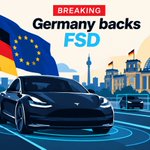
🚨 BREAKING: Germany's Transport Minister Steffen Bilger backs EU approval of Tesla FSD (Supervised) 🇩🇪🇪🇺
He vows to push for a timely Europe-wide rollout – and if an EU deal fails, Germany will have to talk about what it can do on its own.
Details 👇
What Bilger (CDU) said today at a Tagesspiegel Background conference in Berlin:
- An EU-level agreement is the preferred route
- Open points: technical questions + liability
- His priority: enabling innovation
- He also sees road safety benefits
- Germany should lead on autonomous driving
Source: dpa-AFX
heise.de/news/Tesla-FSD-Verk…


Mercedes-Benz and Wayve just announced that the Wayve AI Driver will enter production vehicles “starting in the next two years”, enabling advanced point-to-point driving assistance on both urban roads and highways.
That certainly sounds impressive, and more competition in autonomy is exactly what the industry needs — every serious push toward better self-driving technology is a positive development.
That said, the timeline deserves some context. Tesla has already been doing essentially this with FSD (Supervised) for years: navigating city streets and highways point-to-point under driver supervision.
The difference? In Germany, customers still can’t use it because regulatory approval remains missing.
Wayve, meanwhile, is still not deployed in a single mass-production vehicle today.
So by the time Mercedes and Wayve plan to bring this capability to production cars, Tesla’s equivalent system may have been technically available elsewhere for roughly four years.
The bigger question is becoming increasingly difficult to ignore:
How far behind is Europe because of technology — and how far behind because regulators simply aren’t allowing already-existing technology onto the road?

We’re partnering with @MercedesBenz!
We’ve signed a definitive production agreement to integrate the Wayve AI Driver into future Mercedes-Benz vehicles, bringing intelligent and scalable driving assistance technology to more consumers.
As part of a multi-year technical collaboration, we’ve integrated the AI Driver into the Mercedes-Benz production system architecture using their HW & MB.OS - watch us driving around the world in DE, US, & UK 🌍

✅ CONFIRMED: The Czech Ministry of Transport has officially recognized the Dutch RDW's provisional EU type-approval (issued 10 April 2026, under Reg. (EU) 2018/858, Art. 39) for Tesla FSD Supervised.
🇨🇿 Czechia joins the Netherlands + 5 other states — now 7 EU countries. Decision followed months of technical review covering speed-limit handling, traffic sign interpretation & driver monitoring. Minister Ivan Bednárik said: CZ wants to support a harmonized EU-wide framework going forward.

🇨🇿 Asistenční systém Tesla FSD Supervised bude možné za stanovených podmínek používat také v Česku. Uznali jsme prozatímní schválení nizozemského úřadu RDW. Připojujeme se tak k Nizozemsku a dalším pěti evropským státům.
Tomuto kroku předcházely měsíce odborného posuzování a jednání s českými i zahraničními odborníky a zástupci Tesly. Zajímalo nás především, jak systém funguje v běžném provozu, jak reaguje na dopravní značení a rychlostní limity a jak zajišťuje, aby řidič řízení stále věnoval pozornost. Důležité byly také zkušenosti ze zemí, kde už systém používají.
Chceme moderním technologiím otevírat cestu na české silnice. Bezpečnost přitom zůstává na prvním místě.
ℹ️ Co to znamená pro řidiče? Tesla FSD Supervised je stále asistenční systém. Řidič musí sledovat provoz, dohlížet na jeho činnost a být připraven kdykoliv okamžitě převzít řízení. Odpovědnost za jízdu zůstává plně na řidiči.
👉md.gov.cz/Media/Media-a-tisk…

🇨🇿🎉 Big news for our friends in Czechia — FSD Supervised has been approved, making it the 7th EU country to greenlight the system! Rollout starting soon.
But it's hard to ignore the irony: major automotive powerhouses like 🇩🇪 Germany — the heart of the EU car industry — are still sitting on the sidelines waiting for a bloc-wide decision, while smaller markets keep leading the way. When will the big players catch up? 🤔


Please be cautious, a YES is not confirmed.
The Swedish government reiterates that its goal and ambition is for an EU-wide approval of advanced driver-assistance systems such as Tesla FSD (Supervised) to happen. That is clearly a positive political signal.
However, the minister does not say how Sweden will vote on the current proposal, nor does he overrule the concerns previously raised by Sweden’s Transport Agency.
Sweden’s government is clearly supportive of getting FSD approved at EU level. However, this only applies as long as the system meets the necessary safety requirements — and Sweden’s Transport Agency has raised concerns about whether the current proposal does.

FSD in Europe 🇪🇺
Sweden intends to vote YES for FSD.
Bellow you can see a statement on Swedens position on the EU wide approval vote in the TCMV.
Answer to question 2025/26:1000 by Rickard Nordin (C)
Sweden’s position in the EU regarding the handling of FSD
Rickard Nordin has asked me whether I intend to take any initiatives in light of the Swedish Transport Administration’s position and recommendation to the EU’s technical committee concerning the vehicle system Tesla FSD (Supervised), and if so, which ones.
In the ongoing discussions in the EU’s technical committee on motor vehicles on the conditions for approving Tesla FSD (Supervised), extensive supporting material is being taken into account, including the assessments of the Swedish Transport Administration. As I have previously stated, it is the Government’s starting point and ambition that a Union-wide approval of advanced driver assistance systems such as Tesla FSD (Supervised) should be put in place. Such approvals are always preceded by evaluations and analyses of the available material on the system. This is important in order to guarantee safety in the use of these systems.
Stockholm, 31 August 2026
Andreas Carlson
Minister for Infrastructure and Housing
Ministry of Rural Affairs and Infrastructure

🚨 Tesla just published a public "Article 39" Evidence Dashboard — a data package built specifically to support its exemption requests from UN R171.01 (DCAS) for FSD (Supervised) in the EU.
Inside: 8 studies, ~2B miles analyzed, 793K EU engineering miles with zero major/minor collisions, and 230K+ fixed-route scenario tests across 6 European cities with a 99%+ pass rate.
It's Tesla's most detailed public case yet for FSD approval in Europe.
An update on FSD Supervised in Europe
FSD is currently approved in five EU countries (NL, DK, BE, EE, LT), used by >70k customers for over 1 million km per day, and is 4.1x less likely to get into a crash compared to manual driving, measured across 100 million km on public EU roads.
Leading up to a potential EU-wide approval vote for FSD Supervised on October 6th, 2026, we have decided to open-source one of the key pieces of evidence used to support the Netherlands approval.
As a reminder, we adjusted the FSD design to be compliant with existing regulation (UN-R-171 DCAS) but requested an exemption for certain behaviors via the EU Article 39 procedure. The following dashboard is evidence of safety for those exemptions.
This exact dashboard was shared with all EU Member States in April 2026, shortly after RDW’s approval, and all data presented is from before that date.
tesla.com/fsd-evidence-dashb…
European countries recorded 19,400 road deaths in 2025. That's around 53 deaths/day, with the vast majority of these crashes attributed to human error. These deaths are largely preventable with technology we have today.
FSD Supervised is already saving lives where it’s approved – yet in much of Europe, that safety benefit remains locked behind bureaucracy.
📄 The summary record from the 05 May 2026 TCMV meeting is now out. The Netherlands gave an update on the Article 39 provisional approval for Tesla FSD, walking through its features, capabilities, and exemptions under UNR171, and pushed for a decision by 30 June — though the EC said that timeline isn't realistic given the data analysis still needed.
The "speed offset" feature drew pushback from two Member States, who worry it could enable over-speeding, while NL argued it can actually help by correcting wrong speed limits and adapting to traffic flow. One MS stressed that making the exemptions permanent will require the EC to propose actual amendments to UNR171 at UNECE/GRVA, with no guarantee of acceptance.
NL also confirmed a long-term effects study is underway and that consolidated Q&As will land on Circabc, while another MS called for a harmonized EU communication and raised questions about how FSD interacts with ADDW. The EC has asked NL to present again at the upcoming MVWG and ACV sub-group meetings for transparency. ec.europa.eu/transparency/co…
