

Stravaiging. Persiflage. Little original input. Just stuff I find. Retweets are not endorsements. Not looking for followers. Competent Clerk. Αἰδώς.
48°52.6′S 123°23.6′W
Joined June 2013
- Tweets44K
- Following217
- Followers165
- Likes16.6K





Pinned Tweet
americanaffairsjournal.org/2… Nuclear energy is not just one option among many within a diversified clean energy portfolio; it is strategic sovereign infrastructure, analogous to missile defense, civil aviation control, or central banking. It is a system whose development cannot be delegated, whose coordination cannot be crowdsourced, and whose permanence transcends commercial return.

The Elephant in the Market: Understanding America’s Weight in Global Benchmarks theideafarm.com/markets/the-…

13


Anathemata retweeted

Big development.

Russia has effectively abandoned attempts to replace the dollar with China’s yuan under the pressure of US secondary sanctions, underlining the difficulties facing other nations looking for an alternative global currency bloomberg.com/news/articles/…

.

To say this plainly: We the U.S. have an unsolved set of conflicts that is collapsing:
I) Science is done in the open in universities and is unprotectable in intellectual property law.
II) Science is the principal ingredient in Weapons of Mass Destruction. Our scientists, however, are like deadly ninja priests kept in a childlike state of ignorance about why and how they are part of the National Security complex. They are preserved often like man-babies who can design mega weapons, infect continents, crack codes, etc. in times of national emergency, but who are encouraged to sound like slow and beautiful children staring at the pure wonder of flowers and fireflies during peacetime.
III) We moronically stopped providing for our own Scientists to produce science as a public good as in I). Beginning in the 1980s, we then invited China (!!) and other nations to provide our STEM labor force at vastly reduced cost which we labeled “Foreign Students”. We called our own people lazy and stupid just so we would not have to pay U.S. compensation. And no, I’m not making this up.
IV) China, Epstein, Iran, Russia, etc. remain interested in our science scientists as Washington and technologists increasingly freeze U.S. scientists out of any ability to materially capture what they created. Just as importantly, they are frozen out of how their funding and control systems actually work.
V) We have some completely crazy and weak cryptic science interception mechanism based on ArXiV (which came from Los Alamos), peer review of Grants (Washington DC), Peer Reviewed Journals (Robert Maxwell, NSF pushed after 1975). It doesn’t work and targets anyone qualified who points it out. It is “anti-interesting”. Nobody covers this question. “Why claim that String Theory is the only game in town after 42 years of non-stop failure!?”
VI) Somehow we started poisoning our own science system, trying to save a few nickels and lying to our own scientists about the fact that we expect them to help our military, intelligence community and businesses when asked. So we destroyed their families ability to participate in the American Dream in favor of young Chinese nationals and started running “Science Coolies” (not my term) while destroying any U.S. PhD who pointed this out as if they were racist, lazy and stupid.
VII) We developed an antiquated system of ridiculous stop gap measures for keeping this together. Like intercepting work and blackballing our own PHDs (!!?!) who take an interest in the collosal collapse of scientific ethics and the obvious paradox of “Open Science in the National Security Interet.” It’s pathological.
————
I didn’t want to have to spell it out more than I have to…but this is absurd. And dumb. And unsafe. And obvious.
Is there anyone at all following this? Because it is going to get us all killed.
22
What 400 Years of Financial Manias Teach Us About Today | Edward Chancellor youtu.be/bhgiF3nWr7w?si=aU-S… via @YouTube
32
.

The latest on The Antidote, on the Aesthetics of AI, the topic of my upcoming TED Talk. Why are most things AI so ugly? What is the architectural legacy of tech titans? Data centers and bunkers. Where is our attempt at beauty?
carissaveliz.substack.com/p/…

14
Mike Milken: Who Gets Access to Capital? | Podcast | In Good Company youtu.be/G_WVmxyPSp4?si=623_… via @YouTube
21
Anathemata retweeted

Today is Martinmas, the feast of St Martin of Tours, a major festival in medieval Europe which heralded the approach of winter with fire and feasting.
St Martin is the patron saint of soldiers, often shown sharing his cloak with a poor man to protect him from the winter cold.

Anathemata retweeted

Worthless and stupid documentaries about secret nazi projects, seriously harm history and degrade all understanding of the very interesting results of nations who pursue markedly different scientific approaches in wartime.
No, they did not build UFO`s, and various other moronic contraptions, but they DID do some really very impressive stuff (which obviously nobody cares about because science isnt interesting unless it involves occultist sacrifices or nazis on the moon).
Things German engineers actually DID do, were things like ceramic gas turbines.
This was driven by wartime shortages of metallic elements such as Cobalt, Nickel, Chromium and Tungsten, and not by some desire to build space age engineering ideas.
The materials used were not able to function to the level needed for operational use, but they did work to a basic degree, and included rotors (below) and stator vanes.
Ceramics promised much as they have amazing resistance to high temperature operation, but then (as now) problems always arise with brittleness and also how you attach the stuff to metal parts.
Some German experiments, (much more closely predicting future experiments today) instead of monolithic ceramics, they developed early MMC ("meta matrix composite"), where turbine blades were made with a metal matrix (this just means the bulk of the thing is in effect a "glue" formed of metal), where at the blade tips there was a high percentage of ceramic material, lowering density and increasing temperature resistance, but at the more bothersome blade root (where the blades always try to detach themselves at unwanted times from the rotor hub), the blade had a much higher metallic proportion, thus giving it ductility needed to avoid fractures.
Almost nobody knows any of that happened because engineers made these things, without any blood-priests summoning undead Wagnerian gods, so its not as fun in the cineama.
*sigh*

Anathemata retweeted
The GE9X turbofan, made by General Electric is the world's largest, most powerful, and fuel-efficient commercial airliner jet engine.
It was built exclusively for the Boeing 777, and has over a hundred ceramic parts.
But, "haha" or something at people doing early research into ceramics in gas turbines ?!?!
geaerospace.com/commercial/a…

Anathemata retweeted

Remember when CNN reported data centers were causing enormous "heat island" effects based upon a (bogus) non-peer reviewed research paper on March 30?
Well, now published research shows the exact opposite: the reflective roofs of the data centers actually dramatically cool the daytime temperatures around the buildings compared to otherwise.
eurekalert.org/news-releases…
Study: iopscience.iop.org/article/1…
CNN sloppy work:
cnn.com/2026/03/30/climate/d…

Anathemata retweeted

"A 100MW datacenter in China now costs under $300M to build, excluding IT equipment, about a fifth of the US cost. China's build cost has fallen about 25% since 2021."


Anathemata retweeted

Nearly a third of statistically significant findings in development economics may be false discoveries
In a new NBER working paper, Qingyuan Chai, Kevin Lang, and Liang Zhong question the statistical credibility of randomized controlled trials (RCTs), which have become one of the main tools of modern empirical economics.
The authors analyzed 745 tests of primary hypotheses from 190 papers published in leading economics journals and arrived at some rather troubling findings.
nber.org/papers/w35999

"The finding that pessimism is morally penalized has implications for societal trust in expert predictions"

Glass half empty Pessimism is considered morally disgraceful and a sign of a lack of goodwill.
Does expressing pessimism signal a lack of moral virtue? Across eight preregistered studies (N = 3952), forecasters who made pessimistic predictions about the state of the world in the future were consistently judged as morally inferior to forecasters who made optimistic predictions. This moral penalty persisted even when pessimism was evidently accurate, and even pessimists themselves penalized pessimism.
Pessimists appeared less desirous of positive outcomes—a perception that undermined impressions of their morality. Supporting this mechanism, the same pattern emerged when pessimism was merely held in forecasters' private thoughts.
Why is forecasting moralized? Studies 5–6 uncovered that pessimism is seen as a moral failing because it signals uncharitable desires: Pessimists appear to lack goodwill, which reflects poor morals. People judged pessimists as less generous, less sociable, and less likely to engage in moral behaviors (e.g., help someone cross the street).
The finding that pessimism is morally penalized has implications for societal trust in expert predictions. Experts expressing pessimistic forecasts might be publicly dismissed because their outlooks appear uncharitable. [This] could distort collective risk assessments by suppressing necessary caution in critical societal decisions.
15
Anathemata retweeted

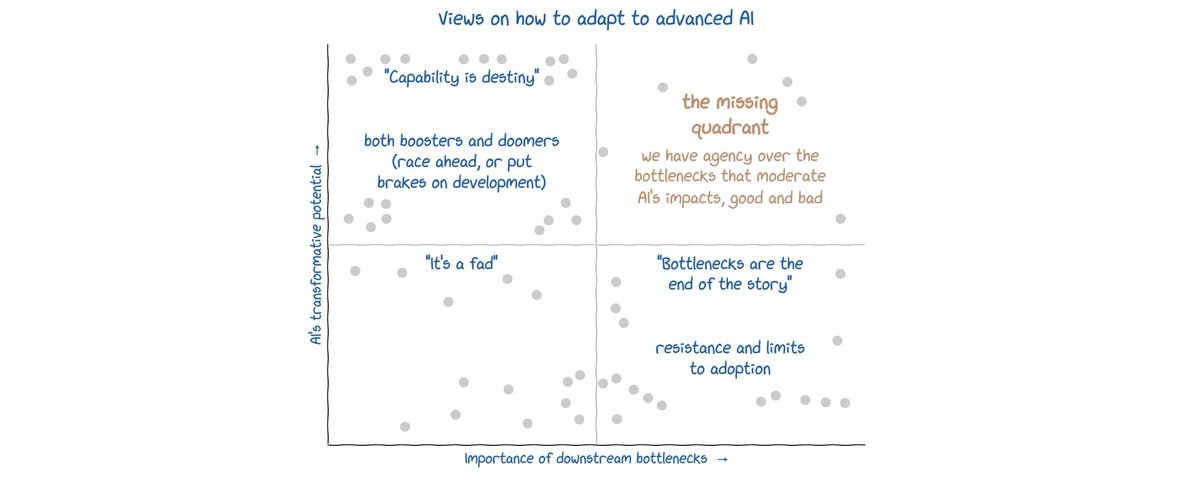
📢 We need more orgs that take AI’s transformative potential seriously *and* take downstream bottlenecks seriously. We have just launched STABL, and hope to lead by example. Read our launch essay below and check us out at stabl.ai.
The three of us have long felt that society’s responses to advanced AI are unproductively polarized. So we’ve decided to do something about it. Our work will have four pillars: Recursive Self Improvement, risks and resilience, steering AI’s economic impacts, and sectoral and professional adaptation.
We will bring our distinctive methods and approach to each of these workstreams. Our underlying worldview avoids the extremes that dominate the discourse, so building a movement and ecosystem around this work won’t be easy. But that is the task we have set ourselves and we are excited to try. The good news is that there are many others who share our views. The next step is to come together, better articulate our vision and agenda for research and action, and amplify each others’ efforts.

Steering AI's societal impact requires taking both AI development and downstream bottlenecks seriously.
Today @RishiBommasani @random_walker and I are starting a new non-profit: STABL @stabl_ai to guide societal adaptation and resilience to advanced AI.
Anathemata retweeted

Well..
Virtually every single seasonal model for this winter shows blocking throughout December, January & February with the trend in blocking strengthening as the winter progresses.
In all my time of weather watching I've never seen such a strong and collective signal for a potentially very cold winter.
We do have to be cautious, though. They are all going off the same long term drivers and given the current unprecedented nature of this El Nino event, we have no real way of knowing whether or not this is a real model signal, although it sure looks like one.


Masayoshi Son’s SoftBank reserved enough gas turbines to generate the power of six Hoover Dams. It cost the company billions of dollars in losses. wsj.com/business/energy-oil/… via @WSJ

32
Anathemata retweeted

When a Vanguard-class SSBN slips past the Gare Loch into the Clyde, the Ministry of Defence PR apparatus frames it as the relentless triumph of the Continuous At Sea Deterrent (CASD). The operational reality is far darker. This is a scene of institutional brinkmanship, played out in four distinct acts across the British state.
1. Within forty-eight hours, that 16,000-ton boat will vanish below the acoustic layer. Somewhere in the North Atlantic, another Vanguard is waiting. That returning crew has likely been submerged for upwards of 150 to 180 days—double the 90-day patrol limit the submarine was originally designed for. The handover is entirely cryptographic. Once Northwood Headquarters confirms the outbound boat has the watch, the exhausted inbound crew will turn her bow toward Scotland. They will be back in Faslane within a week. But the crew that just left? They are now entombed until late spring 2027.
2. Who actually makes the decision to lock 140 men and women in a steel tube for six months? The operational order comes from Commander Operations (COMOPS) deep inside the permanent joint headquarters at Northwood, specifically the node designated as CTF 345. But the admirals at CTF 345 are not making a strategic choice; they are playing a rigged hand dealt by Westminster. The doctrine of CASD dictates that one boat must always be on patrol. You need four submarines to maintain this mathematically: one on patrol, one training/working up, one in routine maintenance, and one in deep refit. But the math has collapsed. COMOPS is forced to order 200-day patrols because he simply doesn't have the hulls available in the rotation cycle.
3. Why doesn't the government intervene? Because successive governments are the exact architects of the crisis. To understand why that boat is being run into the ground, you have to look at the Treasury and the civil service managerial cartel. In the 2010s, chancellors like George Osborne and Philip Hammond engaged in "fiscal smoothing"—delaying the Dreadnought-class replacement submarines to save in-year accounting costs. Simultaneously, Whitehall utterly failed to manage the sovereign refit infrastructure at Devonport (Babcock’s Dock 9). They outsourced the deep maintenance (the Long Overhaul Period and Refueling, or LOP(R)) and let the dry docks decay. So, instead of a refit taking two years, it takes four to five.
You cannot rotate four boats if two are functionally trapped in a crumbling dockyard in Plymouth. The politicians did not intervene because intervention requires capital expenditure; they preferred to quietly force the Royal Navy to absorb the risk on the balance sheet.
4. Can it be proven that the Royal Navy is at a drastically elevated risk entirely due to government decisions? Unequivocally.
First, there is metallurgical and mechanical reality. The Vanguard class was commissioned in the 1990s with a 25-year lifespan. They are now being pushed past 30 years. Running ancient pressure hulls, aging reactor cooling systems, and legacy life-support scrubbers on 200-day continuous cycles creates exponential mechanical fatigue.
Second, there is the human capital destruction. You cannot repeatedly subject highly specialized, nuclear-qualified engineers to six-month underwater incarcerations without destroying their family lives. The retention death-spiral in the submarine service is not a mystery; it is the direct, predictable outcome of Treasury penny-pinching.
The politicians delayed the replacements. The civil service botched the dockyards. And as a direct result, the Vanguard crews are now operating at the absolute outer edge of physiological and mechanical safety just to keep the Whitehall illusion of seamless deterrence alive.

