Felag (@Felagnet) header
Felag (@Felagnet) profile picture

Senior engineers who own the architecture and ship to production. A principal-led studio for technology companies, priced on outcomes rather than hours.

Worldwide
Joined October 2026
Photo by Felag (@Felagnet)Photo by Felag (@Felagnet)Photo by Felag (@Felagnet)Photo by Felag (@Felagnet)Photo by Felag (@Felagnet)Photo by Felag (@Felagnet)Photo by Felag (@Felagnet)Photo by Felag (@Felagnet)Photo by Felag (@Felagnet)Photo by Felag (@Felagnet)
Myth: AI writes so much code that reading it matters less. Fact: review is taking a bigger place. In Sonar's survey, 53% of respondents spend more time reviewing code than creating it. Before AI tools, it was 18%.
1
1
1
8
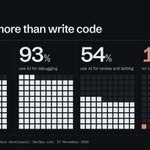
AI does more than write code. In a survey of 360 Java developers, 98% use it for writing, 93% for debugging and 54% for review and testing. Only 1% let it approve a pull request. Source: BellSoft, November 2026.
1
2
34
Almost every engineering team works with AI now. A survey this month: AI generates or significantly assists 65% of the code respondents commit, up from 42% a year ago. The part worth watching is the method: which tasks go to a tool, who reviews, who answers for it.
2
1
2
32
AI agents work inside engineering teams, ours included. A staging credential mismatch, a routine bug fix, a database migration: public cases of agents damaging live systems began there. Our habit: the access of the task and no more, and changes down the same path as everyone's.
1
1
2
32
Large outages are a good prompt to look at how systems change. A backup test, an internal update, scheduled maintenance: last week's started with routine work. The change path needs as much care as the request path. Our RPC proxy rolled changes to a small share of traffic first.
1
1
2
17
Two weeks on the Binance case, one idea: a system that holds value should stay safe even when one trusted account is taken. We start with a free technical workshop with a founder, then an Architecture Sprint with a principal. felag.net
1
1
1
21
Two steps in the Binance chain were tools: a take-home task that ran code on setup, and an internal AI tool that could reach colleagues' machines. On our projects, outside code runs isolated, and AI tools only get the access of their task.
1
1
2
17
The token that opened the way to the Binance signer sat on a laptop. On our systems, deploy credentials live in the pipeline, cover one job and expire when it ends. People get access for a task and a time window, then it closes by itself.
1
1
20
On the payment systems our team builds, one identity starts a transfer and a different one approves it. Per-transfer and hourly limits sit in the signer itself, and large movements wait for the people on call.
1
1
1
15
Every step of the Binance theft used legitimate access. So the question is what a trusted identity can do once someone else controls it. Our team maps every path to the most valuable action in a system, then narrows each one to its task.
1
1
1
22
$6.3B left Binance hot wallets on 29 October. Four days later the Fed and the OCC began calling US banks, and South Korea's regulator asked exchanges for more cold storage and 24h withdrawal monitoring. Wallet limits are becoming a requirement inside the system itself.
1
1
1
2
54
From one laptop to the wallet signer in about six weeks. An internal AI tool reached two more engineers, one machine held a token that could deploy containers, and a container reached the signing service. Every step used legitimate access.
1
1
1
2
38
It started with a job offer. A fake recruiter, two interviews, and a technical assignment to run on the work laptop. During setup the repo ran its own code. A standard dev tool was swapped for one that took orders from the attackers, and the traces were cleaned up.
1
1
2
35
29 October. About $6.3B left Binance hot wallets in roughly 20 minutes, across ten blockchains. It is the largest theft the industry has recorded. The cryptography held. The attackers went in through access the exchange had given its own people and tools. This week we trace how.
2
1
1
2
24
We have launched our new website, felag.net. Principal-led engineering for backends, payment rails, identity and distributed ledgers. Book a free technical workshop with a founder at felag.net. Two fields, and we reply within two working days.
1
1
2
39
Two weeks after the PHP update, three things are worth having: a list of what runs, an update routine, and a clear picture of what each part can reach. A free technical workshop with one of our founders shows where your system stands.
2
1
1
2
41
Reason three: separation. Each service reaches only the data it needs, and the network enforces it. Request size and rate limits sit at the entry point. During the PHP update, experts suggested those limits as a stopgap. We already had them in place.
1
1
1
2
45
Reason two: updates are routine. We rebuild images from the patched base, restart every worker and roll out in stages, with health checks and the last build on standby. We do this every week, so an urgent fix brings no new decisions.
1
1
1
2
29
Reason one: we know what runs where. Each system we build has a runtime map with the service, runtime, version, owner and connections. It comes from what is deployed and gets refreshed every release. So when an urgent fix lands, the update list takes minutes.
1
1
1
3
37
21 October passed us quietly. We moved off PHP years ago. Another urgent fix will come for some other runtime, though. This week, three habits that keep that day short: we know what runs where, updates are routine, parts stay separate.
1
1
1
2
42