Pinned Tweet
Fillbook in 90 seconds, narrated by me, the founder.
Pick your prop firm and account size, and Fillbook loads that firm's rules. You see your drawdown buffer, how much you can still lose today, and the biggest size your next trade can take.
Then bring in your trades: import a file, or connect Tradovate or NinjaTrader to sync live (Core and Elite).
Sample data shown. Fillbook is a journal and analytics tool, not trading advice, and it can't place trades. 14-day free trial, no card required:
fillbookhq.com/?utm_source=x
How to review a losing day in 5 minutes:
1. List every trade. No skipping the ugly ones.
2. Mark each one: planned setup, or not.
3. Total the P&L on the unplanned ones.
Before blaming your strategy, check how much damage came from off-plan trades.
7
Three drawdown types, one question: when does your loss line move? Intraday trailing chases your peak equity mid-trade, end-of-day trailing moves only at the close, static never moves.
Save it. Check your firm's rulebook for the actual numbers.
Fillbook's Prop firm rules page lets you set each account to trailing or static, and intraday or end of day.
Three rules to write down before the open: your max loss today, your max trades today, and the one setup you're trading.
After the close, compare them with what you actually did. That gap is your journal.
1
1
25
If you track this in Fillbook, you can see how your recorded results differ by setup and weekday.
fillbookhq.com/?utm_source=x…
13
Take your three best days out of your equity curve and look at it again.
If the line goes flat or negative, those three days were your edge, and the other 40 were paying for them.
That's worth knowing before you size up, because a curve that's mostly a few spikes isn't the same as one built on steady days.
Fillbook's Edge Score blends five parts, consistency among them, into one score.
On an intraday-trailing account, the drawdown floor can trail your best open profit.
Run a trade to +$1,200, close it at +$200, and the floor may have moved up $1,000 anyway.
Your journal shows a green day. By the firm's math, you gave back most of your buffer.
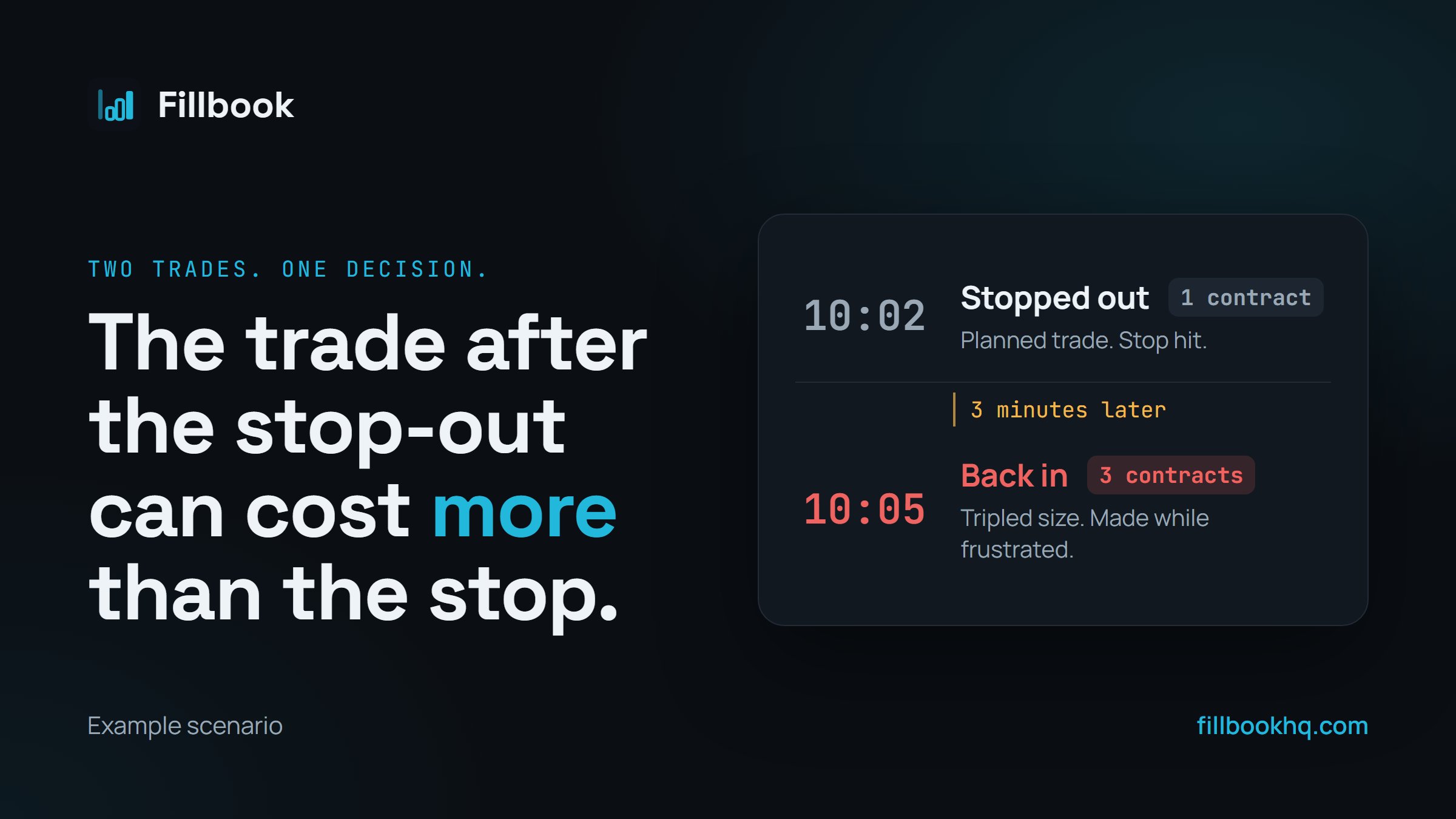
Stopped out at 10:02.
Tripled size at 10:05.
Two trades. One decision, made while frustrated.
Sometimes the trade after a loss does more damage than the stop-out itself.
What's your rule for the next trade after a stop-out?
Journaling is how a pattern like this shows up when you review your trades.
Fillbook is a trading journal for futures traders. It splits your results by setup and weekday from trades you sync or import.
fillbookhq.com/?utm_source=x…
Clean-slate size comes from your plan. Size 20 minutes after a loss comes from the number you want back.
Sort your trades by minutes since the last loss. If contracts rise as the gap shrinks, that's the tell.
Fillbook's Trade log flags sized-up trades soon after a loss.
Under a 40% consistency rule, a $2,000 day on $3,000 of total profit is 67%. Your best day is the problem.
To get under 40% you need $5,000 total, so another $2,000 from smaller days.
Fillbook shows your consistency share from your synced trades.
See the line before you cross it.
Fillbook shows your drawdown buffer and daily loss room from your own trades, for each futures account you track. Sample data shown.
Try it free for 14 days (no card, it starts with your first trade): fillbookhq.com/?utm_source=x…
1
24
Same trader. Same three days. $50,000 start. An intraday trailing drawdown left $400 of room; an end-of-day one left $1,800.
The difference: intraday peaks that never became profit, including a spike on a flat day.
Know which rule your firm uses before you size a trade. Worked example and a firm table with check dates: link in the first comment.
Worked example and the firm table: fillbookhq.com/learn/prop-fi…
13
Your habits, measured over time.
Edge Score looks at your rules, stops, risk, consistency and profitability across recent weeks, so you can see where your plan slips. Sample data shown.
2
2
46
Try it free for 14 days: fillbookhq.com/?utm_source=x…
1
18
A journal that asks for 9 fields per trade usually dies on the first red day. Nobody wants to write an essay about the trade that just cost them.
Make the entry one line: the plan, then what you did.
Fillbook's Review queue walks the trades still missing a note, one at a time.
1
1
34
Up $1,500 by 11am on a trailing drawdown account? Check whether your floor trails intraday or locks at the close. Same day, very different floor.
Intraday trailing follows your unrealized peak. Give back $900 of open profit and the floor still moved up the full $1,500.
End-of-day trailing only moves on the closing balance. Sizing up into a good morning costs a lot more on the first kind.
Fillbook's Prop firm rules page sets each account to end-of-day or intraday trailing.
1
2
76
Five numbers to check before you hit "request payout": profit target or payout minimum, trading days, consistency share, drawdown buffer, payout threshold.
Every one of them comes from your firm's rulebook, and the fine print tends to move. Save the picture for the next time the button looks tempting.
Fillbook's Payouts screen scans consistency, minimum days and buffer from the rule numbers you typed in.