

FinWise makes your money simple to see: spending, budgets and net worth, synced from your bank accounts. Founded in Cape Town. Try it free for 14 days.
- Tweets757
- Following0
- Followers675
- Likes553







ALT A table of what working the 4 November public holiday pays at five monthly salaries, from R10,000 to R60,000: double a normal day. On R25,000 a month, a normal day is about R1,150 and the holiday about R2,300.

ALT A chart of 1c doubled every day for 30 days against a flat R1 million line: the cent stays near zero until about day 25, passes R1 million on day 28 and reaches R5.37 million on day 30.

ALT A petrol pump display showing petrol 95 inland at R30.25 a litre yesterday and R30.24 today, after a R1.50 levy cut. On a 50-litre tank, that's 50c less than yesterday (50 litres × 1c), and about R75 less than it would have cost without the cut (50 litres × R1.50).

ALT Bars showing how much prices rose in South Africa in the year to September 2026: food and non-alcoholic drinks 1.2%, minibus taxi fares 13.8%, long-distance bus fares 14.1% and flights 18.6%. R3,000 of food is now about R3,036, and a R2,000 flight about R2,372.

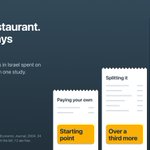
ALT Three white till slips rising from the bottom of the image, each as tall as what students in Israel spent on lunch on average in one study. Paying your own is the starting point. Splitting the bill is over a third more. A free meal is more than double.

ALT Bars showing how long it takes to earn a R119,99 medium rotisserie chicken from Woolworths, before tax: 1 hour 23 minutes on R15 000 a month, 42 minutes on R30 000, 25 minutes on R50 000 and 12 minutes on R100 000.

ALT A card reading "The rand launched on Valentine's Day, 1961. It came with a mascot.", then "Decimal Dan" in large type. Below: "the rand-cent man", a cartoon and a radio jingle to teach people the new money, called Daan Desimaal in Afrikaans.

ALT A card reading "One Lotto ticket every Wednesday and Saturday", then "196 000 years": how long until you'd expect to win the jackpot once. The odds are 1 in 20 358 520 a ticket, with 104 draws a year.

ALT A table of how much of an 8-hour working day goes to income tax, by monthly salary: R15 000, 39 minutes; R20 000, 51 minutes; R30 000, 1 hour 15 minutes, highlighted; R50 000, 1 hour 46 minutes; R100 000, 2 hours 28 minutes. From SARS's 2026/27 tax tables.

ALT A table of how many more sales a discount needs to make the same profit. At a 30% margin, 10% off needs 50% more sales and 20% off needs 200% more. At a 20% margin, 10% off needs 100% more and 20% off leaves no profit. At 40%, it's 33% and 100% more; at 50%, 25% and 67% more.

ALT A table showing that 72 divided by an interest rate is close to the years it takes money to double. 6%: 12 years by the rule, 11,9 exactly. 9%: 8 and 8. Prime, 10,75%: 6,7 and 6,8. 15%: 4,8 and 5. The credit card cap, 21,25%: 3,4 and 3,6.

ALT A chart of R2 000 a month invested for 30 years. The green line, with no fee at an assumed 10% a year, ends at R4,52 million. The grey line, with a 1% annual fee at 9% a year, ends at R3,66 million. The shaded gap between them is R859 000, more than the R720 000 paid in.

ALT Two rows of blocks, one block per tax year, each row adding up to the R500 000 lifetime limit of a tax-free savings account. At R36 000 a year, the limit up to February 2026, it takes 14 years: 13 years of R36 000, then R32 000. At R46 000 a year, from March 2026, it takes 11 years: 10 years of R46 000, then R40 000.

ALT Three bars for R100 000 over one year. A savings account at 7%, after tax at 41%: R4 265. The same account before tax, if all your interest stays under R23 800 a year: R7 229. Paid into a bond at prime, 10,75%: R11 296 of interest not charged, with nothing to tax.

ALT A table of what a weekly one-hour meeting costs in salary a year. On R30 000 a month: R36 000 for 4 people, R72 000 for 8, R108 000 for 12. On R60 000: R72 000, R144 000 (highlighted), R216 000. On R100 000: R120 000, R240 000, R360 000.