





Charles Findling retweeted

Do impulsivity and compulsivity traits rely on the same computational mechanisms❓
📰📌📥 #preprint
Read our preprint with @TobiasUHauser and @_BrainExplorer at @MPC_CompPsych @WCHN_UCL @UCLBrainScience on @researchsquare: researchsquare.com/article/r…
The key points are below:
Charles Findling retweeted

I am truly honored to be one of the 35 laureates of the 2021 Young Talent @4womeninscience award 👩🔬🧠 I am very grateful to the #FondationLOreal - @UNESCO, and especially to my great supervisor and mentor @StePalminteri !
#FWIS

Neuroendocrinology, cognitive neuroscience, disease transmission... The work of the four 2021 @LOrealGroupe-@UNESCO Young Talents France in #medicine will help to meet the major medical challenges of our time. A big congratulations to them. 👏 @sophiebavard
Charles Findling retweeted
🧩New DIY for scientific publications: our data and behavioral analyses scripts are finally available at github.com/hrl-team/range! Any comment is welcome 💡


📢 New paper out! 📢
Finally out in @ScienceAdvances, check out our latest work with Aldo Rustichini and @StePalminteri on context-dependent reinforcement learning in humans 🧠
Link: advances.sciencemag.org/cont…

Charles Findling retweeted

Some of us have not waited for Kahneman's new book to do just that: 🙃 nitter.gq/valentinwyart/status/1…

Charles Findling retweeted
Our review with @FindlingCharles on the origin, impact and function of computation noise in human learning and decision-making is now out (no paywall) in Current Opinion in Behavioral Sciences: doi.org/10.1016/j.cobeha.202… Main points below: (1/25)
Charles Findling retweeted

Very happy to share our paper in #NeurIPS2020 with @pouget_alex and Peter Dayan!
(1/10) We present the Laplace code, a neurally-plausible Temporal Difference rule for Distributional Reinforcement Learning.
Paper: proceedings.neurips.cc/paper…
Video: crossminds.ai/video/5fa6093f…

Very happy to share this work at @NatureHumBehav with Nicolas Chopin and @KoechlinE on the properties on inference noise in changing environments! Across simulations and experimental work, we show that noisy agents performs as well as more complicated agents that track volatility

Glad to share our new paper rdcu.be/b9935 in @NatureHumBehav entitled "Imprecise neural computations as a source of adaptive behaviour in volatile environments" by @FindlingCharles, Nicolas Chopin and @KoechlinE. The Weber Law in inferring stable state beliefs is key!
Charles Findling retweeted
Interested to hear about the surprising benefits of cognitive noise in adverse conditions? Tune in to @neuromatch #nmc3 room 3 this Friday at 09:15 UTC, new work led by @FindlingCharles.
Abstract: neuromatch.io/abstract?submi…
Preprint: doi.org/10.1101/2020.06.10.1…

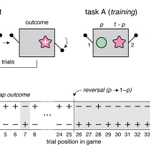
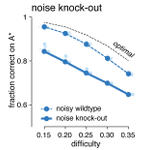
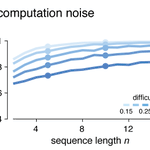
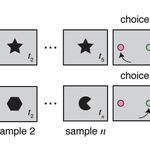
Excited to share my preprint with @valentinwyart on the cognitive benefits of computation noise for deep reinforcement learning @Inserm @Cognition_ENS @ERC_Research. A quick summary: (1/15)

Computation noise promotes cognitive resilience to adverse conditions during decision-making biorxiv.org/cgi/content/shor… #biorxiv_neursci
These results show how computation noise promotes zero-shot adaptation to unexpected adverse events without purposeful cognitive sophistication. (14/15)
Thanks for reading, I hope you’ll find it as compelling as we do! For more information, check out the preprint on @biorxiv_neursci: doi.org/10.1101/2020.06.10.1… (15/15)
1
7