

Ancient Mysteries’ Researcher🗿Inventor of The Natron Theory🧂Solved the artificial granite problem 🪨 with caveman materials only. Author: The Natron Theory 📔
Budapest, Hungary
Joined March 2009
- Tweets17.3K
- Following321
- Followers31.5K
- Likes41.7K


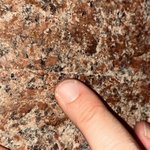


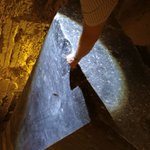


How did I figure out that natron dissolves granite?
With difficulty. First I had to forget what school taught me about stone.
Granite isn't some sacred, eternal material. Roughly three quarters of it is SiO₂, quartz. The rest is metal oxides: aluminium, sodium, potassium, calcium, iron.
(Just like wood ash. Remember that, it matters later.)
A Mohs hardness of 6–7 isn't a verdict, just a physical state. The real question is what breaks down quartz.
Glassmakers have known the answer for centuries: molten natron (Na₂CO₃) takes SiO₂ apart at 851 °C.
SiO₂ + Na₂CO₃ → Na₂SiO₃ + CO₂
What's created in the reaction is a strong glue, called waterglass. The main ingredient of artificial stone. Oops!
I tried dismantling a piece of red granite with charcoal embers, a tin can and washing soda (=natron). The result is in the photo, after removing the dry waterglass with a plastic(!) tooth brush.
Later, in my garden, I etched granite with NaOH and KOH separately, at around 360–400 °C.
This year, with a NaOH–KOH eutectic mix, 168 °C was enough. That's all it takes for the "invincible" stone.
I discovered nothing. Glassmakers, ceramicists and recyclers all know this.
Nobody had just connected it to the scoop marks on ancient stones. Let’s connect the dots, archeologists!

Recently I posted three structures that share one feature: they were carved out of porous, bubbly rock.
Yet by the time they were carved, the bubbles had vanished.
The Kailasa temple at Ellora, Bete Giyorgis at Lalibela, and the Olmec "El Rey" head in Mexico.
How is that possible? 🤔


Okay, let’s get this straight. The limestone blocks of the Great Pyramid of Giza are ARTIFICIAL. Why? Because they taste salty.
This one fact PROVES it.
No natural limestone contains table salt. None.
I know, I know. Limestone formed in the sea, tidal waves, millions of years of geological processes, blah, blah. NO-NO!
Natural limestone is NOT SALTY! Never! Check this out.
Even though limestone forms on the seabed, beneath miles of salty seawater, its interior contains no salt. Why? Because salt dissolves readily in water and stays dissolved as long as the water remains. When water is squeezed out of limestone, THE SALT GOES WITH IT.
Anyone who has ever tried to extract salt from water knows this. Either you use a salt evaporation pond, or the salt stays dissolved in the water. That’s it.
By a strange twist of fate, I happen to have a piece of stone from the Great Pyramid. Before you freak out and accuse me of stealing it, first of all, I didn’t. And second, the person who took it didn’t steal it either. He simply brought it home, back in 1978, long before anyone cared or taking such a piece became illegal.
A friend’s father brought it home at a time when climbing to the top of the pyramid was still allowed. Heck, a French couple even had sex up there, in the middle of a Muslim country. Climbing was banned shortly afterward.
Anyway, my friend’s father took this infamous piece of stone from one of the inner corridors of the Great Pyramid. Go ahead and freak out now, but it doesn’t change anything. He took it more than 40 years ago, and it’s not going to grow back. He brought it all the way back to Hungary in his pocket.
When I read Davidovits’ recipe for making pyramid stones, I came across his claim that the stones are indeed salty. So we organized a pyramid-stone-licking session with the guys. (Don’t freak out again!) Four grown men licked this original, unquestionably authentic piece of pyramid stone.
And guess what?
It IS salty.
So, what now? How did the salt get in there if not millions of years ago? Well, then, thousands of years ago. Exactly.
The recipe is astonishingly simple:
2 parts natron + 1 part quicklime + water = limestone paste (CaCO₃).
That’s the basic idea. But the mixture isn’t salty yet, and it can even release corrosive NaOH. To prevent this, Imhotep added one part magnesium salt (MgCl₂), which transforms the mixture in a rather interesting way. But that’s too much chemistry for one post. I’ll explain it separately.
The point is that the final product is an artificial limestone containing a little dolomite and table salt.
But what about the snails?
“But the pyramid stones must be natural because they contain fossils!”
Ever heard of gravel or aggregate?
As far as I know, it’s absolutely impossible to find billion-year-old pebbles in concrete. Nooo, you can’t mix gravel into concrete! Impossible!
Just as impossible as finding fossil-bearing limestone fragments embedded in a limestone binder.
So much for the snails.
And now comes the inevitable question: “But how did they lift the cast stones into place?”
They didn’t.
Why lift something that’s already in place?
CAST IN PLACE, MY FRIEND. CAST IN PLACE!
Here are four advantages of casting the stones in place:
1. You only have to lift the raw materials, never the finished blocks.
2. Hardly any formwork is needed. Just a few boards, because three sides of each block are already there: the bottom and the two sides formed by adjacent stones.
3. The joints can be so precise that you can’t even slip a razor blade between them.
4. Every block can have a unique shape and size because there’s no need for a standardized mold.
The result? An interlocking wall that could be highly resistant to earthquakes!
If you believe the pyramids were built by aliens, or that 20-ton blocks were hauled 600 kilometers from a distant quarry, that’s your problem. That’s a belief, not an established fact.
LET THE COMMENTS BEGIN! :-)

Takasago, Japan, the Oshiko Shrine. This is Ishi-no-Hoden, a stone block about 6–7 meters across, estimated at over 500 tons. It "floats" above a pool of water, because underneath only a narrow neck connects it to the bedrock.
The official version says it's an unfinished carving from the Kofun period, about 1,500 years ago. They cut it out of the surrounding rock and then just forgot to haul it away. Happens.
So let's see what they actually did. They carved all around the block, nice straight sides. Then they reached underneath and started chiseling the stone out from below too, until it was standing on just a thin neck.
500 tons on a neck. Who was the brave stonecutter who crawled under it to keep chiseling? And what was the plan if the neck snapped?
Because if you want to move a block that size, you don't start by thinning it from below. You wedge it off from the side. Every quarryman knows that.
But you don't have to take my word for it. What do you think this is?
A. An unfinished carving, the master went to lunch and never came back
B. They undercut it on purpose so it would float, because it looks nice
C. They cast one big block, no undercutting. But that pesky water at the bottom started washing the material out all around, and it was a race against time: would it set first, or would the water wash it out first? Setting won, but by then the water had cut in deep.
D. ?

Lalibela, Ethiopia. This is Bete Giyorgis, the Church of St. George: a cross-shaped building supposedly hollowed out of a single block of rock, top down, at the bottom of a pit 12 meters deep.
The official version says it was made in the 12th–13th century with iron picks, and it was easy, because the rock is soft. Well, measurements say it's harder than concrete, but let's not split hairs.
The best part is the classic setup we already saw in India, at Ellora. The bedrock is porous, full of gas bubbles, like a sponge. But whatever was left after the carving somehow isn't porous.
Look at the stepped cross on top! Sharp edges, straight lines, and not one broken-out bubble in the corners. Anyone who has ever carved stone like this knows a chunk pops out every second blow.
So they took a sponge and carved a solid church out of it. Clever!
But you don't have to take my word for it. How do you think they did it?
A. Lucky them, there just happened to be no bubbles there
B. They filled in every single hole afterwards
C. They really did dig the pit with picks, but they dissolved the rubble in molten lye and made waterglass out of it. And from the waterglass... well, who dares to say it? 🤣
D. ?

Polishing a 70-ton, supposedly granite box to a mirror finish with a copper chisel and sand is like digging your basement with a toothpick.
Underground at Saqqara, along tunnels cut into the bedrock, there are about two dozen giant stone boxes (sources say 24 or 25), each sitting in its own niche. This is the Serapeum.
The official story: it's a burial place for the sacred Apis bulls. Except the boxes are empty, and big enough for a bull to stand up in. Must have been cozy. 🐂
Their weight is up for debate. In my book I cautiously wrote 20–40 tons and up, and plenty of sources put the biggest ones at 60–70+ tons, with lids around 30 tons.
Nobody has ever actually put one on a scale, so let's just say they're heavy. Insanely heavy.
The material is supposedly granite, hauled from Aswan, roughly 800 km away. That second part I'm not buying. I've been there, and these boxes come in every shade from pink to black.
So let's see how they were made, according to the official version!
Step one: they bashed out a huge block with dolerite pounders, then hollowed it out. A few months, done.
Then they grabbed a copper chisel. Copper, mind you, is way softer than granite. With it they carved everything nice and square.
Finally came the sand, and they rubbed the surface until it shone like a mirror.
Sure. A hundred percent that's how they did the inner corners 🤣
The outside I can almost picture: twenty guys standing around it, whacking away. But the inside walls? The inside corners?
Then they dragged it into the tunnel.
The niches are tight, and so are the corridors. If it takes ten men to move a ton of stone, a 70-ton box needs seven hundred strong lads. Where do they stand? On each other's shoulders?
Hey engineers, I'd love to see that logistics plan drawn up just once!
And what about the famous mirror-flat walls and perfect right angles?
Years ago Christopher Dunn argued that this kind of precision needed advanced ancient technology. Later, others measured the boxes with better instruments, and the surfaces and angles deviate exactly as much as you'd expect from handwork. Oops!
The surface is still weird, though. It's not just the flat parts that shine, but the bottoms of palm-sized dents and tiny flaws too.
You could only pull that off with a UFO 👽 and a polishing disc, because a regular one can't reach the bottom of a dip.
On top of that, the underside of one displaced lid shows dried drip marks. Like someone painted the edge of a board and the paint ran down underneath.
That's not polish. That's a coating. 💡
What could the coating be? Waterglass, i.e. sodium or potassium silicate. See my experiment from last month. At room temperature!
I brushed waterglass onto the rough, unpolished side of a piece of red granite, and it turned into a hard, glassy surface.
So where does waterglass come from? You have to dissolve stone for it, not hammer it.
The recipe is simple if you don't mind a bit of kitchen chemistry: dissolve natron in lye made from wood ash, then stir in quicklime. That caustic mix starts eating stone at around 168 °C. That's a kitchen oven, not a furnace.
That's why I think these boxes aren't carved granite at all, but cast artificial stone, poured right there in the niche.
No need to cram seven hundred men into a corridor. Just carry buckets. 🧱
Granite is a touchy subject anyway: half of all "granite" kitchen countertops are really crushed stone plus a binder. Only there the binder is resin, not waterglass.
So we have an official explanation where a copper chisel carves stone harder than itself, a dolerite ball turns into an inside corner, sand reaches the bottom of every dent, and seven hundred men fit in one corridor.
Hats off. You rarely see a stunt like that even at the circus :-)
Now here's the challenge, because you don't have to take my word for anything.
Name the measurement or experiment (who, what year, which publication) where someone used copper, a dolerite ball and sand to work the INSIDE corner and inside wall of a granite block of at least one cubic meter to a mirror finish.
Link in the comments, please, not opinions. And if there isn't one, say that too!
If you want the full story, my book The Natron Theory is on Amazon: amazon.com/dp/B0DG3JT2N5
@UnchartedX1 @FlintDibble @GeologyPage @JimmyDiResta @wrathofgnon

Marcell Fóti 🪨 retweeted

Here are some clues for chemistry nerds.
They call this material “schist”
You know, the same schist used to create the enigmatic Egyptian Sabu Disk?
We could tweak the formula and they would call it “diorite”😂
Get mixing😎
#geopolymer #natrontheory


These stones lie at the Sphinx’s “feet,” in the sand in front of the Sphinx temple.
UnchartedX recently shot a long video about exactly these blocks, and he always ends up at the same place: the giant cutting machines that would be needed for this are missing. So where are the ancient machines?
I’ll admit it — I believed in them too, until the chemical path clicked into place.
Because it’s true: there are no chisels, no angle grinders left lying around in todays churches or the museums either. But they have to be somewhere, right?
Ah, but after the Younger Dryas the sea level rose by a hundred metres, burying a whole lot of coastal civilisations. Bingo?!
That’s also true. But why were those particular power tools only there — and not a single one above today’s waterline?
Then water-glass science hit, and slowly I can make stone out of almost anything. That’s how — and why — I let go of the ancient-machine line. The lost ancient technology is chemistry.
And it still is, even though I haven’t managed a fake “Aswan” granite that looks exactly like the real thing yet. But what’s delayed isn’t lost!
You don’t have to believe me. Let’s argue it — what do you think happened here?
A. They carved this out with copper chisels, no question
B. There really was a machine UnchartedX keeps looking for and can’t find
C. They cast it, and that’s what explains the impression
D. ?

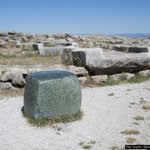
In Hattuša, the Hittite capital, this dark green cube stands in one of the rooms of the Great Temple. Roughly seventy centimetres on a side, about a tonne.
The material is serpentinite or nephrite. Either–or. Isn't that great? But at least the excavation director says it's a local stone. Local stone — just that nobody can point to the exact source. Makes sense!
What was it for? We can answer that without thinking: it had a religious role, no doubt about it. What DIDN'T have a religious role back then?
The nicest part: in the period they point to (the Hittite empire), if it was already here, the Hittites wouldn't have known about it — it sits a metre below the threshold level, i.e. underground.
A beautiful, smoothly polished green cube. Material, date, function: question mark.
But at least it's local. 🤷♂️

Marcell Fóti 🪨 retweeted

Why sculpting a column when you can cast it? 👀 Here I try to use hematite sand as an aggregate. Shining super effect, but too heavy. It tend to separate and leave free plaster at the bottom.


Look at that! The dumb tourist is standing right there and doesn't even notice the huge cut in the colossal statue of Ramesses II!
So someone did cut granite after all? But who?
A. The sculptors. The head came out too big, so they tried to shrink it.
B. 👽
C. Someone later on, who wanted to chop it up and haul it off for building material.
D. ?


Now THIS is a scoop mark! 15 m tall!
The handiwork of Australian giants. Or Mother Nature?
I added a little man to scale. Can you find him?

The top of an 800-ton Japanese granite block is mirror-smooth, with two square holes. So why is its side covered in a chaotic grid pattern?
A. I have no idea. The stonemasons were bored and practised a checkered pattern on 800 tons
B. They wanted to carve a regular, square tub here too, like the ones on top
C. It was cast after all, and this is somehow the imprint of the formwork
D. ?

What did ancient quarries do with the cubic meters of stone dust and rubble piling up? Hatnub, alabaster quarry, Egypt.
A. Nothing. Waited for the wind to blow it away
B. Used it as road base, like we do today
C. Cast artificial stone from it, though we know that's impossible 🤷🏻♂️
D. ?

Quiz: why is the lattice full of holes like a sponge, while the stone right below it (red circle) is completely solid? Ellora, carved from a single rock.
A. The window sill is made of a different stone after all
B. Same stone, the ancient master deliberately carved where the whole thing was most likely to break
C. The sill was later coated with a layer of its own material, artificial stone
D. ?

Ellora, Kailasa temple. A lattice window, carved out of a single rock.
The lattice is full of bubbles, like a sponge. But in the red circle, right below it, there isn't a single bubble, even though it looks like the same stone.
Why?
A. The window sill is made of a different stone after all
B. It's the same stone, and the ancient master deliberately looked for a challenge, carving exactly where the whole thing was most likely to break.
C. The sill was later coated with a layer of its own material: artificial stone
D. ?

And here's me running my mouth and doing nothing:
I cast this limestone block a year ago, in the summer of '25. As you can see, it's still in one piece, but I wouldn't call it indestructible. This recipe needs refining.
The binder was plain potassium hydroxide, which has since partly leached out and partly carbonated. On its own, that didn't give a strong, weatherproof bond.
Another mistake: the limestone I used was too fine and too pure, 99% CaCO3 (that's what I could buy), so geopolymerisation couldn't happen at all, for lack of aluminium oxides, i.e. clay.
And yet look: right here, where I'm tapping, a much harder stone formed that doesn't crumble. How is that possible? It's the same 99% pure material, and here it set.
I know the secret!
I started casting the whole thing with potassium hydroxide, which ran out at some point, so I filled the rest with a sodium hydroxide mix. Both crumble, but at the boundary, where the two lyes accidentally mixed, a much harder material formed!
The explanation? In the mixing zone, after carbonation, DOUBLE SALTS formed (KNaCO3), which give a far more stable bond than pure K2CO3 or Na2CO3 alone.
Ta-dah! We learned something again! Another stone recipe from the "who would have thought" category!
Is this fake limestone salty there? Salty. But who's going to lick it!
(By the way, I wouldn't start from 99% pure limestone again: it lacks the material needed for geopolymerisation.)
Here I'm pointing at an offering table in the tomb of Ramesses III.
I'll admit it: I had no idea what it was. It just looked good in the photo.
Egyptologists do the same with 70-ton granite blocks: they point at them and declare: natural stone, carved.
They just don't admit it.
Plot twist: this tomb really was carved. The limestone in the Valley of the Kings is so soft you can practically dig it out by hand. I was there, I tried it. Copper chisel for the win!
