

Can data beat Buy & Hold? ₿ Bitcoin quantitative research • Backtests • Systematic strategies.
Joined September 2026
- Tweets900
- Following1.3K
- Followers529
- Likes949







Pinned Tweet
You can be right about where $BTC is going and still lose everything.
That's what leverage does: it turns "I was right" into "I was right, but too late."
Here's how liquidations actually work 🧵

Option A: 100x to "buy the hack dip" and pray.
Option B: no leverage, no shorts, eight hours of sleep.
Withdrawals are paused. Liquidations aren't. A hack can drop the price, but it can't liquidate what isn't borrowed.
Are you sleeping tonight?
Follow if your strategy also includes sleeping.

The timeline: screaming, selling, posting red candles.
Me: no leverage, nothing to liquidate, coins in my own wallet.
Binance paused withdrawals and says it will cover all losses. Still a good night to learn what "not your keys" means.
Panic seller or salad-eating cat: which one are you?
Repost for the friend who's yelling at the table right now.

The hack lit the match. Leverage was the gasoline.
My take: the more people bet that Bitcoin "won't move," the easier it is to push the price and hunt their liquidations.
Was it only the hack, or the leverage?

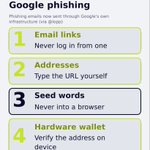
🚨 New phishing trick: emails that come from Google's own infrastructure.
So 'it came from Google' is no longer a safety check.
Basic rules for anyone holding $BTC:
- never log in from an email link
- type the address yourself
- seed words never go into a browser, ever
- hardware wallet? verify the address on the device screen
Boring rules beat clever attackers.
What's your one non-negotiable security rule?
Save this and send it to the person in your family who clicks links.

The timeline: screaming, selling, posting red candles.
Me: no leverage, nothing to liquidate, coins in my own wallet.
Binance paused withdrawals and says it will cover all losses. Still a good night to learn what "not your keys" means.
Panic seller or salad-eating cat: which one are you?

Leverage/Short is positioning against bitcoin:native volatility.
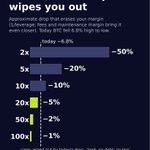
The simple math of leverage:
The drop that wipes out your margin ≈ 100% ÷ leverage.
• 5x → −20%
• 10x → −10%
• 20x → −5%
• 50x → −2%
• 100x → −1%
Fees and maintenance margin make it even closer.
Today $BTC fell 6.8% high to low. A long opened at 20x+ near the high would have been wiped out.
My rule: never use leverage. Bitcoin is volatile enough already.
Without debt, a drop is noise, not a margin call.
Here is a complete explanation:
nitter.gq/forecastquant/status/2…


You can be right about where $BTC is going and still lose everything.
That's what leverage does: it turns "I was right" into "I was right, but too late."
Here's how liquidations actually work 🧵
Binance got hacked.
Bitcoin dipped.
Leveraged longs: "this is fine."
The liquidation engine: "sure, buddy."
How many "this is fine" accounts are on your timeline? 🔥

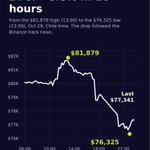
$BTC today.
• High: $81,879
• Low: $76,325
• Drop: −6.8% in 10 hours
• Last: $77,341
The trigger: news of the Binance hack.
What made it worse: leveraged longs getting force-closed one after another. Every liquidation is a market sell, and each sell pushes the price into the next batch of liquidations.
For spot holders with no debt, this was noise.
My view remains bullish.
Where were you when it dropped?

🚨 Don't bet against $BTC volatility & Self-custody your Bitcoins
How a chain liquidation works, step by step:
1. A headline hits (today: the Binance hack) and price drops
2. The most leveraged longs lose their margin
3. The exchange closes them with market sells, at any price
4. Those sells push price into the next layer of liquidation levels
5. Repeat until the leverage is flushed out
Nobody decides to sell in steps 3–5. The engine does it.
Spot Bitcoin with no debt has no liquidation price. Nobody can sell it for you.
Did you know this before today?

What if TRUE Bitcoin self-custody didn’t require a hardware wallet at all?
Most people associate Bitcoin security with buying a cold wallet from a "trusted" manufacturer.
But real self-custody can go much further.
Bitcoin doesn’t live inside a device. Your bitcoin:native exists on the blockchain. What you actually need to protect are the private keys that give you control over it.
With the right knowledge, it’s possible to generate and manage your own keys in a completely offline environment, without relying on commercial hardware wallets, proprietary software, cloud services, or third-party custody.
The concept is simple: minimize trust, reduce your attack surface, and maintain full control over your Bitcoin.
This involves understanding cryptographic entropy, offline key generation, secure backups, and air-gapped transaction signing.
Of course, eliminating commercial devices doesn’t automatically eliminate risk. Poor entropy, compromised software, or inadequate backups can be catastrophic.
True self-custody isn’t about owning a device. It’s about understanding the technology well enough to eliminate unnecessary dependencies.
We’re going to explore this concept in much greater depth.
Because financial sovereignty should not depend on a manufacturer.
Not your keys, not your $BTC

Why leverage makes $BTC easier to push around:
Every leveraged position has a liquidation price. When thousands of traders bet that Bitcoin "won't move" (or will only move one way), those prices cluster at levels many can estimate.
Pushing price into a cluster triggers forced orders. Those orders move price further, for free.
Moving price that way takes less capital than moving the spot market alone.
Less leverage = less fuel for the hunt.
My take: spot holders make the market harder to manipulate.
Agree?
Repost if you think leverage hurts the market.
Option A: 100x to "buy the hack dip" and pray.
Option B: no leverage, no shorts, eight hours of sleep.
Withdrawals are paused. Liquidations aren't. A hack can drop the price, but it can't liquidate what isn't borrowed.
Are you sleeping tonight?

Saturday plan: relax, no screens, touch grass.
Saturday reality: checked the Bitcoin price 41 times. It moved $12.
One does not simply check it once. How many times have you checked today?
Repost if you've checked it more than 10 times today.

Bought Bitcoin for the adrenaline.
Volatility just hit 2023 lows.
I've been sold the most boring roller coaster on Earth. Anyone else checking if the chart is frozen?
Save this for when it gets wild again. It will.

Someone with 1M+ followers just called $BTC a "dead network."
Here's what the data says instead:
High: $126,198 (Oct 6, 2025)
Low: $57,740 (Jul 1, 2026)
Now: ~$80k, about 37% below the top.
That's a deep drawdown. It's also the kind $BTC has lived through before.
Million-dollar bets are entertainment. Holding spot, without leverage, is a decision you can actually survive.
Bookmark this chart. Check it again in 12 months.

Uncle Sam is HODLing harder than half of crypto Twitter.
What's the dumbest thing you ever sold sats for?

How many cycles is that based on? Three, maybe four.
Worth showing the spread, not just the average: how many months after each top did the bottom actually come? If the range is wide, '13 months' isn't a timer.
nitter.gq/BitcoinArchive/status/…


Bitcoin is right where previous cycles bottomed, 13 months after the top — Glassnode.
👉 Bull market loading…
🫡 @n3ocortex

"November of a bear market year typically kickstarts the final leg down."
Typically, out of how many?
- $BTC has had very few bear-market Novembers
- 'final leg' is only labeled after the fact
- bands and levels fit the past by design
Useful as a scenario. Weak as a forecast.
For a spot buyer the question is simpler: does it change your DCA plan?
Save this for the next 'final leg down' post.
