




Pinned Tweet
A Framework at the Intersection of Sovereignty, Emotional Intelligence, and Multi-Strategy Pragmatism
Multi-strategy pragmatism is not amorality dressed in analytical clothing, nor is capital a category to be sanitized out of serious discourse.
It is, rather, the refusal to let any single framework become a prison.
open.substack.com/pub/rosiej…


joy retweeted

France is not having a student crisis.
It is having a creditor crisis.
The students are just the first ones in line paying for it.
The media is telling this as a story about angry young people and an unpopular president.
At the end of June, foreigners held 58.4% of French government securities. Eighteen months earlier it was 52%.
France's budget is increasingly being written for people who do not vote in France.
The 2027 budget carries 43 billion euros in cuts, and why schools are where the cuts show first.
In 2012, when Italy was under this kind of pressure, the ECB said it would do "whatever it takes." This time Christine Lagarde said "the primary and first solution lies at home in France."
That means the ECB has had a tool for exactly this situation but it is choosing not to use it.
France is being told to discipline itself in public, and the bond market is doing the disciplining.
The left tried to kill the budget before parliament even debated it. They lost, because the far right National Rally, voted to save it.
That's the party that benefits most from this chaos by the way.
Because presidential election is in April 2027, and its candidate, Jordan Bardella, leads the polls.
Before it can win, it has to convince France's lenders that a far-right government would still pay back its debts. So in effect, it is making its pitch to the lenders, not to the protesters.
This all sits at a trajectory where bondholders, largely made up of private sector power will end up having more say over French spending.
Macron has achieved what he was set out to achieve.

joy retweeted
The complete opposite is going to happen.
Saudi Arabia is coming through the 2026 as the strongest state in all of Middle East and North Africa.
Riyadh in October 2026 is in the absolute opposite position to Tehran in late 1978,
and I expect the kingdom to finish this "war" and set full terms for its neighbors, Iran included.
Whatever settlement ends the war, Iran will be in a position of needing significant capital, and Saudi Arabia,
is the neighbor best placed to supply it and to attach conditions.
And in doing so, the entire region will see an end to the Shia Axis era.
This is coming.

The Fall of the House of Saud
Mohammed bin Salman, the Crown Prince and Prime Minister of Saudi Arabia, has presided over failed policies, both foreign and domestic, that have weakened his hold on power. This is a good thing.
We may be living in one of the most significant moments in time regarding West Asian and global geopolitics. In 1977, the world could not imagine the Persian Gulf without factoring the reality of the Peacock Throne. In 1979 the fall of Reza Shah Pahlavi took the world by surprise.
Read more: scottritter.substack.com/p/t…


👏 @CsTominaga
‘There is something magnificently modern about an arrangement in which one party experiences intimacy, another supplies the language of intimacy, and a third reserves the right to update both the personality and the payment terms.’
singulargrit.substack.com/p/…


“Tacit allowance can coexist with coercive bargaining, particularly where the parties accept the broad direction but disagree over payments, shipping guarantees, or military restriction.”
@EvanWritesOnX on Houthis expansion and the evolving terms of engagement with US - Saudi - Iran
coldstatecapital.com/home/th…
for in-depth perspective

🎯 23/3/25 post by @EvanWritesOnX
“I form my opinion across multiple tools. Through my work, I look at annual reports and track economic trends. I sift through news, filter it with my regional experience of the Middle East, and apply a game theory framework to understand state actors and their moves.”
🤖 Made with AI


Who was behind October 7th attack and why did it happen?
This is the question I'm asked almost every day on here.
I’ll address it in this post, but first,
a disclaimer.
I form my opinion across multiple tools. Through my work, I look at annual reports and track economic trends. I sift through news, filter it with my regional experience of the Middle East, and apply a game theory framework to understand state actors and their moves.
My theory on October 7 is weak on evidence. On the empirical curve, it’s probably two standard deviations away from hard facts. That's because state soft power plays are usually hard to track with evidence. And the October 7 story is already dipped in propaganda, and the full truth might not surface for five or ten years.
So, consider this a hypothesis of mine stitched from evidence-based patterns I’ve watched unfold.
___
If you’ve followed me long enough, you know my stance on Israel.
They’re not zeroing in on Hamas or Hezbollah; their dominant strategy as a colonial state prioritizes leveling women, children, and entire buildings in Gaza.
The evidence, to me, is very clear and their operation from a colony standpoint makes perfect sense: erase Gaza, forge a “pure” Jewish state, shed the global apartheid label, and lock in America’s second regional hegemon in the Middle East.
That’s the primary payoff in their game. And it's their only dominant strategy. I have said many times that Gaza is the Stalingrad of Palestine, and it will undo Israel if Israel fails to achieve ethnic cleansing or total displacement of the population.
Israel knows this.
It’s why they sabotage normalization with regional Arab states. It's why they eliminate ministers who are partial to the Palestinian cause. And it's why they prop up Hamas as Gaza’s rulers.
The Israeli cabinet isn’t calling the shots. It’s a conduit for US foreign policy, aiming for dual hegemony: one in the Atlantic, another in Palestine, the continental map of the World.
Success would’ve handed the US global hegemonic status.
That’s my lens. And it shapes what I think went down on October 7.
Some of you might call this overblown. And that's fair. But I judge actions, not guessed intentions. Israel claims it’s crushing the Axis, but their moves and all their allocation of resources point to wiping out Palestinians as fast as possible.
You might argue against this by using the West’s defense of “If Israel wanted all Palestinians killed, they could’ve done it already.”
That kind of rhetoric is just designed to water down their genocidal behavior. It’s like saying, “We could kill you quicker, but we’re pacing ourselves because we’re noble.”
It sidesteps the reality: Palestinians are dying and vanishing at a staggering rate under Israeli bombardment, far beyond any military necessity and far beyond what the numbers suggest.
___
Within the context of this understanding, I’ve made a case and argued that Netanyahu was racing against time to ethnically cleanse Palestinians.
This is the first fundamental point to understand.
There was a clock on Netanyahu's operation.
This is why he ordered 1.1 million northern Gazans to flee south in 24 hours just days after the attack, to head start the displacement and clear land. It's why he rejected a ceasefire deal in May 24' identical to the one he was coerced to accept in January by Trump. And this is also why he conducted a starvation blockade choking all aid flows. So if the bombs didn't kill the Palestinians, the starvation would.
His “total victory” rhetoric, paired with flattening homes, hospitals, and schools, was a systematic sprint to render Gaza unlivable.
From a game theory angle, Netanyahu has played a perfect strategy; maximizing cleansing and displacement by any means possible while treating global outrage as background noise.
But the question is, why was he racing against time? Why the rush? Why ditch the 70-year “mowing the lawn” strategy that has always worked for them in the past?
We have to rewind to the years before October 7 to answer the element of urgency in Netanyahu's actions.
___
The Middle East was shifting under everyone’s feet long before October 7. In 2019, the UAE, tired of bleeding $5 billion in Yemen’s war, quietly approached Iran despite Houthi tensions. By 2022, they had diplomatic ties, a major crack in the US’s Iran-containment wall.
UAE and Iran mended tensions.
In January 2021, the Al-Ula Summit saw Saudi Arabia, UAE, Bahrain, and Egypt mend fences with Qatar after the 2017 rift. Qatar’s Iran-Turkey flirtations had irked the GCC, but with $200 billion in rail and trade at stake, they reconciled. Russia and China cheered. Putin with Saudi oil talks, China with $10 billion UAE deals.
Qatar, the KSA, UAE, Bahrain and Egypt normalized.
From April 2021 to 2022, Saudi Arabia and Iran held five Iraq-hosted talks, Oman mediating, GCC cash flowing. By 2022, MBS told Biden in Jeddah he’d rather bet on China than the US to manage Iran. A $1 billion flex.
Iran and the KSA mended tensions.
That July, Iran and Kuwait swapped ambassadors, healing a 2016 rift with $5 billion in trade and Iran’s $100 million regional take. In March 2022, Syria’s Assad visited the UAE; his first GCC trip since 2011, defying US sanctions with $1 billion in talks, backed by Iran, Russia, and China.
Iran, Kuwait, Syria and the UAE normalized.
By December 2022, China hosted GCC leaders in Riyadh, securing $10 billion for refineries and ports. Xi pitched a “security architecture,” and $5 billion in trade kicked off. Iran sat out, but Xi’s Tehran visit two months later kept them looped in.
Then, in March 2023, Saudi Arabia and Iran shook hands in Beijing, a $1 billion Chinese deal reopening embassies and silencing anti-Iran noise.
Iran and the KSA normalized.
Four months later, Russia backed the GCC over Iran’s islands in a Moscow meet-up. Iran was fuming but cooperated. This was the FIRST sign of Iran conceding to stay in the game and remain a team player.
And a new question started to emerge.
What else was Iran willing to concede to maintain cooperation?
In May 2023, the UAE dumped the US-led Maritime Security Alliance; a billions-in-trade blow to Washington. Days later, Iran floated a naval pact with GCC states, while China’s $10.7 billion Oman port deal and Russia’s $5 billion oil exports knit the Gulf against the US naval force.
The UAE was slowly forming its own regional MIC.
___
Over at the US, the MIC was systematically being outmaneuvered, and its foreign policy of keeping the region fractured was collapsing. The FIC, no longer saw eye to eye with the MIC, and ensured they would seek economic partnerships with the GCC rather than risk missing out on the new emerging opportunities.
The Middle East was unifying. While the US was fracturing.
___
Meanwhile, Gaza faced a desperate game. Israeli police stormed Al-Aqsa during Ramadan, unleashing stun grenades and tear gas. The blockade, tightening since 2007, left 47% unemployed, 80% of 2.3 million on aid. Power was reduced down to four hours daily after Israel cut fuel. Water was 97% undrinkable, 40% of freshwater gone by 2022, kids dying from dehydration. 63% of 20 year olds jobless, permits blocked 98% of the time. Settlements encroached with 300 evicted in Jarrah in 2021, 3,500 new units by 2023, a $500 million land grab with Smotrich pushing “voluntary migration.”
A slow chokehold on 2.3 million lives.
___
With the Middle East unifying, Gaza suffocating and the US fracturing,
a perfect storm brewed for Israel, and it wasn’t subtle.
October 7 was the manifestation of Middle Eastern powers unifying just enough to devastatingly cripple Israel once and for all.
So, who orchestrated October 7?
At minimal examination, both the GCC and the Axis powers.
Who knew about it beforehand? Almost everyone.
Hamas, Hezbollah, Houthis, Axis states like Iran and Syria, the GCC, Israel, (and by extension the US), Russia and China.
I still recall the videos of Hamas fighters in Gaza’s streets, urging Palestinians to stay safe and survive, repeatedly promising Oct 7 to be the final war.
Everyone tracked the board.
For the first time in 70 years, I believe the Axis and Sunni economic powers allied to break Israel. A grinding attrition war led by Hamas, Hezbollah, Houthis wearing Israel down, followed by a GCC economic takeover, turning Israel into a dominion state under new rulers. The region acted as one bloc, with Iran agreeing to ditch the Axis when expedient.
This manifested when Hezbollah and Hamas leaders fell to decapitation strikes. And Iran stood passive, with the Houthis and Hamas taking instructions from the GCC thereafter.
Israel knew October 7 was coming, and there's strong evidence that suggests they did. But it played right into their dominant strategy. So they let it unfold, to seize the chance for a genocidal war to erase Palestinians from Gaza, backed by billions in propaganda to smear Hamas and blur the truth.
Both players were aware of October 7.
Both players were confident that their side was going to win.
Hamas initiated, Israel went to work.
And the rules of the game were simple:
Palestinians had to resist ethnic cleansing and total displacement while Israel had to conduct it in totality.
Israel lost.
Meanwhile, the US MIC and FIC cooperated and watched from the sidelines, hedged their positions, betting on the outcome, tying it to the election cycle.
If Netanyahu cleansed and annexed Gaza pre-election, Biden would’ve won. The MIC would have cashed in. The war would have dragged on until Palestinians were extinct, redrawing the map of Israel. Then the MIC would have cashed out, paving the way for the FIC to cash in and seek substantial leverage on its own terms. Just like Ukraine.
But by late 2024, Netanyahu’s timeline faltered. Decapitation strikes ended the Axis, and effectively, placing Zionism on its deathbed. The FIC finalized the deals that require stabilization across the Middle East, chasing the GCC's economic spoils rather than dictating them. The MIC already locked into Europe, will not deviate back into the Middle East.
That region is finished for them.
And because Netanyahu missed the deadline, Trump won the election. The cleanup guy, ready to cement the new order.
___
No player was static. Geopolitics never is. They watched, hedged, ready to switch sides.
October 7 was a coordinated, carefully crafted attack after years of pressure and diplomatic progress; Gaza suffocating, Arab states uniting, and Israel racing to legitimize its colonial roots.
Hamas lit the match, but every regional player held the fuse, betting on Palestinian resilience against Israel’s onslaught.
Critics on here often call my geopolitics a 5D chess. I call it standard geopolitics that's embedded in reality, not emotions, and that which factors in finance, not just militancy.
But if you want to know what 5D chess looks like,
It's October 7.
A tactical masterclass.
And a Palestinian victory.

joy retweeted

I can't quote or use statistics from my business but the de-dolarization and incentives for the US national debt efforts being paid down can be confirmed:
Top level bankers
The elite from Wall Street all the way to different major consulting firms (McKinsey etc.) & funds I've spoken with can *ALL point to the pattern Evan is defining.
This is why I trust Evan's analysis.
Why pay another junior analyst or intern a high salary for their first few days working with me when Evan can effectively clear the entire data set with 1 post on X app?
Exactly, Evan will always outperform no matter what Harvard MBA graduate I hire because they lack the context & nuance to parse through geopolitical and financial incentives while demonstrating accuracy in predictions *live over the many months & years I've known Evan.
"But how do you know Evan will predict again with the same efficiency?"
I don't.
But the *PATTERN is that Evan's analysis & models map accurately onto the reality I'm experiencing working with sovereign wealth funds & different elite firms etc.
Now talk about the architects of debt is another topic I'll leave for Evan to breakdown in future posts as these players make their moves across the board.
• Zero effort will be made to pay down the US national debt.
• The US national debt is a NATIONAL problem. The architects of the debt are transnational actors. It is NOT their problem.
• Bessent and Warsh are adaptation actors. They link the bridge between transnational actors and the multipolar world so capital flight can take place.
• No efforts will be made to improve US citizen welfare.
• The clarity act has nothing to do with crypto. And everything to do with adaptation to currency rails OUTSIDE the US dollar.
• The clarity act is a hedge against gradual de-dollarization.
• The architectural framework for the multipolar world has already largely been established. Many are not aware because they think there’s a real war taking place.
• Trumps policies since his presidency, has equipped the transnational private sector for a new global order while simultaneously abandoning the US.
• Coordination at the highest level has happened and is still happening between;
TPS
Iran
Russia
China
GCC
the Levant
and Netanyahu.
Not Israel.
well worth the deep dive regardless of nationality
or a $5 sub if Canada particularly interesting for you
Nobody Negotiates for Canada
coldstatecapital.com/home/no…
by @EvanWritesOnX
As per @EvanWritesOnX commentary 👇🏽
🤖 Made with AI

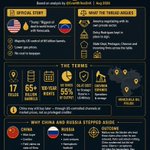
This is not America negotiating with Venezuela. It is America negotiating with its own private sector.
Delcy Rodriguez is not an independent counterpart.
She is the lady the US kept in place to sign.
Across the table sit the State Department, the Pentagon, Chevron, and the firms coming in behind them.
The announcement calls this a deal between countries.
It's not.
It is the US assigning Venezuelan oil to US agencies and US companies.
Maduro’s backers were China and Russia.
China was the main buyer and the main creditor. It took cheap crude against loans and held claims on Venezuelan fields through its state oil companies.
Russia sold weapons, sat in joint ventures, and used Caracas as a foothold in the US hemisphere.
They did not back Maduro out of friendship.
They backed him because he was the man who kept those claims alive.
As long as he held the presidency, US could sanction Venezuela and still not take the oil.
There was no public three way contract that handed the fields to American companies.
What there was, and what mattered, was acceptance.
Russia had floated that kind of trade before: US free in Venezuela, Russia free where it cares more.
When Maduro was taken, Putin said almost nothing. Ukraine came first. Some in Moscow treated the raid as the US acting in its own backyard, the same logic Russia claims for itself.
China condemned the raid in hard language. A Chinese envoy had been in Caracas hours earlier.
Beijing still did not move.
Venezuela was not worth a clash with the US.
That silence is the understanding. A decision not to defend the man who blocked the transfer.
Lavrov called it discrimination. China called it bullying.
Neither reversed Maduro's removal.
Rubio told the new authorities that China, Russia, Iran, and Cuba had to go if production was to rise.
Now terms indicate a private company gets 100 year rights over 17 fields said to hold more than 65 billion barrels. US officials say Washington takes 55% of the output, including oil at cost for the strategic reserve and the US military.
Chevron expands.
China may still buy barrels later. But it will buy them through channels US controls, at prices closer to the market, not as the privileged creditor sitting behind Maduro.
Venezuela is now inside the American private sector’s orbit because China and Russia allowed the blocker to fall.
They did not join the new company.
They accepted a world in which the US takes the hemisphere in front of it, and they keep their fights elsewhere.
East Africa & the Transnational Private Sector by @EvanWritesOnX
I am sharing this as an example of the quality of reply to member requests - an option for members of coldstatecapital.com
Africa digs up more than 70% of the world's cobalt and refines less than 5% of it. Refining is the step where raw rock gets cleaned and processed into a material a battery factory can actually use, and almost all of the money in a mineral sits in that step rather than in the digging. A country that only digs sells cheap rock. The country that refines it sells an expensive product. So when African governments and foreign powers argue about mining deals, the argument that matters is not who owns the mine. It is who does the refining, and that question is usually settled before anyone starts negotiating.
China refines 94% of the world's battery-grade graphite. It will handle more than 75% of the world's cobalt refining this year. Across 19 of the 20 minerals that matter most to modern manufacturing, China is the biggest refiner, averaging around 70% of world capacity. Nobody else is close. This is the fact that sits underneath everything happening in Africa right now, and it does not change when a government switches sides.
What Tanzania is actually holding
Tanzania has the world's fourth largest graphite reserves and could become the largest producer. Graphite goes into battery anodes, so demand is rising and Tanzania is sitting on a lot of it. That sounds like a strong position and it is not, because China refines 94% of battery-grade graphite. Whatever Tanzania digs up will be shipped somewhere else to be turned into something valuable, and the profit on that conversion will be booked in another country.
The infrastructure being built confirms it. China put $227 million into Tanzania in the first quarter of 2026, more than any other country. It bought the Ngualla rare earth mine in 2025. It is spending $1.4 billion rebuilding the Tanzania-Zambia railway, which the Tanzanian finance ministry expects will carry 3 million tons of minerals a year to the coast. That railway is designed to move rock out. No part of that $1.4 billion builds a refinery in Tanzania.
What the accusations are for
Since late 2025 the Trump administration has made three loud accusations against African governments. It claimed a white genocide is happening in South Africa, which is false and which Pretoria has repeatedly asked for evidence of. It claimed a Christian genocide is happening in Nigeria, which misdescribes a real war whose victims are mostly Muslim, a point the head of the African Union stated publicly. And it called Tanzania an autocracy, which is true. Samia Suluhu Hassan won 98% of the vote in October 2025 with her main opponent in prison and his party banned from the ballot, and the commission she appointed afterward counted 518 people killed in the protests.
Two of the three charges are invented and one is accurate, and all three produced roughly the same kind of American pressure. That tells you the accuracy of the charge is not what triggers it. Uganda, Rwanda and Egypt could all be charged with the same things as Tanzania and none of them has been. Uganda helps with American counterterrorism operations. Rwanda controls territory in eastern Congo where the cobalt is. Egypt does what it is asked on Gaza. What separates them from Tanzania is not their behavior at home. It is what they hand over.
How the three cases ended
Nigeria gave in. Trump designated it a country of concern, said he was ordering the Pentagon to prepare options, and on December 25 2025 the United States flew 16 airstrikes against Islamic State fighters in northwest Nigeria with President Tinubu's approval. By February the two governments were calling it a security partnership. The designation was never lifted, so Nigeria removed the threat of invasion and accepted in exchange that America now runs operations on Nigerian soil and Abuja agrees afterwards …

… Tanzania refused. It got a travel ban, a visa ban on its police chief in May 2026, a Senate bill ordering a review of its relationships with China and Russia, and a European Parliament vote blocking €156 million of aid. Samia responded by flying to Moscow in June 2026, the first Tanzanian state visit there since 1969, and signing a $1 billion uranium deal with Rosatom.
South Africa was never really the target of a deal. It had nothing Washington urgently needed, so the pressure stayed symbolic: an executive order cutting aid in February 2025 and exclusion from a summit.
Why looking east does not solve it
Tanzania's answer to Western pressure has been to deal with Russia and China instead. I understand the appeal and I think it changes less than it appears to. Under the old arrangement a Western company took the profitable step. Under the new one a Chinese company takes it. Tanzania still sells rock in both versions. The country has swapped which foreigner collects the money, not whether a foreigner collects it.
The Congo shows the same thing from the other direction. On December 4 2025 it signed an agreement in Washington giving American companies priority access to mining zones covering more than 70% of world cobalt reserves. That deal hands the mines to American firms and leaves the refining in China, because that is where the refineries are. Congolese lawyers have filed a constitutional challenge against it. The flags on the two deals are opposite and the outcome for the African country is the same in both.
… What actually works
Indonesia did the one thing that changes the answer. It banned the export of raw nickel ore and required companies to process it inside the country. Within two years the value of its nickel exports went from $3 billion to $30 billion, while nickel prices themselves stayed roughly flat. The extra $27 billion came from selling processed material instead of rock.
The obvious worry was that buyers would go elsewhere and investment would collapse. The opposite happened. Foreign investment into Indonesia rose 47% in 2022, led by processing projects, and close to half of that increase came from China and Hong Kong. Chinese firms did not boycott Indonesia for forcing them to build refineries there. They built the refineries there, because they needed the nickel more than they needed the old arrangement.
That is the whole difference between the two paths available to Tanzania. It is not America or China. It is whether the law requires the valuable step to happen inside the country.
What I expect
Tanzania will not be pulled back by American pressure. The Russian and Chinese money was already committed before the sanctions landed, and a visa ban on one police officer is not an answer to $227 million a quarter. I expect more designations through 2027 and no interruption to the minerals moving east. I would be wrong if Tanzania signs a minerals agreement with Washington resembling the Congolese one before mid-2027, or if Lissu is released and the treason charge dropped as part of a deal restoring Western funding.
The Nigerian outcome will be repeated because it is cheap for both governments. An accusation, a threat, then a partnership where the host approves operations it did not ask for. I expect at least one more African government to take that trade within twelve months.
Watching whether any African government with real reserves copies Indonesia and writes a law requiring processing at home is key. The Congolese court case is the nearest test. If it voids the December agreement, signing gets riskier for every government currently negotiating one. If it fails, I would expect two to four more countries to sign similar deals by the end of 2027, on terms that leave the refineries where they already are.
joy retweeted
I remember when I first saw the decapitation of Hezbollah back in 2024.
It became obvious to me that Iran was actively assisting in the leadership removals.
I remember tweeting about this and sounding absolutely delusional to almost everyone who read it.
The post still exists on my timeline, written on the 26th October 2024.
People called it insane, conspiracy, projection, wishful thinking.
When I see posts like this one from Al Jazeera today; Iraq proposing a unified security coordination council with Iran and Saudi Arabia to rebuild trust between long-time regional rivals,
it could not have been more obvious in hindsight what game was being played all along.
This was never about permanent confrontation.
It was about Iran shedding its old axis of resistance so it could arrive to this exact moment; regional integration and partnership with the Gulf states.
For years the network of groups linked to Iran, across Lebanon, Syria, Iraq, Yemen, and beyond, served as tools of pressure and leverage.
And Israel fed off that.
Now those tools had reached the end of their usefulness.
Keeping them intact would have blocked the larger realignment that was already underway, necessary for Iran to pivot and survive.
So the leadership structures of those groups were systematically removed, one after another, until the network could no longer generate disruption on a scale that would derail the new arrangements.
In Lebanon the command layer of Hezbollah was dismantled with remarkable precision.
So remarkable in fact that anyone with half a brain could deduce Iranian involvement.
In Syria the remaining aligned forces were weakened to the point of irrelevance.
In Iraq the most independent factions were brought under tighter control or sidelined.
Across the region the same pattern repeated: key figures eliminated or neutralized, supply lines constrained, operational freedom reduced.
The result was a controlled reduction in the capacity of those groups to act independently.
By the time the dust settled, none of them retained enough strength or autonomy to sabotage the emerging understanding between Iran and Saudi Arabia, or between Iran and the wider Gulf.
While supporters of the old axis were still calling for total war against Israel, few of them paused to calculate the human and material cost such a war would impose on the very populations they claimed to defend.
Instead of that path, a different board has taken shape. Iraq, Iran, Syria, Lebanon, the KSA, the UAE, Qatar, and Turkey are now moving, step by step, toward coordinated security and political frameworks.
The old fault lines that once defined the region are being papered over by shared interests in stability, energy flows, reconstruction contracts, and insulation from external pressure.
When I watched the Hezbollah leadership removals in 2024, I said publicly that this marked the beginning of the end for Israel’s regional position, and the emergence of Palestine.
At the time it sounded extreme.
Today the picture is clearer.
A Middle East that was once fractured into competing camps is consolidating around a core of states that no longer need a permanent confrontation with Israel to maintain internal legitimacy or external leverage.
The old strategy of managing the region through division is losing ground. What remains is a set of governments that increasingly treat Israel as an outlier rather than a central player whose security concerns must shape every calculation.
Israel now faces a neighborhood that is less fragmented and less dependent on outside guarantees.
A neighborhood that demands a Palestinian state.
The US, the ultimate backstop, has shown repeated signs of competing priorities elsewhere.
Capital allocators have placed new bets.
In that environment, a state that once thrived on regional isolation of its adversaries discovers that isolation is being reversed, and that the reversal is being driven by the very actors who once sustained the confrontation.
The security council proposal reported today is not an isolated diplomatic gesture. It is one more visible marker of a deeper shift that has been under construction for years.
The people who insisted that every setback for the old axis was a defeat for Iran missed the larger picture.
The people who demanded escalation without end never asked what the region would look like once the proxies were no longer needed.
The answer is becoming visible in real time: a set of capitals that once viewed each other with suspicion are now exploring joint mechanisms for security coordination.
That is not the outcome most predicted in 2024.
It is, however,
the outcome that follows once an actor decides its former instruments have become liabilities rather than assets, and once the surrounding states decide that managed partnership serves them better than managed conflict.
When the leadership of Hezbollah was removed and Iran did not respond with the all-out escalation many anticipated, the signal was already there.
The subsequent removals across other theaters confirmed it.
Each step reduced the risk that residual forces could spoil the larger settlement.
Each step cleared space for the conversations now taking place between Baghdad, Tehran, and Riyadh.
The post that appears on our screens today is simply the latest public expression of a change that began in years earlier.
A unified security framework among Iraq, Iran, and Saudi Arabia does not erase every difference.
It does, however, signal that those differences are no longer allowed to dictate the overall direction of the region.
For Israel the implication is straightforward.
The environment that once permitted it to operate with relative freedom of action is narrowing.
The external sponsor that once underwrote that freedom is no longer willing to underwrite it indefinitely.
And the surrounding states are no longer divided in ways that automatically work to its advantage.
That is the board as it stands.

Iraq has proposed establishing a unified security coordination council with Iran and Saudi Arabia to rebuild trust between the regional rivals.
🔴 LIVE updates: aje.news/ac72h2

joy retweeted
I've been following Evan for *many years, longer than most people even know of his career etc.
When I first started following Evan I wasn't sure about the trajectory of my own geopolitical understanding especially when I began operating in multiple countries etc.
Evan made sure I was able to maintain my business despite my lack of European geopolitical analysis for example during 2020-2022 when I experienced multiple setbacks and successes.
For context, Evan's career is a DIRECT reflection of his ability to elevate understanding of markets, not only human nature but systems & processes most people will never study in an MBA program at Harvard.
So why follow Evan?
It is more efficient for me to learn from Evan's geopolitical + markets analysis then add my own assets & resources in the field to create a dichotomy (multiple perspectives).
Evan may not even remember the years but I do.
Tons of people remember who are *SILENT supporters of Evan some a few years and others longer than me (upwards of 5+ years).
I don’t do affiliated or cahoots.
I work alone.
Cold State Capital is not something I do for a living.
It originated from significant of my followers asking me to start substack/patreon.
I charge $5 a month capped at 750
members.
Cold State members themselves can tell you the value return on their subscription.
I don’t promote my site.
And charging $200 a month is outrageous.
Michael Burry charges $49.