

News and analysis on mining, critical minerals and geopolitics. The policies, projects and decisions shaping the material economy.
Toronto
Joined September 2025
- Tweets61
- Following9
- Followers4
- Likes31








Marimaca Copper says Sprott’s investment committee approved a proposed financing package of up to US$450 million for its copper project in Chile. Due diligence and definitive agreements are still pending.
In today’s Geopolitical Mining Daily:
- Canada: Generation Mining placed orders or issued letters of award for Marathon’s major equipment packages.
- Timor-Leste: Estrella moved manganese ore to Tenu for a trial shipment by sea.
- Peru: Forte secured one year of community access for surface exploration at Alto Ruri. Drilling still requires a separate permit.
- Uganda: Silverback signed a conditional agreement to acquire 90% of the Ruhizha tungsten project.
- Brazil: Power Minerals reported near surface rare earth drill results at Morro do Ferro.
#Copper #CriticalMinerals #GeopoliticalMining #Brazil

1
7
Qatar and the United States signed a memorandum on critical minerals processing at their Strategic Dialogue in Washington. The public readouts did not name a facility, a funding commitment or a timetable.
Also in today’s Geopolitical Milestones:
- Canada: Natural Resources Canada announced nearly C$3 million to digitise drill core from the Northwest Territories.
- France: The domestic Choose France summit showcased industrial investment projects, most of them outside the Paris region.
- European Union: The European Commission proposed a 22nd Russia sanctions package that would expand restrictions on banking and energy services.
- Chile and India: Chile says 15 of 17 trade chapters are closed. Market access and critical minerals remain under negotiation.
#Qatar #CriticalMinerals #GeopoliticalMining #Chile #EU #Canada #France

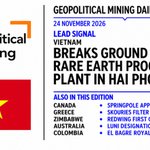
Khanh An Industry broke ground on a rare earth processing plant in Hai Phong, Vietnam. The city says the plant is designed for 10,000 tonnes a year and targets commercial operation in late 2028.
In today’s Geopolitical Mining Daily, we also look at five developments affecting mining and mineral supply:
- Canada: Ontario approved Springpole’s environmental assessment. Further permits and a construction decision are still ahead.
- Greece: Four tailings filter presses are operating at Skouries. Eldorado still targets commercial production in late 2026.
- Zimbabwe: Namib Minerals poured first gold at Redwing. A separate study is evaluating a larger operation.
- Australia: Western Australia granted Luni Strategic Project status, which provides three years of support through the approvals process.
- Colombia: Soma Gold closed the first tranche of its El Bagre silver royalty transaction. The remaining US$7 million is conditional.
#Vietnam #Canada #Greece #Zimbabwe #Australia #Colombia #RareEarths

At COP31 in Antalya, parties to the Paris Agreement named critical minerals in their just transition decision. The text recognises the importance of helping developing countries build productive capacity and capture more value locally, in line with their own national strategies.
In today’s Geopolitical Milestones, we also look at four developments:
- Côte d’Ivoire: The government identified financing needs of CFAF 4.9 trillion for 19 mining, oil and energy projects at SIREXE.
- South Africa: Parliament wrapped up the Limpopo round of public hearings on proposed changes to mine health and safety law.
- UAE and Kazakhstan: The two countries’ export credit agencies renewed cooperation on export credit insurance.
- Singapore and China: Singapore businesses can now use verifiable digital records to register in Shanghai.
Read the full edition:
geopoliticalmining.com/cop31…
#COP31 #CriticalMinerals #EnergyTransition #GeopoliticalMining

Codelco needs a lot of money to keep its copper mines running and to develop new ones.
In 2025 it generated about US$3.9 billion in operating cash and spent US$5.1 billion on equipment and plants. It also has debt to pay.
The company can use its own cash, issue bonds, keep more of its profits (with the state’s approval), or bring in private partners for specific projects. Each option changes who puts up the money, who takes the risk, and when Chile actually sees the return.
Full analysis here:
geopoliticalmining.com/codel…
#Codelco #Copper #GeopoliticalMining

Kenya has named a preferred bidder for Mrima Hill. The proposal would bring rare earth and niobium refining to Kenya. The decision this week opens negotiations for a prospecting licence, and the consortium still needs to work with affected communities and show how the material can be processed.
In this Geopolitical Mining Weekly, we follow five other developments that changed a different part of the route to supply:
- American Samoa: The U.S. offshore auction drew US$6 million in high bids. The leases have yet to be issued.
- Papua New Guinea: Rio Tinto committed US$250 million to help address Panguna’s legacy impacts with affected communities.
- European Union and Indonesia: A signed trade agreement brings the rules of origin for products such as nickel sulphate into focus.
- Mexico: Vizsla moved Panuco’s first silver target to the second half of 2028 as it works on site readiness, permits and construction planning.
- Brazil and Australia: Colossus received development equity, while Hillgrove received US$30 million from customers against future concentrate deliveries.
Read the full Weekly:
geopoliticalmining.com/kenya…
#GeopoliticalMining #CriticalMinerals #RareEarths #Mining #Kenya #MineralProcessing

What does a trade summit tell us about where globalization is going? In Shenzhen, the answer depends on which table you look at.
APEC’s 21 member economies agreed on priorities for trade, connectivity and innovation. Alongside the summit, Chile and the Philippines signed a trade agreement, while China and Indonesia opened negotiations. Each outcome has a different path from announcement to implementation.
In our latest Geopolitical Mining analysis, we look at why APEC was created, what it has achieved since 1989 and what Shenzhen reveals about the next phase of globalization. Trade agreements can open markets. Using that access depends on the capacity to produce, process and move goods reliably.
The future of mining is taking shape in this same context. Where minerals are processed and how they reach customers help determine where the industry creates value and who benefits from it.
That gives us a way to follow what happens after Shenzhen: which trade procedures become simpler, which agreements businesses actually use and where investment adds productive capacity.
Read the full analysis:
geopoliticalmining.com/what-…
#APEC #APEC2026 #CriticalMinerals #SupplyChain #Geopolitics #China #Mining #Trade

Vizsla Silver has moved its first silver target for Panuco in Sinaloa to the second half of 2028, a year later than previously planned. The company cited permitting, site readiness and construction timing. It has not updated its 2025 feasibility economics or made a production decision.
In today’s Geopolitical Mining Daily, we also look at five developments:
- Chile: The environmental regulator opened a dust control case at Codelco’s Ministro Hales mine. In a separate case, it approved a compliance programme for the Talabre tailings facility.
- Canada: Ottawa and Ontario announced up to C$250 million in public support for a proposed port and rail transfer hub at Sault Ste. Marie.
- Peru: The mining ministry and public registries authority agreed to prepare data sharing for a planned digital permitting portal.
- United States: Blue Moon Metals says the Bureau of Land Management approved the operating plan for its California mine. Other approvals remain pending.
- United States: Spartan Metals published a preliminary assessment for its Victorio tungsten and molybdenum project in New Mexico.
Read the full Daily:
geopoliticalmining.com/mexic…
#CriticalMinerals #Copper #Silver #Mexico #Chile #Ontario #Canada

Donald Trump, Vladimir Putin and Xi Jinping issued a joint declaration in Shenzhen on November 19. They said their governments would hold talks on reducing nuclear risks and planned to increase the supply of refined petroleum products. The declaration sets no timetable or supply volumes and does not address the wars in Ukraine or Iran.
In today’s Geopolitical Milestones, we also look at five developments:
- APEC: Leaders adopted the Shenzhen Outlook and backed work on paperless trade and regional connectivity.
- Canada, Australia, New Zealand and Singapore: Leaders discussed expanding trade under the existing CPTPP.
- European Union: Negotiators reached a provisional deal to delay specific methane reporting and verification deadlines by two years.
- COP31: The electrification package brought together initiatives on clean power, grids and storage, including a financing mechanism for emerging markets.
- United States: An interim rule on remote access to advanced semiconductors took effect.
Read the full edition:
geopoliticalmining.com/us-ru…
#Geopolitics #China #Russia #USA #APEC #Trade #Semiconductors #EnergySecurity #COP31

47
Kenya named the Frontier Minerals Consortium as the preferred bidder for the Mrima Hill rare earths and niobium project. The notice sets out a proposed award. Community consent and licensing are still required before prospecting can begin. RareX, whose consortium with Iluka Resources ranked second, says it intends to challenge the selection.
In today’s Geopolitical Mining Daily, we also look at five developments affecting mining and mineral supply:
- Mexico: Endeavour Silver completed its Pitarrilla feasibility study. It estimates US$585 million in initial capital, and the tailings storage permit is still outstanding.
- United States: Century Lithium says federal regulators accepted baseline studies for Angel Island in Nevada and selected a full environmental impact statement. Public scoping is still ahead.
- Germany: Vulcan Energy received an exploration licence for lithium and geothermal energy at Landau-Ost, next to its Lionheart project.
- Australia: South Australia allocated more than A$4.6 million to 19 exploration proposals. With funding from recipients, the state expects over A$12 million in exploration activity in 2027.
- Argentina: Patagonia Gold agreed to acquire Don Sixto in Mendoza. Closing is pending, and part of the consideration is payable only if commercial production begins.
Read the full Daily:
geopoliticalmining.com/kenya…
#CriticalMinerals #RareEarths #Mining #Geopolitics #Africa #SupplyChain #EnergyTransition #China #Kenya #Niobium #GeopoliticalMining

The Council of the European Union has authorised the signature of its trade and investment agreements with Indonesia. The trade agreement would liberalise up to 98.5% of tariff lines once fully implemented. The parties still need to sign and complete the steps required for provisional application. That timing matters because Indonesia is due to leave the EU’s existing tariff preference scheme on January 1.
In today’s Geopolitical Milestones, we also look at five developments:
- Canada and United States: Mark Carney and Donald Trump agreed to continue trade talks after meeting in Shenzhen. Ottawa announced no new tariff changes.
- Barbados: Four multilateral partners announced US$600 million in guarantees to refinance existing debt. The savings are expected to support US$160 million in health and resilience investment.
- European Union: The Council and Parliament reached a provisional agreement to streamline permits for renewables, electricity grids and storage. Formal adoption is still pending.
- United States: The Federal Reserve’s October minutes show that almost all participants saw further rate increases as likely under their baseline outlooks. The release did not announce a new rate decision.
- Bangladesh and Jordan: The governments signed a memorandum on political consultations and agreed to establish a joint business forum and activate a labour committee.
Read the full Geopolitical Milestones:
geopoliticalmining.com/eu-in…
#EuropeanUnion #Indonesia #InternationalTrade #Canada #Barbados #FederalReserve #Bangladesh #Jordan #GeopoliticalMining

SQM reported that Novandino, its lithium partnership with Codelco in Chile, sold 73,300 tonnes of lithium products in the third quarter. Sales volume rose 16% from a year earlier and fell 3% from the previous quarter’s record. The average realised price was 10% lower than in the second quarter.
In today’s Geopolitical Mining Daily, we also look at five developments affecting mining and mineral supply:
- South Korea and China: POSCO says lithium deliveries to CATL are already underway under an agreement covering 2026 through 2028.
- Norway: Grangex proposes converting about US$56 million in existing Orion obligations into a royalty on revenue from the Sydvaranger iron ore mine. The terms remain nonbinding.
- Australia: NVRO Metals took control of its Northern Territory site and applied for the environmental mining licence needed to begin mining and processing its oxide reserve.
- United States: M2i signed a site agreement for its planned critical minerals repository in Nevada. It expects operations to begin in early 2027.
- Canada: Generation Mining expanded its Marathon project team in Ontario with appointments in mining, processing, construction and sustainability ahead of a final investment decision.
Read the full Daily:
geopoliticalmining.com/chile…
#Chile #SouthKorea #China #Norway #Australia #UnitedStates #Canada #GeopoliticalMining

The World Trade Organization reports that accumulated import restrictions and other measures still in force covered US$5.4 trillion, or 21.3% of world imports, as of June 30. Its latest monitoring report also records new measures facilitating trade, showing how market access is changing across products and destinations.
In today’s Geopolitical Milestones, we also look at five developments shaping the wider business environment:
- Philippines: Quad leaders announced maritime and infrastructure cooperation at their Manila summit, with a patrol aircraft exercise and a business leaders’ forum planned for 2027.
- European Union: Defence ministers meeting in Brussels discussed supply dependencies, Ukraine’s air defence needs and industrial cooperation. The European Defence Agency separately approved its latest defence review.
- Sudan: The UN documented civilian deaths from drone attacks and warned that damage to electricity and fuel infrastructure was disrupting health services, water access and food production.
- Türkiye: UN Climate Change reported the launch of the first version of the Article 6.2 international registry at COP31. The registry provides administrative infrastructure for countries participating in international carbon cooperation.
- Switzerland: The Financial Stability Board outlined priorities for 2027, including artificial intelligence, stablecoins, finance outside banks and international payments.
Read the full Geopolitical Milestones:
geopoliticalmining.com/wto-t…
#InternationalTrade #Philippines #EuropeanUnion #Sudan #Türkiye #Switzerland #GeopoliticalMining

Koryx Copper has published a pre-feasibility study for the Haib copper project in Namibia. The study outlines an estimated initial investment of US$2.06 billion and a 24-year mine life. Financing and approvals remain ahead.
In today’s Geopolitical Mining Daily, we also look at five developments affecting mining and mineral supply:
- Australia: Larvotto delivered the first gold concentrate from Hillgrove to Glencore, following an earlier antimony shipment.
- New Zealand: Contact and Rio Tinto signed a power agreement to support the planned restart of Line 4 at the Tiwai Point aluminium smelter.
- United States: Elevra received an air permit for Carolina Lithium. Construction remains subject to further steps, including financing and zoning approvals.
- United States: Perpetua signed a non-binding memorandum to explore tungsten opportunities associated with the Stibnite project in Idaho.
- Guinea: PDI received exploitation permits for its Bankan and Mansounia gold projects as it advances engineering and procurement.
Read the full Daily:
geopoliticalmining.com/namib…
#Namibia #Australia #NewZealand #UnitedStates #Guinea #GeopoliticalMining

Rio Tinto has committed US$250 million to a fund addressing the legacy impacts of the Panguna mine in Bougainville, Papua New Guinea. The fund will be developed with the Autonomous Bougainville Government, Bougainville Copper Limited and community leaders. Its priorities and delivery arrangements are still to be defined. The commitment is separate from decisions about the future of the mine. Panguna brings an important dimension of mining into focus: the relationship between a project and the people and places around it continues long after production stops.
In today’s Geopolitical Mining Daily, we also examine:
- Canada’s support for technical work at the Mactung tungsten project.
- The start of civil works at Vulcan Energy’s lithium extraction plant in Germany.
- A second funding tranche for Viridis Mining and Minerals’ rare earths project in Brazil.
- FLSmidth’s agreement to acquire CE Africa in South Africa.
- Black Rock Mining’s financing update for the Mahenge graphite project in Tanzania.
Read the full edition:
geopoliticalmining.com/papua…
Follow Geopolitical Mining for our daily perspective on the developments shaping mining and the material economy.
#Mining #CriticalMinerals #MiningInvestment #GeopoliticalMining

ASEAN leaders adopted a critical minerals declaration at their summit in Manila, setting out a shared direction for regional cooperation across the mineral value chain.
The declaration calls for a strategy that connects exploration and extraction with processing, refining, manufacturing and recycling. It also raises a broader question: how can countries with different resources and industrial capabilities build the infrastructure, partnerships and projects needed to create value across the region?
Canada and Brazil joined the summit as guests of the Philippine chair. ASEAN also scheduled separate meetings with partners including Australia, China, India, Japan and the United States, reflecting the region’s place in a wider network of economic and strategic relationships.
In today’s Geopolitical Milestones, we also examine:
- Bahrain’s report of drone interceptions and its call for Gulf defence cooperation.
- Australia and the Philippines’ new defence cooperation arrangement.
- South Africa’s proposal to explore flexible electricity demand for artificial intelligence at Grootvlei.
- The second week of COP31 negotiations in Türkiye.
- Ukraine’s air defence priorities ahead of a Ramstein meeting.
Viewed together, these developments show how resources, energy, security and institutions are shaping the capacity of countries and regions to pursue their priorities.
Read the full edition:
geopoliticalmining.com/phili…
Follow Geopolitical Mining for our daily perspective on the developments shaping the global economy.
#Geopolitics #CriticalMinerals #ASEAN #Energy #InternationalRelations #GeopoliticalMining

Geopolitical Mining retweeted

What is happening at Codelco?
Over the past months, we have examined different aspects of Codelco's operations, financial performance, governance and strategic partnerships.
Each development has raised important questions. However, looking at them together reveals a much broader picture of the challenges and opportunities facing Chile's state mining company.
Codelco must sustain copper production while developing major investment projects. At the same time, it is expanding its participation in lithium, establishing partnerships with private companies and investing in technologies that could strengthen its industrial capabilities.
These activities involve different responsibilities, financial commitments and timelines. Understanding how they relate to one another is essential to evaluating the company's decisions and long-term prospects.
In our latest Geopolitical Mining article, we bring together a chronology of major developments from 1994 through November 2026, examining how Codelco's operations, investments and partnerships have evolved.
Codelco is also an interesting case beyond Chile. Its experience raises questions relevant to other resource producing countries about the relationship between state ownership, private investment, technical capabilities and industrial development.
Ultimately, the discussion extends beyond who owns mineral resources. It concerns the ability to develop them, sustain production and generate lasting economic value.
What Is Happening at Codelco? Partnerships, Production and the Value of a State Miner
Read our latest analysis at Geopolitical Mining:
geopoliticalmining.com/what-…
#Codelco #Copper #CriticalMinerals #Mining #GeopoliticalMining

BASF has agreed to sell its global mining solutions business to France’s SNF. The transaction includes a production site in Ireland and chemicals used to recover metals from ore. Completion is expected in 2027, subject to approvals and other conditions. The agreement puts the spotlight on a part of the mining industry that is often less visible: the specialised products and knowledge that make mineral processing possible.
In this week’s Geopolitical Mining Weekly, we also examine five developments shaping mineral supply and investment:
- Ukraine: Ferrexpo suspended production following disruptions to electricity supply, although its mining assets remained undamaged.
- Canada and Cuba: Sherritt’s results show how input supplies and regulatory authorisations connect Cuban operations with Canadian refining.
- Chile and India: Codelco and Adani signed a memorandum to advance discussions on a potential exploration partnership at Kaburkaala.
- Malawi: Lindian agreed on terms for future concentrate sales from Kangankunde, subject to conditions.
- United States and Canada: American Barrick filed for a proposed initial public offering for its North American gold assets.
Read the full Weekly:
geopoliticalmining.com/germa…
#Mining #CriticalMinerals #MineralProcessing #IndustrialPolicy #Geopolitics
