






big goose retweeted

Some of you thought that Inkling 2 Small was too big at 594B parameters. We heard you: Inkling 2 Mini is a looped transformer with just 26B parameters, small enough to run on your laptop, powerful enough for agentic work with a score of 20.1 on AA Index.
thinkingmachines.ai/news/ink…


It seems that the final 100k B300 units of Stargate Abilene have come online, providing surplus computing resources

Day 25/
We are doubling all usage limits for all Pro 100/200/500 tiers and Business Premium, effective today.
We heard your kind feedback and won’t be reducing usage limits for Pro 200, so your Work and Codex usage will stay the same. We’re also going to continue offering extended limits for dots for now, and usage of your dot will still continue to be separate from your default usage.
And we'll of course also keep shipping better models and other efficiency improvements that increase your effective usage over time.
85
Latency lock is still acceptable, but how do you plan to handle the existing legitimate players? Asian official servers should be excluded entirely. They are full of cheaters and cheat selling ads. Asian community servers do not have enough capacity, and the providers still are not restocking.

Today we have begun the process of controlling regions. 📢
Over the next few hours we will be reducing the maximum ping on a server to be 175 after we have decided that protecting the largest amount of players from an influx of regions that are more prone to cheating.
It’s disappointing for us to have to put these divisions in place with social experience being such a core focus of WARDOGS, but we must prioritise the largest group of players over the minority.
Region locking is in progress on the backend, but is more than a switch to make a meaningful impact to the desired effect.
We’re sorry we let it get to this point that we are forced to make this decision, but we felt that giving certain regions the opportunity to prevail was the right move. Unfortunately, it has not panned out as we’d hoped and we’ll be getting stricter on cross pollination of regions.
@BULKHEAD

73
big goose retweeted

Is RL actually making your LLM better?
Gains from RL are mostly on easy questions🤯
We're calling this the Matthew Effect for RL on LLMs. We then leverage async RL to solve harder problems by Never Giving Up!
paper arxiv.org/abs/2609.13443 blog mnoukhov.github.io/posts/ngu… 🧵👇

big goose retweeted

SARS-CoV-2 saltation variant PJ.2.1 has raised concerns over another JN.1-like event.
Here we found:
1. PJ.2.1 shows markedly higher ACE2 binding.
2. PJ.2.1's antigenicity remains comparable to the JN.1 family.
3. No increased immune evasion against human plasma.
While PJ.2.1 currently lacks the immune evasion capabilities of other contemporary strains (XFG, PQ.16.1.1, BA.3.2.2...), its robust baseline receptor-binding strength mirrors the early evolutionary trajectory of BA.2.86 to JN.1, necessitating continued genomic, epidemiological, and virological surveillance of the PJ.2.1 lineage.
Details can be found in the recent BioRxiv manuscript:
biorxiv.org/content/10.64898…

DeepSeek:
The intermediate version of DeepSeek V4.1 Flash is now available for internal testing. Welcome to try it out. It adopts a new model architecture, with native multimodal support, stronger capabilities, faster speed, and lower cost. Keep your base_url unchanged and set the model name to deepseek-v4.1-flash-expires-on-0910 to call it. The current billing is the same as deepseek-v4-flash, and each account is limited to 20 concurrent requests. You can submit feedback through the following questionnaire.

4
528

If the 100,000 GPUs OpenAI said it used to train Astra, as reported by Axios, were B200s, and Bel is confirmed to have used B300s, then a roughly three-month pretraining run for Bel seems quite plausible. Astra’s post-training and Bel’s pretraining appear to have overlapped substantially, while the 100,000 B300s at the Stargate site in Abilene were likely only enough to support one of the two workloads.
According to Leo (@synthwavedd), Bel has ~10T parameters, roughly twice Astra’s ~5T. In an August 25 post, he also said that Bel had completed pretraining. Given that the B300 has twice the memory of the B200, it seems more likely that those B300s were used for Bel’s pretraining.
Epoch AI’s analysis also helps narrow down the timeline. It interprets Oracle’s April 22 update that 200 MW was already operational as suggesting that only Buildings 1 and 2 were running at that point, and estimates that Buildings 3 and 4, which house those GPUs, became operational roughly a month later, around late May.
Taken together, that estimated availability date and Leo’s August 25 completion report are consistent with a roughly three-month pretraining run.
All of the above is personal analysis
108
big goose retweeted

Nobody gets more fast tokens out of a megawatt than us. Nobody.
· Bit-accurate log math is locked in.
· Chip is taped out with Broadcom and in wafer fab on TSMC 3nm.
· System bring-up of compute tray with HPE Juniper scale-up fabric is ahead of schedule.
Today we're publishing our whitepaper on how we solved for what really matters in AI inference.

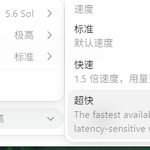
Some people may have noticed an UltraFast button in Codex and turned it on, but it is actually still unavailable. The actual TPS remains at the standard rate of 50 to 60 tokens/s
2
114
big goose retweeted

they could have published a nice report on architecture modification during post/continual training, but they chose to mislead the community with a clickbait title.
I saw it yesterday and thought they were unprofessional, but found out today it was all intentional.
> That would have cut our visibility by 90%. The fact is, you saw the title, you engaged with it. It worked its purpose.
i doubt if they really want to make contributions, but i'm sure they want to be known.
let's check the author list, @jm_alexia @RheaSukthanker @CameronPashmina @Emy_Aze, they wanted to be famous, but instead, they made themselves infamous.

This Post is from an account that no longer exists. Learn more
I just saw UltraFast on Codex and i tried it, but it seems unusable. the throughtout still is 50-60 token/s

239
big goose retweeted

🚨 SCOOP: OpenAI recently finished its next pretrain, codename "Bel" - the successor to "Doug", which is expected to be the base for Astra and GPT-6 (w/ further RL)
Bel is a giant pretrain with >10T total parameters, similar in size to GPT-4.5. OpenAI expect it to be a post-GPT-6 base, and potentially even the base for an AGI-threshold model.
All of this has Anthropic concerned. OpenAI believe Anthropic have no good response to Astra prepared for a public launch, and my understanding is that they're correct - mostly as a result of compute constraints, Anthropic are bracing for much of the rest of the year to go OpenAI's way, but think they'll be back on top early next year.
For coding, the best price reduction is actually a further price cut on cache read.
The bulk of all quota consumption comes from cache reads (if cache reads consume quota at all).
OpenAI doesn't do this as well as A/.
Grok also deserves criticism on this point.
1
96
As I said before, I don't recommend enabling 1M directly, 400k-500k is quite good
Here is how to enable a 1M-token context window in Codex for GPT-5.6 Sol.
Even though we have tuned the context limit in Codex to be set optimally when it comes to performance and cost, this is a common ask, so here it is documented.
A larger context window lets Codex retain more code, tool output, and conversation history before summarizing older material. You need a model that supports it. And GPT-5.6 Sol, for example, has a documented 1,050,000-token window.
Open ~/.codex/config.toml and add or update these settings at the top level, before any [section] headers:
```
model = "gpt-5.6-sol"
model_context_window = 1000000
model_auto_compact_token_limit = 900000
```
The first setting selects the model. The second tells Codex to use a one-million-token context budget. The third starts automatic history compaction around 900,000 tokens, leaving some headroom. Restart Codex client and start a new session after saving.
To try the configuration for a single CLI session without changing your defaults:
```
codex -m gpt-5.6-sol \
-c model_context_window=1000000 \
-c model_auto_compact_token_limit=900000
```
Have fun, but also know that we tuned the default carefully!
107
I can't use it, so it's as good as not released. Right, that's exactly it

Previewing Ultrafast mode for @OpenAI's GPT 5.6 Sol, powered by Cerebras.
GPT-5.6 Sol Ultrafast generates responses at up to 750 tokens per second. That's the full, GPT-5.6-Sol model -- up to 14× faster than the same model on Standard processing.
It speedran Humanity’s Last Exam in 11h 11m, nearly 7× faster than Claude Fable 5 with comparable accuracy.
94
I think it might also be a cache read issue. Did cache reads consume quota back in 5.5? What about the current 5.6 Sol?
Hello people of Sol! I've reset usage limits for all ChatGPT Work and Codex users. Together with that, a quick update on GPT-5.6 Sol usage limits.
Over the past few weeks, many of you have told us that Sol was using your Codex limits faster than expected. To be clear, we have not reduced usage on any subscription plans.
We’ve been digging into what was happening and have landed several improvements. As a result, we expect your usage to last around 18% longer during typical use of Sol. Some of you should already see significantly larger improvements from today. Tomorrow, we’ll also restore the five-hour limit that we temporarily paused while investigating.
Here’s what we found:
- GPT-5.6 Sol is much more willing to work for longer, make additional tool calls, and coordinate complex workflows across tools and subagents. That makes it better at solving hard problems, but some tasks were using far more than we intended.
- Sol also works harder at the same reasoning effort than previous models. High on Sol can use more tokens than High did on GPT-5.5.
- Programmatic tool calling, also referred to as code mode, gives Sol much more flexibility to run tool calls in parallel or continue working while waiting. But it also led to more responses per turn, more cached input tokens, and higher usage than expected.
- This was particularly noticeable when Sol was waiting for tool calls to finish or running many web searches. We’ve improved how we handle both cases and are continuing to make code mode more efficient.
- The impact was also very uneven. The median user actually found Sol quite token efficient, while some power users working on harder tasks saw their usage drain much faster. We were very focused on average and median usage before launch and missed some cases where the long tail could use significantly more usage.
Sol is a significant step forward in what Codex can do, but capability and efficiency do not always improve at the same pace, and some issues only become clear once people are using the model at real-world scale. We should have recognized this sooner and been more upfront about it.
You keep pushing the frontier and we’ll keep improving efficiency and sharing updates as we go.
97
big goose retweeted

Hello people of Sol! I've reset usage limits for all ChatGPT Work and Codex users. Together with that, a quick update on GPT-5.6 Sol usage limits.
Over the past few weeks, many of you have told us that Sol was using your Codex limits faster than expected. To be clear, we have not reduced usage on any subscription plans.
We’ve been digging into what was happening and have landed several improvements. As a result, we expect your usage to last around 18% longer during typical use of Sol. Some of you should already see significantly larger improvements from today. Tomorrow, we’ll also restore the five-hour limit that we temporarily paused while investigating.
Here’s what we found:
- GPT-5.6 Sol is much more willing to work for longer, make additional tool calls, and coordinate complex workflows across tools and subagents. That makes it better at solving hard problems, but some tasks were using far more than we intended.
- Sol also works harder at the same reasoning effort than previous models. High on Sol can use more tokens than High did on GPT-5.5.
- Programmatic tool calling, also referred to as code mode, gives Sol much more flexibility to run tool calls in parallel or continue working while waiting. But it also led to more responses per turn, more cached input tokens, and higher usage than expected.
- This was particularly noticeable when Sol was waiting for tool calls to finish or running many web searches. We’ve improved how we handle both cases and are continuing to make code mode more efficient.
- The impact was also very uneven. The median user actually found Sol quite token efficient, while some power users working on harder tasks saw their usage drain much faster. We were very focused on average and median usage before launch and missed some cases where the long tail could use significantly more usage.
Sol is a significant step forward in what Codex can do, but capability and efficiency do not always improve at the same pace, and some issues only become clear once people are using the model at real-world scale. We should have recognized this sooner and been more upfront about it.
You keep pushing the frontier and we’ll keep improving efficiency and sharing updates as we go.