
Just a guy who wants good things for you.
Joined January 2023
- Tweets66
- Following60
- Followers27
- Likes12




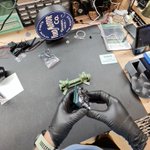


Something incredible happened in my shop this morning. You can now literally speak objects into existence. It's 2026 and we have flying cars and Star Trek style replicators. How can you not be excited about the future?

Pleasant updates from Google with Workspace MCP. I like the inclusion of a task manager that's native to the workspace in the MCP. BUT.... I don't like being forced to flag traffic as agentic. Feels like I'm about to have Gemini forced on me as a workspace user.

Build Day update: 6 builds shipped. My camera watcher went live just in time to catch a neighbor shutting off the chicken I forgot on the grill before heading to a soccer game. And a network sentinel now watches my home internet and devices, with a chat running on a local model.

Eight hours of work done by noon, so I took a nap and a decidedly analog break in my 63 Falcon. Energy drink in hand, back to the robot arm.

Second build shipped. My home network table now maintains itself: a Raspberry Pi scans every 15 minutes, fills in what it finds, logs every change, and emails me when something looks wrong. Three hours of build time against a two-day estimate.
First build of the day shipped. Codex and I added use tax tracking to my books app this morning, and it's deploying now. One down, seven still going.
Before I pull the old controller board off the arm, I'm mapping every connection with a multimeter. The Uno Q is on the bench waiting, and I want the wiring diagram right the first time.

Friday Build Day: as many AI-assisted builds as I can finish in one day, with a crew of AI assistants working in parallel. First milestone on the robot arm: a printed case for the Arduino Uno Q that's replacing the stock servo controller. Wiring it in next.

Greg Kienast retweeted

My clients are consistently surprised at how much work has to be done to simply describe the work to be done when working with AI.
“Can’t I just hand it to Claude and say do it?”
In some simple cases, yes. When the process is more involved, usually not.
Greg Kienast retweeted
Small business has an advantage in how quickly it can move compared to much larger companies. But, they’re lagging in AI adoption, and letting that advantage go to waste:
imperiaforged.com/blog/big-a…

Noticing something interesting with my clients using AI heavily as well as in casual conversations. People are hesitant to try a new agent harness, provider, etc. Trying something new is low effort, and easy to experiment. But, the camps are forming, the lines being drawn.
After one day of use, I can say this one is going to be big. This is the first time someone built something that made me feel like I’m working with a real team and not just different personas on the agents I’ve built. As a personal assistant, it’s outstanding.

There’s been a lot of talk about a company’s “Alpha” getting transferred to private companies and escaping the enterprise moat. I think that’s the wrong threat. The bigger problem I see is that Alpha getting eroded from the inside as knowledge work collapses via shared tool use.

Greg Kienast retweeted

This is what entrepreneurialism feels like. xitter.cf/tannokasa9/status/2079…
I can’t help but trying to guess which model penned every post I read— kind of like an AI sommelier.
“This one is very anthropic-forward. Hints of opus subtly hit the palate just before the BS arrives at the nose.”
“A smart model with messy company context is still a mess. A decent model with clean data and a tight workflow can make money.”
Buried the lead on this one! Probably the most important thing an operator or business can understand right now.

I had dinner with a group of operators, founders, and investors who are actually deploying AI inside real companies. We're talking 9-10 figure revenue companies.
The best question I asked was simple:
What part of the company would you rebuild from scratch if AI were native from day one?
The answers were way more useful than another model launch thread.
A few things stood out.
The serious operators are moving past the model debate. They care more about data access, permissions, memory, routing, evals, and human review.
A smart model with messy company context is still a mess. A decent model with clean data and a tight workflow can make money.
The first margin wins are boring. Customer support containment, document processing, accounting workflows, sales prep, call center context, recruiting ops, campaign analysis.
That is where the money is right now.
Manual work
↓
AI drafts / routes
↓
Human checks exceptions
↓
Cost drops
↓
Capacity rises
AI creates capacity before it creates clean headcount cuts.
That is the part most leaders will waste.
A team saves 10 hours, then spends 8 of them in more meetings. Congrats, you bought a Ferrari and drove it in a parking garage.
The better question is:
If this role were designed today with agents available from day one, would it still look the same?
That question gets uncomfortable fast.
The org chart is shifting from people management to workflow ownership.
Old model:
Manager
├─ analyst
├─ specialist
└─ coordinator
New model:
Workflow owner
├─ agents
├─ tools
├─ data
├─ QA loop
└─ outcome
That person is closer to a mini-GM than a prompt engineer.
They understand the business goal, wire the tools, inspect the output, catch bad answers, and improve the loop.
Compensation is going to get awkward too.
If two people have the same title but one can produce 5-10x more output with AI systems, they are no longer doing the same job.
Companies can keep forcing them into the same salary band.
That will work until the AI-native person realizes they are carrying the operating system.
Recruiting also gets weird.
The easy part is using AI to source, enrich, personalize outreach, screen, and summarize.
The hard part is evaluating talent when AI is part of the work.
Do you test people with AI? Without AI? Both? Do you grade the final output, their prompts, their taste, or their ability to catch bad model answers?
The future interview will look less like a whiteboard puzzle and more like:
Show me how you think with tools while I watch your judgment.
One underrated point from the dinner:
LLMs should not do everything.
If the job is math, rules, constraints, or calculations, use software.
If the job is synthesis, communication, ambiguity, or judgment, use the model.
Human asks
↓
LLM understands intent
↓
Tool/database runs
↓
LLM explains
↓
Human decides
The best AI systems will be less magic, more plumbing.
That is a compliment.
For agencies, the implication is obvious.
The old pyramid gets squeezed.
A strong AI-native marketer can now own strategy, research, execution, reporting, iteration, and client communication with a much smaller support layer.
The agency model moves from labor layers to outcome owners.
The dentist model wins.
High-skill human at the top. Systems underneath. More judgment per person.
AI makes average execution cheaper, but it makes great judgment more valuable.
The premium moves to people who can ask better questions, build better workflows, spot bad outputs, manage agents, understand context, communicate clearly, and move fast without creating chaos.
The weak version of AI adoption is giving everyone a chatbot.
The strong version is redesigning the company around workflows, data, permissions, evals, and AI-native operators.
Most companies are still playing with prompts.
The serious ones are redesigning the entire machine.
with @jonathangold_ , @APompliano , @ArmanHezarkhani , @matthew_kruer , @bbourque , Joe C

It’s remarkable what some companies will trade for the promise of a healthier bottom line.
The focus on scaled efficiency gains can pull the drain plug on the moat if you’re not really careful— and it can happen fast.
Using AI tools in an intelligent way fills your moat. Protect what’s yours! Don’t give it away.

Palantir's CEO just exposed Sam Altman and Dario Amodei for robbing every Fortune 500 company.
Within two minutes, Alex Karp took the entire frontier AI industry apart on national television.
His exact words:
"Every single enterprise in this country, these people are LIVID. They are paying for tokens that create no value. These people are stealing the weights and alpha of my business."
He literally said the entire frontier AI business model is intellectual property extraction dressed up as a subscription.
Then he also destroyed the pricing model with a single question that Silicon Valley still refuses to answer:
"If it was so valuable, let's say I can make you $1 billion tomorrow. Wouldn't I say I'll make you $1 billion and I want 30 percent? Why are they charging for tokens if it's so valuable?"
That question breaks the industry.
If OpenAI and Anthropic's models truly delivered the productivity gains the labs claim, they would take equity or a share of the profit they generate. They would not sell access by the million tokens.
Token pricing is itself the CONFESSION that the product cannot produce reliable value at scale. If it did, they would price for the value. But they price for the compute because that is what they are actually selling.
Karp went even further...
He called the entire arrangement "a wealth tax that does not help the poor. It just punishes."
American businesses are transferring the alpha of their operations, meaning the workflows, the customer data, the strategy memos, the internal models that make them competitive, directly into the training pipelines of a handful of Silicon Valley labs. Once those labs retrain, the customer's own edge becomes the next enterprise product sold back to their competitors.
And the part the AI industry does not want anyone thinking about:
Every enterprise running its confidential documents, its customer conversations, and its financial models through a frontier model is potentially teaching that model HOW to replace them.
The vendor collects the token fee AND the compounding intelligence about that customer's business. That is the mechanism. And that is why Karp used the word "stealing."
He claims this is why every executive he meets is furious in private and silent in public. Nobody wants to be the CEO who called out the labs and then discovered their next competitor was built on their own leaked workflows.
The entire AI industry has been priced for perfection on one assumption:
That frontier labs produce durable, defensible value that justifies infinite compute spend.
But Karp just told us that the customers do not believe that assumption anymore. They believe they are being taxed without benefit, watched without consent, and copied without recourse.
The moment enterprises stop believing, the whole valuation stack shakes.
The advertising business has traded audience and attention for spend since the beginning of advertising.
“Bot fraud” created massive spending increases in fake attention sinks. Fake audience, real engagement, real spend, no ROI.
What happens when the fake audience starts making real purchasing decisions for real people who never saw or heard the ad?