







Pinned Tweet
THE NUMBERS BEHIND ZERUAI’S ONCHAIN TRUST LAYER
Most DeFi lending still prices risk almost entirely through collateral ratios. Wallet history is public, yet rarely used as a structured input for credit, incentives, or access decisions.
@zerufinance is building a behavioral trust oracle that converts onchain activity into scores and signals. Here is the current picture with the main metrics and the open questions.
1. 320M+ wallets scored across 30+ chains
zScore is a 0-1000 behavioral reputation score derived from lifetime activity (trading, lending/borrowing, liquidity provision, staking, governance, and other patterns). It is computed at scale and queryable via API. Coverage at this volume is the foundation. The harder test is whether the scores improve downstream decisions.
2. Live on major explorers
zScore appears in the Cards tab on Etherscan and other explorers (BaseScan, BscScan, Arbiscan, PolygonScan, Linea, Robinhood Chain, and others). Users can check a score next to existing transaction history. 1M+ checks have already occurred on Etherscan alone. Visibility matters, but actual usage by protocols for capital allocation is the more important adoption metric.
3. Activity Markets (Zaps) and campaign participation
Zaps tracks quality filtered onchain contribution rather than raw volume. Campaigns and leaderboards (including trading competitions) have drawn 25k+ participants. Zaps function as points tied to measurable activity. They are not an immediate token claim. The design aims to reduce sybil and extractive behavior relative to traditional airdrops. Case studies cited by the team show material reductions in low quality allocation, though independent long term retention data will matter more.
4. Research and underwriting signals
Zeru has published multiple papers (including on arXiv) covering neural network reputation models tested against historical lending repayment data and Uniswap v3 activity, plus frameworks for reward attribution and cash-flow reconstruction for short duration credit underwriting (zLend). These provide a methodological basis that pure marketing claims lack. Live undercollateralized lending volume that relies on these signals remains the clearest proof point still ahead.
5. From scores to capital efficiency
The stated goal is to use more than collateral when assessing risk, filtering incentives, screening counterparties (via tools like zScreen), and allocating capital. 3M+ API calls processed indicate some integration demand. The decisive metrics are not the number of wallets scored, but whether higher zScores correlate with better repayment rates, lower default, reduced sybil leakage, and sustained protocol usage after incentives end.
Behavioral data is public and high dimensional. Turning it into reliable, portable trust signals at DeFi scale is a real infrastructure problem. ZeruAI’s current numbers show progress on coverage and visibility. The remaining test is whether those signals produce measurably better risk and allocation outcomes than collateral only or points-only systems.


A ROBOT CAN RECORD A ROOM. BUT CAN IT UNDERSTAND THE SPACE?
That is the difference between collecting footage and building spatial intelligence.
@vangrid_io is working on the layer that helps turn everyday environments into structured 3D data that physical AI can actually use.
Think about what a warehouse robot needs to know before moving through an unfamiliar building:
→ How wide is the aisle?
→ Can it turn safely around that corner?
→ Where are the obstacles and changes in elevation?
→ Does the reconstructed environment accurately represent the real one?
A video clip may show the answers from one angle. Reconstructed spatial data helps represent the environment in a form that machines can work with.
Here is where VanGrid’s approach gets interesting:
📍 Real world capture: Contributors record physical locations using a phone.
🧩 3D reconstruction: Multiple views can be transformed into spatial representations, including point clouds, Gaussian splats, and textured 3D meshes.
🔐 Privacy conscious processing: Faces and license plates are redacted on-device before encoding, according to the project’s described workflow.
⛓️ Verifiable records: Capture fingerprints and attestations anchored to Base provide a way to inspect and verify records.
The bigger opportunity goes beyond warehouse automation.
As robotics and world models advance, they need more than internet images and synthetic environments. They also need useful representations of the physical world as it actually exists.
That makes spatial data an important piece of the physical AI stack.
The next frontier isn’t just teaching AI what the world looks like. It’s helping machines understand the spaces they move through.
That is the opportunity behind @vangrid_io.
Explore the network: app.vangrid.io
🤖 Made with AI

H B O retweeted
ZERO TRADING FEES, DAILY FUNDING, 1,000+ MARKETS: GRVT’S NEXT MOVE IN ONCHAIN DERIVATIVES
The cost of a perpetual trade goes beyond the entry price.
Trading fees reduce returns with every execution. Funding payments accumulate while positions remain open. Limited market coverage can also force traders to split capital across platforms.
@grvt_io is targeting all three frictions with Stable Funding Perps, scheduled for November.
1. Zero trading fees across traditional markets
$GRVT plans to introduce perpetual contracts linked to stocks, foreign exchange, commodities and indices, with zero trading fees.
That could reduce one direct cost for active traders. Spreads, slippage, funding payments and other applicable costs still matter when calculating the actual cost of a position.
2. Funding charged once daily
Many crypto perpetual markets settle funding every one, four or eight hours, depending on the instrument and venue.
GRVT’s Stable Funding Perps are designed to charge funding once per day, with the rate intended to be more predictable and generally lower than competing venues.
For a trader holding a position over several days or weeks, knowing the funding terms before entry can make position-cost estimates easier.
The important distinction: fewer funding settlements do not automatically mean lower total funding. The rate itself determines the cost.
3. More than 1,000 markets by December
GRVT aims to list over 1,000 markets by the end of December 2026, expanding access to traditional assets through perpetual contracts.
The target matters because broader coverage could let traders manage exposure to different asset classes from one platform instead of relying exclusively on crypto markets.
The actual value will depend on market availability, liquidity and execution quality across those listings.
4. The infrastructure behind the experience
GRVT operates an onchain trading architecture with offchain order matching and cryptographic verification. The platform says its infrastructure is designed to combine fast execution with verifiable settlement.
That distinction is important for derivatives, where speed matters but so do risk controls, collateral handling and settlement integrity.
The bigger picture
GRVT is building toward a trading environment where access to traditional markets, predictable funding and lower execution costs sit within a self-custodial framework.
The numbers to watch after launch are effective trading costs, realized funding payments, spreads, market depth and how quickly new listings attract genuine liquidity.
Zero fees make a strong headline. Consistently competitive execution is what will determine whether the product delivers.
🤖 Made with AI

H B O retweeted
GRVT 2.0: From Token Buybacks to a More Productive On Chain Financial Platform
What if your capital could earn yield, support trading positions, and remain under your control within one ecosystem?
That is the vision behind @grvt_io 2.0, a major product transition designed to bring earning, multi asset trading, and capital efficiency into a unified self custodial experience.
Here’s how its five milestones fit together.
1. Token Buyback & Burn 🔥
GRVT announced its first buyback and burn of 1.1 million GRVT tokens, representing close to 1% of circulating supply at the time. The issuer intends to conduct further monthly buybacks at its discretion, with transactions trackable through a public dashboard.
2. GRVT Earn 💰
Planned to expand access to yield strategies backed by real world cash flows, including interest, premiums, and invoice related income. The announced target is up to 11% APY, not a guaranteed return.
3. Stable Funding Perps 📈
Designed to expand perpetual trading into equities, foreign exchange, commodities, and indices, with zero trading fees and once daily funding planned. GRVT targets more than 1,000 markets by the end of December 2026, up from approximately 200 described in its announcement.
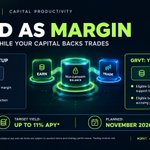
4. Yield as Margin ⚙️
One of the most significant elements of the roadmap. Eligible GRVT Earn balances are intended to keep generating yield while serving as collateral for perpetual positions, subject to product terms and risk parameters.
5. GRVT 2.0: One Unified Experience 🌐
The planned late November launch aims to integrate earning, multi asset trading, and yield-bearing margin into a redesigned app built around a single self custodial balance, alongside a refreshed brand and the 2027 roadmap.
Why the Bigger Picture Matters
These milestones are connected by one central idea: capital productivity.
The token burn introduces a verifiable supply reduction mechanism. Earn aims to connect users with yield generating strategies. Stable Funding Perps broadens market access, while Yield as Margin aims to reduce the trade-off between earning and trading.
$GRVT also says it built its own zero-knowledge infrastructure, giving it greater control over settlement, matching, and risk-management systems.
The opportunity is to bring more financial activity into one integrated environment without giving up self-custody.
The execution challenge is equally important: sustainable yields, competitive liquidity, effective risk controls, and reliable delivery will determine how well this vision works in practice.
GRVT 2.0 is not just about adding more products. It is about changing how capital can be used across one financial platform.
Will unified capital management become a defining feature of the next generation of on chain finance?
🤖 Made with AI
H B O retweeted
GRVT: Yield as Margin | Rethinking Capital Efficiency
What if your capital could earn yield while also supporting your trading positions?
That’s the idea behind @grvt_io’s Yield as Margin, a planned feature designed to bridge the gap between earning and trading.
Eligible $GRVT Earn balances are intended to continue generating yield while serving as collateral for perpetual trading positions, subject to product terms and risk parameters.
Why this matters:
• Capital Efficiency: Make better use of eligible capital across earning and trading.
• Yield Potential: Target up to 11% APY, although returns are not guaranteed.
• Unified Capital: Bring yield generation and trading collateral into a more integrated experience.
• Self Custody: Maintain a self custodial framework, subject to the feature’s specific terms.
The bigger idea is simple: your capital should have the potential to do more than one job.
$GRVT is exploring a more integrated approach to yield and trading, with the aim of making capital more productive.
What’s your take on Yield as Margin?
🤖 Made with AI

H B O retweeted
GM gARC
$ARC Terminal: Bringing AI and On-Chain Trading Together
Crypto markets move fast. Finding the right opportunity, understanding market movements, and managing execution can require switching between multiple tools.
@TheARCTERMINAL is building a different experience: an AI-powered on-chain operating system designed to bring market discovery, analysis, and trading into one workspace.
Core Features
→ AI-Powered Trading: ANIMA helps analyze market opportunities and turn insights into proposed trades, with the user retaining control over confirmation.
→ Market Intelligence: The Feed helps surface market-moving narratives and potential opportunities.
→ Perpetual Trading: Access AI-assisted trading workflows designed to connect market analysis with execution.
→ User-Controlled Execution: Trading decisions remain in the user’s hands, helping combine AI assistance with deliberate risk management.
→ A Unified Experience: Bring research, market context, and trading workflows together in a browser-based terminal.
Why It Matters
ARC Terminal is exploring how AI can make crypto trading more informed and efficient, helping traders move from discovering a market narrative to evaluating a potential trade without losing sight of risk.
The bigger vision is a trading experience where AI does more of the analytical work while users stay in control of the decisions.
Less tool switching. More informed decisions. AI-assisted trading.
What role do you think AI will play in the future of on-chain trading?
GRVT: Yield as Margin | Rethinking Capital Efficiency
What if your capital could earn yield while also supporting your trading positions?
That’s the idea behind @grvt_io’s Yield as Margin, a planned feature designed to bridge the gap between earning and trading.
Eligible $GRVT Earn balances are intended to continue generating yield while serving as collateral for perpetual trading positions, subject to product terms and risk parameters.
Why this matters:
• Capital Efficiency: Make better use of eligible capital across earning and trading.
• Yield Potential: Target up to 11% APY, although returns are not guaranteed.
• Unified Capital: Bring yield generation and trading collateral into a more integrated experience.
• Self Custody: Maintain a self custodial framework, subject to the feature’s specific terms.
The bigger idea is simple: your capital should have the potential to do more than one job.
$GRVT is exploring a more integrated approach to yield and trading, with the aim of making capital more productive.
What’s your take on Yield as Margin?
🤖 Made with AI
GN CT
The future of Web3 isn’t just about building faster, it’s about building smarter.
That’s why @quipnetwork has my attention. The real opportunity lies in creating infrastructure that delivers meaningful utility, empowers users, and scales with the next generation of the internet.
Still early, still watching, and excited to see what comes next. 🚀
Keep an eye on $Quip.

H B O retweeted
It’s very clear that @zerufinance adds a credit style score directly to Etherscan, so an address no longer looks like every other address on the page.
The score runs from 0 to 1000 and is built from onchain history: swaps, borrows, lends, stakes and governance votes. Its models look for patterns across the full record and weight what held up over time instead of what happened last week.
To see it, open any address on Etherscan and go to the cards tab. The score is already listed, and no signup is needed.
I checked a few addresses. Wallets with steady loan repayments scored above wallets that pushed a burst of volume once, which is the behavior an onchain reputation score should reward.
Older activity stays in the calculation, so one recent move does not erase a long track record.

GN CT
Been keeping an eye on @TheARCTERMINAL 👀
The future of crypto is all about making on chain data easier to understand and act on.
Excited to see what they’re building. 🚀

It’s very clear that @zerufinance adds a credit style score directly to Etherscan, so an address no longer looks like every other address on the page.
The score runs from 0 to 1000 and is built from onchain history: swaps, borrows, lends, stakes and governance votes. Its models look for patterns across the full record and weight what held up over time instead of what happened last week.
To see it, open any address on Etherscan and go to the cards tab. The score is already listed, and no signup is needed.
I checked a few addresses. Wallets with steady loan repayments scored above wallets that pushed a burst of volume once, which is the behavior an onchain reputation score should reward.
Older activity stays in the calculation, so one recent move does not erase a long track record.
H B O retweeted

CONSO BOTS MINT IS NOW LIVE 🚨
5,555 BOTS | Free Mint | Agentic Collectibles 🤖
Claim your BOT 👇
conso.xyz/bots
ZERO TRADING FEES, DAILY FUNDING, 1,000+ MARKETS: GRVT’S NEXT MOVE IN ONCHAIN DERIVATIVES
The cost of a perpetual trade goes beyond the entry price.
Trading fees reduce returns with every execution. Funding payments accumulate while positions remain open. Limited market coverage can also force traders to split capital across platforms.
@grvt_io is targeting all three frictions with Stable Funding Perps, scheduled for November.
1. Zero trading fees across traditional markets
$GRVT plans to introduce perpetual contracts linked to stocks, foreign exchange, commodities and indices, with zero trading fees.
That could reduce one direct cost for active traders. Spreads, slippage, funding payments and other applicable costs still matter when calculating the actual cost of a position.
2. Funding charged once daily
Many crypto perpetual markets settle funding every one, four or eight hours, depending on the instrument and venue.
GRVT’s Stable Funding Perps are designed to charge funding once per day, with the rate intended to be more predictable and generally lower than competing venues.
For a trader holding a position over several days or weeks, knowing the funding terms before entry can make position-cost estimates easier.
The important distinction: fewer funding settlements do not automatically mean lower total funding. The rate itself determines the cost.
3. More than 1,000 markets by December
GRVT aims to list over 1,000 markets by the end of December 2026, expanding access to traditional assets through perpetual contracts.
The target matters because broader coverage could let traders manage exposure to different asset classes from one platform instead of relying exclusively on crypto markets.
The actual value will depend on market availability, liquidity and execution quality across those listings.
4. The infrastructure behind the experience
GRVT operates an onchain trading architecture with offchain order matching and cryptographic verification. The platform says its infrastructure is designed to combine fast execution with verifiable settlement.
That distinction is important for derivatives, where speed matters but so do risk controls, collateral handling and settlement integrity.
The bigger picture
GRVT is building toward a trading environment where access to traditional markets, predictable funding and lower execution costs sit within a self-custodial framework.
The numbers to watch after launch are effective trading costs, realized funding payments, spreads, market depth and how quickly new listings attract genuine liquidity.
Zero fees make a strong headline. Consistently competitive execution is what will determine whether the product delivers.
🤖 Made with AI
H B O retweeted
$161 TRILLION IN FIXED INCOME. WHY GRVT WANTS A SHARE OF THE YIELD MARKET
The next phase of onchain finance may be less about creating new token incentives and more about making existing financial cash flows accessible to everyday users.
@grvt_io is building toward that opportunity with Grvt Earn.
The scale is significant. Grvt cites a $161 trillion global fixed income market, where returns are generated through instruments such as bonds, credit strategies and other income producing assets.
Its upcoming Earn product targets yields of up to 11% APY, with returns expected to come from underlying financial activity, including interest, insurance-related premiums and invoice income.
The number deserves context.
At an illustrative 11% APY, a $1,000 balance would generate $110 over a year if that rate were sustained. A $10,000 balance would generate $1,100, before fees, taxes or other costs.
These are projections, not promised returns. Actual performance depends on the underlying strategies, their risks and the rates available over time.
$Grvt has also advertised a 3.5% base yield, making it important to distinguish the standard rate from the higher targeted investment opportunities.
The bigger opportunity is capital efficiency.
Grvt plans to introduce Yield as Margin, allowing eligible Earn balances to generate yield while supporting trading positions.
That could reduce the trade off between earning on idle capital and keeping funds available for market opportunities.
Grvt has also announced plans to build a $100 million position in Ondo’s USDY over a year, demonstrating its broader interest in tokenized Treasury backed yield.
Still, three questions matter before judging the opportunity:
How much of the target yield reaches users after costs?
What liquidity and counterparty risks come with the underlying strategies?
And can the platform sustain competitive returns across changing market conditions?
Grvt Earn’s proposition is straightforward: connect self custodial capital to established financial yield sources, then make that capital useful within the same trading ecosystem.
The execution, transparency and risk management will determine how compelling the model becomes.
GM gVAN
@vangrid_io framed the problem well: when the signal exists but the context does not, embodied systems stay limited.
Robots and world models already process plenty of data. What they lack is fresh, ground-level spatial context from the places they operate in, and satellites or mapping fleets only reach so far. I ran through the capture flow myself. You accept a bounty, walk your phone around the location, faces and license plates are blurred on device, and the video is reconstructed into a 3D spatial model. Each capture gets a content fingerprint and is batched into an EAS attestation on Base, so buyers can audit provenance themselves.
What convinced me is that it is live. Buyers fund bounties in USDC, funds stay in escrow until a capture is accepted, and the public explorer already shows 1.25M+ captures, 4,700+ attestations and $600K+ USDC settled.
The bottleneck for physical AI is less about another model and more about verified ground truth from the places agents actually need to operate.
A distributed grid of phones is a practical way to keep that data current.

H B O retweeted
GN CT
Most land NFTs give you a parcel to own. @tera_map gives you a world to explore.
Built on @RobinhoodChain, TERA features 3,333 land parcels in a live multiplayer 3D city.
You can enter for free, choose a name, explore different districts, build on land, and interact with other players without connecting a wallet.
What caught my attention is that the world is already playable, giving people something to experience before the full economic system arrives.
The next thing worth watching is how TERA connects digital land ownership with its planned resource extraction mechanics.
Explore the world: teraworld.io/
