

M&A Lawyer | 7th Street Legal | We help business buyers acquire with confidence
Detroit, MI, USA
Joined April 2022
- Tweets2.9K
- Following349
- Followers493
- Likes2.4K







I want to clear up some confusion.
Under current SBA rules (SOP 50 10):
If you want the seller note to count towards your equity injection, it must be on full standby for the term of the SBA loan (10 years).
But if not, a seller note doesn’t have to be on standby at all.
That doesn't mean you don't want the seller note to be on standby.
Seller notes are regularly on full or partial standby for the first two years to ease the transition from seller to buyer.
Your lender may even require it for that reason.
But don't spook the seller unnecessarily.
Asking him or her to defer a portion of the purchase price for 10 years is a big ask.
1
93
By choosing inexperienced M&A counsel, you are putting your deal at risk, as inexperienced lawyers often react in one of two ways.
They insufficiently protect your interests.
They overzealously protect your interests.
Both reactions come from the same place: a lack of context.
Yet the latter is particularly problematic.
Deal fatigue sets in.
The financials get stale.
The risk increases that something goes wrong.
5
6
315
Completing financial diligence first can help you avoid dead deal fees, but it isn’t always the best strategy.
Sequencing financial and legal diligence extends the transaction.
And the longer a deal takes, the more likely deal fatigue will set in.
1
43
Seller representations are only worth what the buyer can practically enforce. A representation standing alone could be close to worthless.
That matters because so much of the effort in negotiating a purchase agreement goes into seller representations.
Seller representations are statements of fact that, if untrue, may require the seller to indemnify you for losses.
For example, to the seller’s knowledge, no material customer is thinking of leaving post-close.
But let’s say a representation is untrue.
Perhaps the seller knows that a material customer is thinking of leaving for a competitor.
Perhaps that is part of her motivation for selling?
What happens then?
Once the customer leaves and you suffer indemnified losses, your options depend on what recovery mechanisms you negotiated before signing.
For instance, did you finance part of the purchase price with a seller note?
If so, did you negotiate a strong offset right, allowing you to deduct indemnified losses from the amount owed?
If you have no such mechanism for recovering your losses, you are left to fight it out in the courts.
And if the legal costs of doing so are significantly lower than the losses in question, this is a viable (if risky) strategy.
But if the legal costs are comparable to or higher than the loss, the seller’s representation is next to useless.
Harsh but true.
45
Earlier this week, the SBA released an important update that goes into effect today.
Veterans can now fund the entire 10% equity injection from permitted outside sources, including investor capital and full standby seller notes.
For example, if total project costs are $5,000,000, the buye equity injection is $500,000 (10%).
Under the current version of SOP 50 10, non-veterans can only use permitted outside sources to fund half of that requirement ($250,000).
The rest has to come from their own money.
In contrast, veterans can now raise the entire $500,000 from investors or rely on other permitted outside sources such as a full-standby seller note.
That's pretty great news for veterans who are eyeing up a larger transaction.
34
The SBA’s recent tightening of credit standards in SOP 50 10 were designed to protect the future of the 7(a) program.
In recent years, buying a small business has been marketed as a path to wealth and fulfillment.
There’s truth to that, but it isn’t the whole story.
Buying a small business also involves substantial risk, and buying the wrong one can land you in serious trouble.
Even with thorough diligence, hidden skeletons may remain. Small businesses are informal affairs.
And you can protect yourself, for example through seller indemnification. But those protections only go so far.
The fact is a highly leveraged buyout only works if the company can comfortably service the debt.
Otherwise, one bad month or a downturn in the economy could spell disaster.
When SBA-financed deals fail, the 7(a) program may take a loss.
If those losses keep accumulating, the program may not survive.
So, the SBA was right to take action to curtail the failures.
Have the recent changes to SOP 50 10 made it harder to buy a business? Yes.
Are some of the changes a little heavy handed? Yes.
But, in general, are they a net win for the future of ETA?
In my perspective, yes.
2
2
98
Bulk sales laws are one exception to the general rule that asset purchases insulate buyers from inherited liabilities. Here’s how:
Traditionally, bulk sales laws protected creditors when a business sold substantially all of its assets.
The concern was that an owner could transfer assets to a new entity to avoid paying creditors.
So the laws required the owner to notify creditors of the sale, giving them a chance to protect their interests.
If the owner failed to do so, the buyer became liable for those debts as a successor in interest.
Yet these laws have evolved.
In some states, they now focus on local taxes rather than creditors.
There, the seller must obtain a certificate from the local taxing authority confirming that no taxes are owed.
Otherwise, the buyer can again become liable as a successor in interest.
Other states have abolished bulk sales laws altogether.
And some have abolished them but kept the tax clearance requirement.
So, when buying a business, make sure you know which laws apply and what compliance requires.
1
42
Even in the small business and lower-middle markets, opposing counsel is sometimes Big Law.
And that means legal negotiations are time consuming, costly, and a bloodbath of redlines.
Sometimes, the additional effort is necessary.
Hard negotiations can be the result of real issues.
But all too often, large firms staff small deals with a junior associate, meaning:
Pointless legalese is added to clean drafts.
Immaterial changes are made to defined terms.
And on and on.
All this creates friction.
And while friction may not always kill a deal, it can kill a deal under the wrong circumstances.
As for the seller, junior associates at large firms are still billed out at close to $1,000 / hour (maybe more).
So do yourself a favor, work with experienced and credentialed lawyers who focus on closing the type of deals you want to do.
Big law is great for big transactions.
Main street is a different animal.
1
84
Raising investor capital is a step on the business buying journey. Here’s how to do it.
Step 1: Identify potential investors.
Understanding who you want to raise money from is crucial.
When raising capital, most buyers proceed under Rule 506(b) of Regulation D.
The simplest way of doing so is to raise money from accredited investors with whom you have a pre-existing relationship.
Step 2: Gain soft commitments.
Some buyers prepare a Private Placement Memorandum (PPM): A marketing deck that pitches the potential upside and articulates the very real risks of the opportunity.
Yet many buyers forgo a PPM. Instead, they opt to rely on term sheets, which summarize the terms of the investment (preferred return, minority voting rights, etc.).
If you’re forgoing the PPM, make sure that all investor risks are clearly stated in the subscription agreements.
Step 3: Negotiate the investment documents.
The operating agreement sets out the rights and responsibilities of the parties.
This is where the economics (priority return of capital, preferred return, etc.) are documented, in addition to minority protections (veto rights, tag-along rights, etc.).
The subscription agreements are the instrument by which you issue equity to investors.
This is also where your investors will formally represent that they know what they’re doing, understand that they may lose their money, and that they can afford that loss.
You should also prepare an investor questionnaire (best practice, regardless of your relationship with the investors).
Step 4: Close the round.
Closing sometimes happens concurrently with the closing of the deal. But it also happens in advance.
Just be aware, when you close on the round, the clock starts ticking to comply with Regulation D’s filing requirement and any state securities (blue sky) laws.
Engage a lawyer to get things right. Violating securities laws isn't a great idea, even when raising from friends and family.
1
60
Buyers wait until the last moment to hire an attorney.
There is a better way to avoid dead deal fees.
1️⃣ Meet with lawyers early.
An initial meeting won’t cost you anything (other than 45 minutes of your time).
By identifying one or two candidates early, you’ll be ready to pull the trigger once under LOI.
2️⃣ Consider limited hourly engagements to provide on-demand legal support.
Prior to signing an LOI, you may not be ready to enter a full engagement.
But depending on your experience, you may need legal support.
Limited hourly engagements are a great way to secure support while controlling costs.
3️⃣ Insist on a flat-fee engagement, with most of the fee earned at a successful closing.
Any decent M&A lawyer won’t work on a pure contingency basis.
Yet lawyers focused on the ETA space will agree to back-end some of their fees, sharing the risk of a deal not closing.
4️⃣ Sequence the various workstreams.
You can reduce the risk of dead deal fees by completing financial diligence first before asking your lawyers to begin legal diligence and the transaction documents.
But be aware: sequencing your advisors in this way increases the time it takes to close a deal, which can increase the likelihood of deal fatigue.
And if your deal is over $3M, there is the added wrinkle of the SBA’s new QoE mandate.
Talk to your lender about how they are approaching the new QoE requirement.
67
Or Claude will charge 5k a month...
What? We all know that's where it's heading.

The Harvey’s and Legora’s of the world better cash in now… Over time, the frontier models will duplicate all of the “proprietary workflows” of the legal tech cos, who are just OpenAI and Anthropic wrappers, and instead of $5K per month, you’ll get the same product for $200.
53
If the target business is an S-corp and you don't want to acquire an S-corp, you can execute an F reorganization.
With a waiving of legal hands, you can turn that S corporation into a single member LLC taxed as a disregarded entity.
Just remember, you'll need the seller to agree to execute the F reorganization.
It must occur prior to the closing, while the seller is still the owner.
And, truthfully, F reorganizations can be a tough sell to an unsophisticated seller.
The seller’s lawyer may not understand it.
The seller’s lawyer may charge more to execute it.
The deal will become an asset deal for tax purposes.
On this final point, sellers are sometimes worse off from a tax perspective when selling assets.
So like most questions of structure, raise this issue early to avoid it later derailing things.
And, additionally, be open to the possibility that you may have to sweeten the deal by grossing up the purchase price.
2
3
119
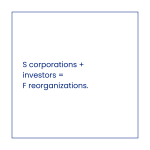
S corporations and investors are like oil and water.
They don’t mix.
Why?
S corporations are inflexible.
For instance, each stockholder must have the same economic rights (no different classes of stock, e.g., preferred).
And only individuals, disregarded entities, and certain trusts can be stockholders.
Those two rules make it difficult to accommodate investors, who often want to invest via a legal partnership and will want a preferred return.
Something to consider if investor capital will form part of your capital stack.
66
Where a deal is seller financed, push back against a personal guaranty on the seller note.
To clarify: I’m not talking about the mythical no-money-down deal structure.
Instead, I’m referring to those deals where the seller largely finances the transaction and there is no senior lender.
These deals do exist.
Normally, they’re smaller transactions.
And because of the risk profile of the business, such as high customer concentration, no lender will offer finance.
In this situation, the seller may argue:
“If this were an SBA financed deal, you would have to PG the entire loan. I’m the bank now, so why should I be treated any differently?”
That’s somewhat true. But in typical small business deal, the seller note is subordinated to the senior loan.
The seller therefore has skin in the game.
When proceeding without a senior lender, you still must make sure that the seller’s incentives align with your own.
So push back against a full personal guaranty.
If a guaranty is necessary to get the deal done, agree only to a limited guaranty so the seller still has meaningful exposure.
After closing, both you and the seller will then remain incentivized to support a successful transition.
1
1
169
Would you like to meet IRL?
I’ll be attending the Booth-Kellogg ETA Conference this Friday.
DM me if you’ll also be in Chicago, as it’d be great to say hi.
After all, social media can only get you so far.
IRL is where relationships are truly built.
2
176
PSA to prospective buyers: Do not sign a form purchase agreement pushed by the broker before consulting with your lawyer.
On a recent deal, we were able to undo the damage. But those forms set us back weeks.
1
62
A personal guaranty on a seller note is rarely a deal killer.
Seller notes are subordinate to senior debt.
Many buyers personally guarantee the senior debt.
So, if the worst were to happen, your lender will take everything of value.
In this light, the seller note PG is more a sign of good faith than an ironclad guarantee.
There are exceptions.
But in general, save your negotiating powder for bigger issues.
3
4
213
If you’re looking to buy a business, don’t be lured into thinking it’s a passive investment.
For one, buying a business costs money and time.
But more to the point, building a business that runs without your day-to-day involvement is tough.
Even if you buy a business with an existing management layer, the seller, who built it from the ground up, may be able to run it part time.
But that is unlikely to be you.
At least, not at first.
And as for the future, sure, the principles are easy to grasp:
Document and improve internal systems and processes.
Hire the right people for the right positions.
Automate and delegate where possible.
But turning principles into reality is more challenging than it looks.
Becoming an entrepreneur is a fun ride.
But have no illusions. It’s not an easy path.
Ask me how I know.
Given the importance of Transition Services Agreements, you would assume the parties spend hours negotiating them.
Why?
The dreaded J-curve is real.
Getting the transition right is crucial.
TSAs obligate the seller to provide transition assistance.
But that’s not normally how it plays out.
When it comes to small business acquisitions, the parties often forgo a stand-alone TSA, opting instead for a broadly written transition services provision in the purchase agreement.
There is a good reason for this contradiction.
The TSA is negotiated at the same time as the purchase agreement.
The seller may not want to talk about the transition prior to signing the purchase agreement.
The parties therefore save detailed transition planning for later, once the purchase agreement is signed (assuming a sign-then-close structure).
I’m not saying that’s the ideal. It’s just the way it often goes down.
22
Buyers should always take raising capital seriously, even if raising capital from family and friends.
Securities laws protect everyone.
Violating them comes with the risk of hefty penalties.
And if you're naive enough to think that raising money from family and friends will never result in legal action, think again.
Friendships are often forgotten in the face of financial losses.
Family ties can come under strain too.
There is no friends and family exception to the securities laws.
Treat all investors the same.
1
52