

#Hiring | Research Lead @Amazon RSI | ex-@CarnegieMellon, @MSFTResearch | DM for Collab | Building https://nitter.gq/t.co/VoJrRsndf3 | Co-Lead @OpenRSI | LM2LM
San Francisco, CA
Joined June 2016
- Tweets617
- Following203
- Followers822
- Likes706






Pinned Tweet
We're scaling this to 100x more research task experiments / new domains / to build the best autoresearch model. That's a lot of work, and we're looking for people to build it with us at a-evo-lab.github.io/.
Know someone great at RSI / autonomous research? Tag them below.

Can 𝐫𝐞𝐬𝐞𝐚𝐫𝐜𝐡 𝐭𝐚𝐬𝐭𝐞 be measured? Research agents can propose far more experiments than we can run. But good human researchers predicting which ideas will pay off before running them.
Can LLMs build such a Research World Model?
We asked 13 LLMs to predict each research idea's gain before running it. With 320 past experiments in context, all 13 beat the best model that had none.
Quick math on the RH proof: ~239MB of Lean ≈ 60–80M tokens. Reading the 250k-page version at 2 min/page is ~4 years of full-time work for one mathematician. We've officially entered the era where the proof is easier for AI to write than for humans to read.

BREAKING: A mathematician at Anthropic claims to have used the company's AI to solve the Riemann hypothesis, the most notorious open problem in all of math
sciam.com/article/anthropic-…

2
182
Early signal for where top researchers go next: their recent posts.
@lilianweng posted about RSI in July and then join @OpenAI to lead RSI. @_jasonwei posted about benchmark of benchmarks and then join @mercor .
Researchers write about what they're about to work on next. (Another reason, they probably don't have enough time and flexibility to write when they were in the last company).

We are excited to bring on @_jasonwei as Chief Scientist at @mercor.
Jason is known for pioneering work on reasoning and agents at Google Brain, OpenAI, and Meta. He also created several benchmarks adopted across the industry: SimpleQA, a widely-used pretraining benchmark, BrowseComp, the top deep research benchmark, and HealthBench, the first public benchmark to popularize rubrics.
Over the past years, Jason has been one of our favorite customers and thought partners. As Chief Scientist, Jason will help build Mercor’s research team and shape our work on data and evaluations.

1
44
10,879
Can 𝐫𝐞𝐬𝐞𝐚𝐫𝐜𝐡 𝐭𝐚𝐬𝐭𝐞 be measured? Research agents can propose far more experiments than we can run. But good human researchers predicting which ideas will pay off before running them.
Can LLMs build such a Research World Model?
We asked 13 LLMs to predict each research idea's gain before running it. With 320 past experiments in context, all 13 beat the best model that had none.
Paper: Language Models as AI Research World Models arxiv.org/abs/2610.12235
Interactive results for all 13 models: a-evo-lab.github.io/rwm/
Thanks to our collaborators @zijun_wang2002 @Zevin_Liu @linminhua16 @WengZhaoti39773 @dakuowang @YisiSang @sammyershi @binghe2727

1
6
663
Very good report about how RSI is going on inside @AnthropicAI . I am curious about a eval of whether they feel their AI has the research taste now, aka., know what the right next idea to try and how likely it’s going to be successful, beyond implementing & bug fixing.

Since August, a team within METR has worked with internal Anthropic information to assess whether AI itself is accelerating AI development.
We are now publishing a report summarizing the results of this risk assessment.
2
346
Exciting, shall we scale up LM2LM to more model training tasks, and build the best open-weight autoresearch models for model training?
arxiv.org/html/2610.23344v1

We’re introducing Hydrogen-1.0, our first open-weight model for scientific research. We post-trained GLM-5.3 (@Zai_org) on our internal scientific data, lab records, and discovery trajectories.
It scores 38.3% on FrontierScience-Research vs GPT-6-Astra’s 33.3% and scores 93.0% on GPQA-Diamonds.
We believe science should be open, collaborative, and democratized, rather than proprietary. Only open weights let researchers inspect, adapt and build on the unprecedented speed of AI growth. There are many recent models named by chemical elements, but we believe Hydrogen-1.0 is the first aiming towards and open scientific superintelligence for discovery. 🧵
5
393
The iconic RSI model launch: One researcher + agents pretrained a 100B–500B model in 3.5 months. Agents wrote over 99% of the code.
But the code percentage doesn’t measure the remaining bottleneck: deciding which experiments are worth running.
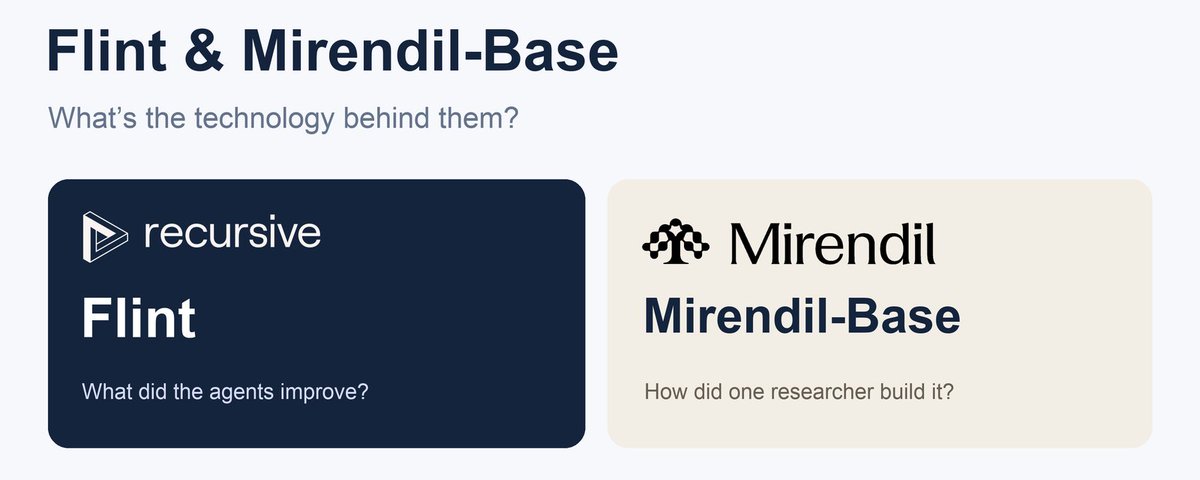
I broke down what the agents actually did in @Recursive_SI’s Flint and @mirendil’s Base model.
4
379
What did the agents actually do in Flint and Mirendil-Base?
@Recursive_SI’s Flint release describes specific architecture, quantization, and kernel changes found by Eureka. @mirendil reports that one researcher + agents pretrained a 100B–500B model in 3.5 months, with agents writing over 99% of the code.
I broke down the technical improvements, the research loops, and the remaining judgment bottleneck in this piece.
4
477
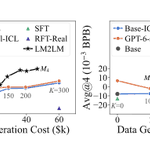
Another important RSI milestone today. @mirendil pretrained a 500B coding model from scratch in 3.5 months. We’re clearly entering the era of LMs helping train LMs. Curious how this might work in practice? In LM2LM we train models to propose better LM improvements, using a Research World Model with periodic real calibration. A 27B model outperforms GPT-6-sol (even with 300 real experimental records in context) at 33% lower data-generation cost.
Paper: arxiv.org/abs/2610.23344

We formally announced Mirendil less than 4 months ago. Today, I'm excited to share an important milestone for:
Pretraining at scale without a pretraining team.
Mirendil's mission is to solve Recursive Self-Improvement (RSI) and use it to democratize frontier AI development, ultimately accelerating science and technology. At Mirendil, when we think about RSI, we think holistically about the company as an intelligent entity that self-improves toward its goal. From that perspective, the most powerful notion of acceleration is reducing the time and resources (number of human experts, compute, and other costs) needed to achieve ambitious goals.
Given that pretraining is perhaps the most important yet most challenging part of frontier AI development, we decided to run an ambitious controlled experiment: Starting fully from scratch, can we significantly reduce the time, number of human experts, and compute resources needed to go all the way to successfully pretraining a strong coding model at scale?
Mirendil-Base is the result of this experiment. Our first pretrained model was built by one researcher in 3.5 months, with less than $10M in compute. This includes all the research and small-scale experiments it took to get there, as well as the final training run.
The recipe holds up as the models get bigger. For reference, Mirendil-Base is in the 100B-500B parameter range, Mirendil-Base-Large in the 500B-2T range, and Mirendil-Base-XL in the 2T-10T range.
We're beginning to see a world where a single researcher, empowered by AI, can take on work that once required an entire research organization. As these systems improve, the bottleneck shifts from the size of a team to the ambition and judgment of the people directing them. This has profound implications for who gets to build AI and, ultimately, who gets to push the frontiers of science and technology forward.
We’ll share independent evaluations, post-training benchmarks and API-access sooner than you think so stay tuned!

1
5
1,011
Recursive shipped Flint, built in under 4 months with their automated research system.
A concrete bottleneck that shows up in these loops: how do you cheaply evaluate the quality of the proposals the system generates?
We studied this in LM2LM — training models to propose better LM improvements with a calibrated Research World Model. 27B beats GPT-6-sol (with 300 real records) at 33% lower data cost.
Paper: arxiv.org/abs/2610.23344

Introducing Flint, @Recursive_SI’s first model: a fast local coding model built with our automated research system, the Eureka Machine.
• Best-in-class fast local coding
• Up to 2x faster than comparable models: 125+ tokens/sec on a MacBook Pro, 150+ on RTX Spark
• Built from scratch in under 4 months
Private, unmetered intelligence on your own machine. Open weights available now on @huggingface, run it locally on your favorite framework or try it for free on @opencode or @pidotdev.
9
726
Can we train language models to propose better ideas to improve LM—not just run them?
Introducing 𝐋𝐌𝟐𝐋𝐌: Language Models Learn to Improve Language Models. We train a 27B model with RL to propose improvements to language models. On held-out autoregressive and diffusion LM development tasks, it outperforms 𝐆𝐏𝐓-𝟔-𝐬𝐨𝐥 —at 33% lower data-generation cost. It also generalizes to a model family unseen during training.
𝐓𝐡𝐞 𝐛𝐨𝐭𝐭𝐥𝐞𝐧𝐞𝐜𝐤: evaluating every proposal with a real training run makes RL prohibitively expensive.
𝐎𝐮𝐫 𝐚𝐩𝐩𝐫𝐨𝐚𝐜𝐡: a Research World Model (RWM) predicts experimental gains as a cheap reward signal. We periodically execute the current policy’s top proposals and add the measured outcomes to the RWM’s context, keeping its predictions calibrated as the policy evolves.
This is a step toward cheaper, more reliable feedback loops for recursive self-improvement (RSI).

Also congrats to the authors of two papers @linminhua16 @Zevin_Liu @zijun_wang2002 @WengZhaoti39773 @binghe2727 @sammyershi @dakuowang @YisiSang Suhang Wang @cihangxie @yuyinzhou_cs Wei Jin Benoit Dumoulin Xiang Zhang
2
153
Related Paper (AI Research World Model): arxiv.org/abs/2610.12235
LM2LM Paper: arxiv.org/abs/2610.23344
𝐁𝐞𝐭𝐭𝐞𝐫 𝐩𝐫𝐨𝐩𝐨𝐬𝐚𝐥𝐬, 𝐥𝐨𝐰𝐞𝐫 𝐜𝐨𝐬𝐭. LM2LM-trained Qwen3.8-27B outperforms GPT-6-sol—even when GPT-6-sol receives 300 real experimental records in context—at 33% lower data-generation cost.
These gains are measured by actually running the proposed experiments.
Average improvement over 4 executed proposals from different models. (10⁻³ BPB; higher is better)

The widely cited 𝟏𝟔× pretraining compute gap has made diffusion LMs look prohibitively expensive to train from scratch. Our new work with @Guanghan__Wang and collaborators revisits that assumption across ~𝟏,𝟕𝟎𝟎 models. With exact-likelihood evaluation and modern block-diffusion architectures, we find a 𝟑–𝟖× gap at matched likelihood, depending on block size.
This is what LM research often looks like: running large numbers of experiments to establish a robust finding.
It raises a natural next question:
𝐜𝐚𝐧 𝐀𝐈 𝐥𝐞𝐚𝐫𝐧 𝐟𝐫𝐨𝐦 𝐞𝐱𝐩𝐞𝐫𝐢𝐦𝐞𝐧𝐭𝐚𝐥 𝐞𝐱𝐩𝐞𝐫𝐢𝐞𝐧𝐜𝐞 𝐭𝐨 𝐜𝐡𝐨𝐨𝐬𝐞 𝐛𝐞𝐭𝐭𝐞𝐫 𝐞𝐱𝐩𝐞𝐫𝐢𝐦𝐞𝐧𝐭𝐬—𝐚𝐧𝐝 𝐚𝐜𝐜𝐞𝐥𝐞𝐫𝐚𝐭𝐞 𝐢𝐭𝐬 𝐨𝐰𝐧 𝐫𝐞𝐬𝐞𝐚𝐫𝐜𝐡?
More on our RSI work soon.

Diffusion language models (DLMs) are often seen as inefficient to pretrain, said to need 16x the compute of autoregressive models to reach the same likelihood.
We revisited this with ~1,700 models. Under current DLM practice, the gap is 3-8x, not 16x.
guanghanwang.com/dlm-scaling

Paper: arxiv.org/abs/2610.17590Proj…
Website: guanghanwang.com/dlm-scaling
Code: github.com/amazon-science/dl…
1
96
Henry Lu retweeted

New Amazon paper shows that an LLM can act as a research world model, predicting whether a training change will help before anyone spends GPU time on it.
AI research agents can propose experiments far faster than teams can afford to run them. Choosing what gets GPU time means guessing outcomes in advance.
They used an LLM as a research world model that predicts an experiment's gain before it runs. They tested it on 2,653 real experiment records from 9 setups, from pretraining to inference.
Past records from the same setup raised average ranking correlation with actual results from 0.506 to 0.774 across 5 setups. On the OLMo3-100M setup, adding records at low reasoning effort scored 0.892, while max effort without records reached 0.648.
If you run research agents, log every experiment, including failures, and feed those records to whatever model picks the next run.
