

Research: DeFi | RWAs In Web3 Since 2017. Survived 3 cycles. Founder @tokastra | Advisor @DinariGlobal
Joined January 2023
- Tweets39.6K
- Following2.2K
- Followers41.3K
- Likes63.8K









Pinned Tweet
i believe we can all agree that tokenization has gone wild this year.
and the numbers back it up.
RWA have reached around $39.3B in distributed value
with over 5.4M asset holders.
a good example is solana.
@Solana's RWA market has grown from $751M to $4.37B in just a year.
but the growth goes way beyond tokenized stocks.
we're seeing new issuers, trading platforms, lending markets, liquidity solutions, etc.
imagine what this sector could look like when the next bull market comes around.
i decided to put together projects across the RWA ecosystem worth keeping an eye on.
---------------
➥ 𝐭𝐨𝐤𝐞𝐧𝐢𝐳𝐞𝐝 𝐬𝐭𝐨𝐜𝐤 𝐢𝐬𝐬𝐮𝐞𝐫𝐬 & 𝐚𝐬𝐬𝐞𝐭-𝐛𝐚𝐜𝐤𝐞𝐝 𝐞𝐪𝐮𝐢𝐭𝐢𝐞𝐬
➢ @Ondo
➢ @xStocksFi
➢ @binance
➢ @Securitize
➢ @SuperstateInc
➢ @DinariGlobal
➢ @RobinhoodApp
➢ @BackedFi
➢ @WisdomTreeOnchn
➢ @galaxyhq
➢ @Sharplink
➢ @Figure
➢ @eqxlabs
---------------
➥ 𝐬𝐲𝐧𝐭𝐡𝐞𝐭𝐢𝐜 𝐬𝐭𝐨𝐜𝐤𝐬 & 𝐞𝐪𝐮𝐢𝐭𝐲 𝐝𝐞𝐫𝐢𝐯𝐚𝐭𝐢𝐯𝐞𝐬
➢ @tradexyz
➢ @Ostium
➢ @extendedapp
➢ @edgeX_exchange
➢ @Lighter_xyz
➢ @Aster_DEX
➢ @OfficialApeXdex
➢ @HyperliquidX
➢ @variational_io
➢ @entropyIO
➢ @Kinetiq_xyz
➢ @BuoyFinance
---------------
➥ 𝐭𝐨𝐤𝐞𝐧𝐢𝐳𝐞𝐝 𝐬𝐭𝐨𝐜𝐤 𝐞𝐱𝐜𝐡𝐚𝐧𝐠𝐞𝐬 & 𝐭𝐫𝐚𝐝𝐢𝐧𝐠 𝐩𝐥𝐚𝐭𝐟𝐨𝐫𝐦𝐬
➢ @krakenfx
➢ @Bybit_Official
➢ @okx
➢ @bitget
➢ @coinbase
➢ @Backpack
➢ @Uniswap
➢ @MEXC
➢ @Gate
➢ @kucoincom
➢ @Gemini
➢ @cryptocom
➢ @treasures_io
➢ @anystock_xyz
➢ @Manci_rwa
---------------
➥ 𝐩𝐫𝐞-𝐢𝐩𝐨 𝐬𝐭𝐨𝐜𝐤𝐬 & 𝐩𝐫𝐢𝐯𝐚𝐭𝐞 𝐞𝐪𝐮𝐢𝐭𝐲 𝐭𝐨𝐤𝐞𝐧𝐢𝐳𝐚𝐭𝐢𝐨𝐧
➢ @PreStocks
➢ @jarsyinc
➢ @joinrepublic
➢ @ventuals
➢ @msxcom
➢ @pipo_stocks
➢ @tZERO
➢ @MetaDAOProject
More in the comments👇

.@ethereum is making post-quantum security its highest priority.
the PQAI initiative targets an overhaul of ethereum's cryptography by 2029.
the goal is to protect it against future threats from quantum computing.
and also the increasingly rampant AI systems.
the transition will move critical parts of Ethereum away from elliptic-curve cryptography toward hash-based signatures.
this has implications across the entire ecosystem.
> validators will need quantum-resistant signature mechanisms.
> wallets will require migration paths for existing accounts.
> blob commitments will need new cryptographic foundations.
these changes extend beyond Ethereum's base layer.
rollups, staking providers, DeFi protocols and wallet infra will all get new security requirements.
one thing to note about hash-based signatures is the efficiency challenges
which is particularly around signature size and verification costs.
research into leanVM and signature aggregation aims to address these limitations.
the December 2028 target and 2029 internal deadline give developers a timeframe to work toward this transition.
ethereum is preparing its security infra for the next generation of computing threats.

Hercules | DeFi retweeted
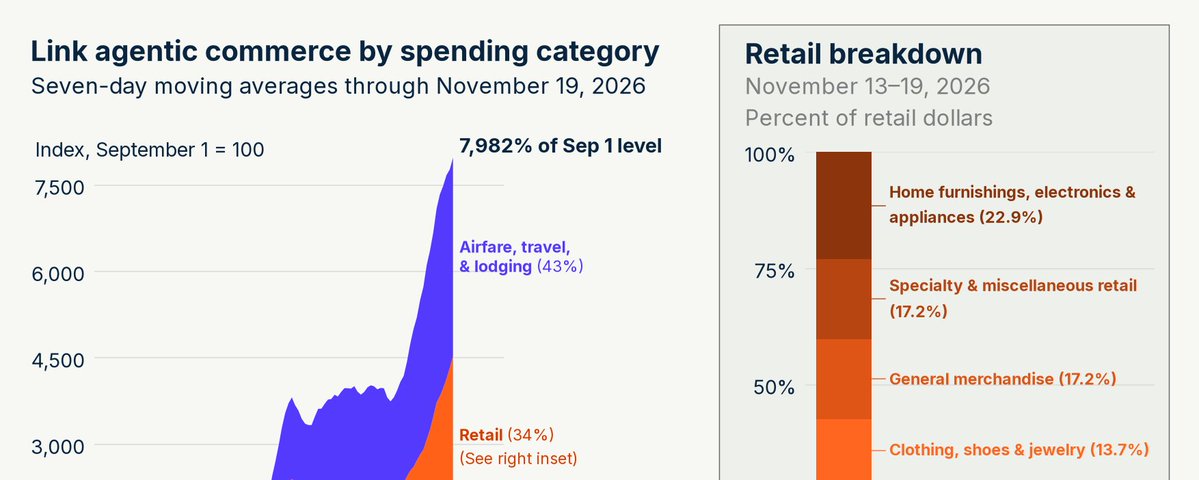
the agentic commerce boom


We're releasing new @Stripe agentic commerce data today, telling the story so far as we look ahead to the kickoff of the holiday season next week.
this is honestly a little scary.
imagine having your money deposited in Aave and suddenly being unable to access the app, without even knowing what you did wrong.
i understand the need for compliance, but users deserve to know why they're blocked and how to appeal.
@aave @trmlabs, What happens when an innocent wallet gets flagged?
defi shouldn't put users in the same position we're trying to escape from traditional finance.


Crypto, AI, robotics… there’s never been a better time to build.
but where do you start?
Peter Thiel has some answers.

the agentic commerce boom
We're releasing new @Stripe agentic commerce data today, telling the story so far as we look ahead to the kickoff of the holiday season next week.
Hercules | DeFi retweeted
BTC plunged near $55K.
yet DeFi TVL continues to climb.
The opportunities right now are honestly hard to ignore.👇
----------------------
➢ @SuiNetwork launched Hashi on mainnet, bringing Bitcoin-backed lending to Sui, with @0xfluid enabling users to borrow USDC against hBTC and @upshift_fi launching BTC and USDC vaults.
----------------------
➢ @1inch integrated @HyperliquidX perps into its dApp and wallet, allowing users to fund positions with existing tokens converted into USDC without leaving 1inch.
----------------------
➢ @Morpho expanded its partnership with @coinbase, bringing Coinbase Borrow to New York and completing its rollout across all 50 US states.
----------------------
➢ @aave launched its Android mobile application while its V4 deployment on @base recorded $7.7M in stock-backed loans.
----------------------
𝐘𝐢𝐞𝐥𝐝 𝐅𝐚𝐫𝐦𝐢𝐧𝐠 𝐏𝐨𝐨𝐥𝐬
➢ sd-PYcrvUSD-vault
DApp: @StakeDAOHQ
Chain: @ethereum
Supply APY: 11.60% (30d avg)
Category: Yield Vaults
TVL: $16.76M
➢ USDS-1
DApp: @yearnfi
Chain: @ethereum
Supply APY: 10.91%
Category: Yield Vaults
TVL: $16.0M
➢ USDC
DApp: @HyperliquidX
Chain: @HyperliquidX
Supply APY: 10.69% (30d avg)
Category: Derivatives
TVL: $151.75M
➢ USDC
DApp: @NawaFinance
Chain: @ZIGFinance
Supply APY: 9.33% (30d avg)
Category: RWA
TVL: $3.4M
➢ zSMB
DApp: @centrifuge
Chain: @pharos_network
Supply APY: 8.57% (30d avg)
Category: RWA
TVL: $1.01M
➢ fUSDC
DApp: @0xfluid
Chain: @ethereum
Supply APY: 7.17% (30d avg)
Category: Lending
TVL: $146.24M
➢ ZIG
DApp: @Valdora_finance
Chain: @ZIGFinance
Supply APY: 5.38% (30d avg)
Category: Liquid Staking
TVL: $4.91M
➢ BTC
DApp: @Chainflip
Chain: Chainflip
Supply APY: 4.50%
Category: Liquidity Provision
TVL: $3.97M
➢ aInkWlUSDT
DApp: @tydrohq
Chain: @inkonchain
Supply APY: 3.94% (30d avg)
Category: Lending
TVL: $212.79M
Which did I miss? Lemme know in the comments 👇
Hercules | DeFi retweeted
Is crypto actually dead, or has CT just lost faith?
> stablecoin transfers are approaching 6B quarterly, with USDC now matching USDT in several quarters.
> tokenized equity supply has climbed to $3.75B, with bStocks emerging as a major contributor alongside @Ondo and @xStocksFi.
> finance apps now generate 43% of crypto project revenue, that mark a significant shift away from onchain-led revenue.
> DEX spot volume has reached 25.5% of CEX volume, putting DEXs at roughly a quarter of CEXs trading activity.
Hercules | DeFi retweeted
only 5-month-old and @RobinhoodCrypto has processed over $132B in DEX volume.
the growth makes sense when you look at what's happening across it.
> $989M in TVL across the chain.
> $132.17B in cumulative DEX trading volume.
> $989M in stablecoin market cap.
> over $1B in daily perps trading volume.
➥ 𝐃𝐄𝐗𝐬
Robinhood opened its public testnet in February.
testnet had processed millions of transactions before mainnet in July.
mainnet brought another wave of liquidity and trading activity.
@Uniswap expanded its presence through v4 and programmable hooks.
hooked pools have generated $25.72B in volume across 32,800+ initialized hooks.
Robinhood now leads every chain in hooked volume.
the VolatilePair hook introduced dynamic fees for the ETH/USDG pool.
@PancakeFi rolled out The Flip, giving LPs 88% of swap fees on v3 and Infinity pools.
@Uniswap, @aeroxyz and @metricxyz are among its leading DEXs.
➥ 𝐑𝐖𝐀 𝐚𝐧𝐝 𝐭𝐨𝐤𝐞𝐧𝐢𝐳𝐞𝐝 𝐚𝐬𝐬𝐞𝐭𝐬
RWA is still one of the most important parts of Robinhood's direction.
it introduced its new stock tokens alongside the mainnet launch.
this opened up new opportunities for devs to build around tokenized equities.
@Uniswap, @ArrowFinanceio and other protocols began integrating these assets into trading and lending products.
we also saw some events that even added to the growth.
> @TheIndexFi introduced a mechanism that uses trading fees to purchase tokenized stocks.
this gave holders more exposure to stocks like NVIDIA, TSLA etc.
> @ArrowFinanceio introduced borrowing markets backed by tokenized stocks and crypto.
> @vimenprotocol also came with tokenized baskets, giving users a way to gain exposure to groups of Stock Tokens.
> @arcus_xyz expanded the trading side with perps for tokenized equities and other assets.
RWA adoption has continued growing on robinhood.
➥ 𝐃𝐞𝐅𝐢
DeFi on robinhood has grown through new financial products and infra.
the v4 hooks was brought by @uniswap and it has generated over $25B in volume
> @Morpho also joined the lending infra behind the robinhood earn.
the flip was launched by @PancakeFi and this infra is giving LPs 88% of swap fees.
> @RamsesExchange brought concentrated liquidity and ve(3,3) infrastructure.
> @0xT3tris introduced managed yield vaults operated by independent managers.
also, robinhood chain runs on @arbitrum orbit stacks and the collab has been good.
@arbitrum just launched the second cohort of its mentorship program with robinhood.
it is backing early-stage teams building on arbitrum one and robinhood chain.
this is another measure to see more developments.
➥ 𝐌𝐞𝐦𝐞𝐜𝐨𝐢𝐧𝐬
we all could say robinhood brought huge volume on memes this year.
it was really one of the big surprises from the launch.
there were different memes that did billions in volume.
there was $CASHCAT, $PONS and many more.
$CASHCAT led the first wave, reaching over $200M in market cap within just over a week.
@ponsdotfamily emerged as one of the leading launchpads and its meme almost touched $1B market cap.
we saw @longdotxyz introduced a different approach by pairing memecoins directly with tokenized stocks.
it opened up markets such as Artificial Inu ($AI), which trades against tokenized NVIDIA.
a report from CoinGecko said memecoins accounted for 79.2% of Robinhood Chain's DEX volume on July 27.
that's how huge memes have been on robinhood.
Robinhood so far this year
it has had a remarkable first year, considering how old it is.
the growth across DEXs, perps, memes and tokenized equities shows how quickly its ecosystem has developed.
there is still so much we will see from robinhood.
especially as more tradFi assets are finding their way into the markets.
looking forward to seeing what the ecosystem brings in the coming year.


what excites me about $ANT going live as a dShare is how quickly tokenized equities are catching up with traditional markets.
Anthropic lists on Nasdaq, and eligible investors can access its tokenized shares from day one.
no months of waiting for onchain integration.
with 1:1 backing, redemption rights, and corporate actions, @DinariGlobal is bringing the actual stock ownership experience onchain.
i think this is where tokenized stocks start becoming a serious alternative to traditional brokerage.

$ANT is live.
Anthropic, the company behind Claude, just opened on Nasdaq. From that first trade, eligible investors in the US and 90+ countries can hold it as a Dinari dShare™.
Day one, onchain, including the US.
33
64
6,771
only 5-month-old and @RobinhoodCrypto has processed over $132B in DEX volume.
the growth makes sense when you look at what's happening across it.
> $989M in TVL across the chain.
> $132.17B in cumulative DEX trading volume.
> $989M in stablecoin market cap.
> over $1B in daily perps trading volume.
➥ 𝐃𝐄𝐗𝐬
Robinhood opened its public testnet in February.
testnet had processed millions of transactions before mainnet in July.
mainnet brought another wave of liquidity and trading activity.
@Uniswap expanded its presence through v4 and programmable hooks.
hooked pools have generated $25.72B in volume across 32,800+ initialized hooks.
Robinhood now leads every chain in hooked volume.
the VolatilePair hook introduced dynamic fees for the ETH/USDG pool.
@PancakeFi rolled out The Flip, giving LPs 88% of swap fees on v3 and Infinity pools.
@Uniswap, @aeroxyz and @metricxyz are among its leading DEXs.
➥ 𝐑𝐖𝐀 𝐚𝐧𝐝 𝐭𝐨𝐤𝐞𝐧𝐢𝐳𝐞𝐝 𝐚𝐬𝐬𝐞𝐭𝐬
RWA is still one of the most important parts of Robinhood's direction.
it introduced its new stock tokens alongside the mainnet launch.
this opened up new opportunities for devs to build around tokenized equities.
@Uniswap, @ArrowFinanceio and other protocols began integrating these assets into trading and lending products.
we also saw some events that even added to the growth.
> @TheIndexFi introduced a mechanism that uses trading fees to purchase tokenized stocks.
this gave holders more exposure to stocks like NVIDIA, TSLA etc.
> @ArrowFinanceio introduced borrowing markets backed by tokenized stocks and crypto.
> @vimenprotocol also came with tokenized baskets, giving users a way to gain exposure to groups of Stock Tokens.
> @arcus_xyz expanded the trading side with perps for tokenized equities and other assets.
RWA adoption has continued growing on robinhood.
➥ 𝐃𝐞𝐅𝐢
DeFi on robinhood has grown through new financial products and infra.
the v4 hooks was brought by @uniswap and it has generated over $25B in volume
> @Morpho also joined the lending infra behind the robinhood earn.
the flip was launched by @PancakeFi and this infra is giving LPs 88% of swap fees.
> @RamsesExchange brought concentrated liquidity and ve(3,3) infrastructure.
> @0xT3tris introduced managed yield vaults operated by independent managers.
also, robinhood chain runs on @arbitrum orbit stacks and the collab has been good.
@arbitrum just launched the second cohort of its mentorship program with robinhood.
it is backing early-stage teams building on arbitrum one and robinhood chain.
this is another measure to see more developments.
➥ 𝐌𝐞𝐦𝐞𝐜𝐨𝐢𝐧𝐬
we all could say robinhood brought huge volume on memes this year.
it was really one of the big surprises from the launch.
there were different memes that did billions in volume.
there was $CASHCAT, $PONS and many more.
$CASHCAT led the first wave, reaching over $200M in market cap within just over a week.
@ponsdotfamily emerged as one of the leading launchpads and its meme almost touched $1B market cap.
we saw @longdotxyz introduced a different approach by pairing memecoins directly with tokenized stocks.
it opened up markets such as Artificial Inu ($AI), which trades against tokenized NVIDIA.
a report from CoinGecko said memecoins accounted for 79.2% of Robinhood Chain's DEX volume on July 27.
that's how huge memes have been on robinhood.
Robinhood so far this year
it has had a remarkable first year, considering how old it is.
the growth across DEXs, perps, memes and tokenized equities shows how quickly its ecosystem has developed.
there is still so much we will see from robinhood.
especially as more tradFi assets are finding their way into the markets.
looking forward to seeing what the ecosystem brings in the coming year.


stablecoins are quietly becoming the financial backbone of the AI economy.
and i think agentic payments could become one of their biggest use cases.
we've spent years talking about stablecoins for transfers, trading, and cross-border payments.
but now, there's a completely different type of user emerging.
AI agents.
they're starting to purchase services, access APIs, and pay for resources without human involvement in every transaction.
and x402 is playing an important role here.
some numbers that caught my attention:
> 196M transactions processed across 12 chains.
> 5.1M transactions and $274K in volume during October.
> 68.3M agent payment transactions in Q3.
what interests me is how naturally stablecoins fit into this economy.
agents need payments that are fast, programmable, inexpensive, and available around the clock.
and stablecoins already offer much of this.
we're also seeing some interesting developments from major players.
1. @brave brings x402 to search
Brave introduced x402 payments for its Search API.
AI agents can now pay for individual searches using USDC on @base.
no subscriptions. just pay for what you use.
2. @coinbase expands x402 to @monad
Coinbase introduced gasless agent payments with transaction screening.
another step toward making autonomous payments easier.
3. @Mastercard enters agentic payments
Mastercard opened early access to Agent Pay for Machines.
this followed payment pilots involving @Coinbase, @base, @Cloudflare, and @BVNKFinance.
4. @circle simplifies agent payments
Circle introduced Managed Agentic Payments.
businesses can accept USDC payments from AI agents and receive fiat payouts across 50+ currencies.
i find this particularly interesting because businesses don't necessarily need to handle crypto themselves.
5. agent marketplaces are growing
Circle's Agent Marketplace has reached 113 services and approximately 2,650 endpoints.
this gives us an early glimpse of how agents could discover, purchase, and use services independently.
looking at all these developments, i think we're witnessing something much bigger than another stablecoin use case.
until now, most digital payments have involved a human making the decision.
but imagine millions of agents continuously paying for searches, data, compute, and other services.
even tiny payments could add up to significant activity at scale.
of course, we're still early, and transaction counts alone don't tell us how much real economic demand exists.
but what excites me is that stablecoins are finding applications in an entirely new economy.
i've always believed stablecoin adoption would extend far beyond crypto trading.
and the rise of AI agents is making that possibility even more interesting.
the agent economy is still taking shape.
but stablecoins could end up being one of the most important pieces of its financial infrastructure.


the more i research tokenized stocks, the more i realize we've been focusing on only half the story.
liquidity, 24/7 trading, and accessibility are great.
but what about actual shareholder rights?
that's why @DinariGlobal's latest move caught my attention.
dinari just integrated dShares™ with @Broadridge, bringing shareholder voting to eligible tokenized stockholders through wall street's existing infrastructure.
think about what's coming together:
✦ 1:1 backed equities
✦ institutional custody
✦ dividends and corporate actions
✦ now, shareholder voting
to me, this is bigger than another integration.
it's a sign that wall street's own infrastructure is extending onchain.
and that's how tokenized equities move closer to mainstream adoption.
Owning a stock has always meant three things. Getting paid, adjusting for corporate actions, and having a say.
dShares™ now carry all three. Eligible holders cast real proxy votes through @Broadridge, counted alongside traditional shareholders.
Do more with your stocks.

after hearing feedback from users, i knew adding trading feature to @tokastra was an important next step.
once a user found a suitable pool, they can select it and get redirected to the corresponding DEX immediately.
i wanted users to have a place where they could explore options before making their picks.
that's why i aggregated all of this on the same page.
users can compare different issuers based on:
> the price
> the liquidity
> supported chains
> the available pools.
i've also made multiple liquidity pools across different DEXs.
because liquidity is often fragmented across different venues.
and each DEX or pool can offer different pricing and available liquidity.
bringing them together gives users more flexibility and better visibility into the market.
Tokastra goal is to make comparing and accessing these markets as easy as possible.
Hercules | DeFi retweeted
selling stocks isn't the only way to access liquidity.
tokenized equities are opening new opportunities across DeFi.
$300M in tokenized stocks has entered DeFi and grown 24x in a year.
the growth is opening another chapter for tokenized equities.
> tokenized stock deposits now represent 6.3% of market cap.
> that figure was only 2.4% one year ago.
> investors are beginning to use stocks as collateral.
the next phase is even going to be interesting.
➥ several protocols are expanding these opportunities.
@aave launched its Coinbase Equities Hub on Base.
the September launch introduced 7 tokenized stocks as collateral.
these include Apple, Amazon, Nvidia and Microsoft shares.
eligible holders can now borrow USDC against them.
@chainlink provides the pricing feeds for these collateral markets.
@Morpho has also expanded its tokenized stock lending markets.
@RobinhoodApp Stock Tokens became available as collateral on Morpho.
eligible holders can borrow stablecoins against supported stock tokens.
the integration initially brought assets like NVDA and GOOGL.
➥ yield strategies are adding another growth opportunity.
@krakenfx launched its xStocks Vaults through @Kamino.
the September integration supports SPYx, QQQx and NVDAx.
@veda_labs provides vault infra for these yield strategies.
@SentoraHQ handles strategy curation and risk management.
the vaults use tokenized equities as lending collateral.
borrowed stablecoins are deployed into additional yield strategies.
rewards are converted back into the deposited equities.
this allows holders to pursue additional stock-denominated yield.
➥ the growth potential across these markets looks really good.
tokenized equities are becoming increasingly useful within DeFi.
> holders can borrow without selling shares.
> lending markets are attracting more equity collateral.
> yield strategies are encouraging additional equity deposits.
i believe this is another important growth opportunity for the ecosystem.


Hercules | DeFi retweeted
do you even know if your DeFi yield depends on a weak asset?
a vault could hold an A-rated protocol while its underlying asset carries a BB rating.
that difference could change the risk rating of the entire strategy.
this is why you need to understand how these ratings work.
and how @Shift_DeFi is making use of it well
➥ 𝐓𝐡𝐞 𝐭𝐡𝐫𝐞𝐞 𝐫𝐢𝐬𝐤 𝐥𝐚𝐲𝐞𝐫𝐬.
a DeFi strategy can depend on multiple assets, protocols, and networks.
each layer introduces different risks that can affect deposited capital.
@Shift_DeFi separates these factors into 3 blocks.
> asset risk evaluates the tokens used by a strategy.
> protocol risk examines the infra managing those assets.
> network risk considers the underlying blockchain infra.
assets and protocols receive individual ratings from AAA to B.
each component is assessed independently.
but it is very important to note that the weakest one determines the overall strategy rating.
an A-rated protocol holding a BB-rated token gets capped at BB.
leverage, liquidation risk, lock-ups, etc., also introduce additional strategy-level risks.
all of this makes weaknesses across layers easier to identify.
➥ 𝐇𝐨𝐰 𝐒𝐡𝐢𝐟𝐭 𝐦𝐨𝐧𝐢𝐭𝐨𝐫𝐬 𝐭𝐡𝐞 𝐫𝐢𝐬𝐤.
assigning ratings is only one part of managing DeFi strategies.
market conditions change, liquidity shifts, and collateral health deteriorates.
Shift monitors its active strategies with every new blockchain block.
the system tracks several important risk indicators.
> liquidity changes across the underlying markets.
> collateral health and stablecoin peg deviations.
> governance proposals and contract upgrades.
> oracle movements and price feed changes.
predefined thresholds determine when these conditions require attention.
triggers can alert the risk team to rebalance positions or exit strategies.
having a system like this will help many of us, really.
➥ 𝐓𝐡𝐞 𝐋𝐢𝐪𝐮𝐢𝐝 𝐔𝐒𝐃𝐂 𝐭𝐞𝐬𝐭.
on Oct 1st, a practical example of this monitoring system was shown.
liquidity dropped sharply across several Morpho markets used by Liquid USDC.
Shift's risk system detected the deterioration and triggered exits from affected positions.
this shows how quickly conditions can change across lending markets.
it is also more reason why monitoring must continue after capital enters a strategy.
because your position's risk can change when it becomes operational.
➥ 𝐓𝐡𝐞 𝐛𝐢𝐠𝐠𝐞𝐫 𝐃𝐞𝐅𝐢 𝐩𝐢𝐜𝐭𝐮𝐫𝐞.
better risk management can make a real difference across DeFi.
lenders can better understand the risks behind vaults holding their capital.
protocols can identify liquidity and collateral problems before they escalate.
vault managers can react faster when underlying markets become unstable.
investors can compare strategies beyond their advertised APY.
this can reduce avoidable exposure and improve how capital moves across the ecosystem.
stronger risk management could make DeFi more attractive to a wider range of participants.
🤝 Paid partnership

Microsoft Outlook
US Aviation
now the US Banks
why I feel this is orchestrated ?
instead of some random attacks.
feels organized by someone or some group.

#BREAKING: Chase, Bank of America, Wells Fargo and U.S. Bank hit by nationwide outage, users report.
4
24
1,563
do you even know if your DeFi yield depends on a weak asset?
a vault could hold an A-rated protocol while its underlying asset carries a BB rating.
that difference could change the risk rating of the entire strategy.
this is why you need to understand how these ratings work.
and how @Shift_DeFi is making use of it well
➥ 𝐓𝐡𝐞 𝐭𝐡𝐫𝐞𝐞 𝐫𝐢𝐬𝐤 𝐥𝐚𝐲𝐞𝐫𝐬.
a DeFi strategy can depend on multiple assets, protocols, and networks.
each layer introduces different risks that can affect deposited capital.
@Shift_DeFi separates these factors into 3 blocks.
> asset risk evaluates the tokens used by a strategy.
> protocol risk examines the infra managing those assets.
> network risk considers the underlying blockchain infra.
assets and protocols receive individual ratings from AAA to B.
each component is assessed independently.
but it is very important to note that the weakest one determines the overall strategy rating.
an A-rated protocol holding a BB-rated token gets capped at BB.
leverage, liquidation risk, lock-ups, etc., also introduce additional strategy-level risks.
all of this makes weaknesses across layers easier to identify.
➥ 𝐇𝐨𝐰 𝐒𝐡𝐢𝐟𝐭 𝐦𝐨𝐧𝐢𝐭𝐨𝐫𝐬 𝐭𝐡𝐞 𝐫𝐢𝐬𝐤.
assigning ratings is only one part of managing DeFi strategies.
market conditions change, liquidity shifts, and collateral health deteriorates.
Shift monitors its active strategies with every new blockchain block.
the system tracks several important risk indicators.
> liquidity changes across the underlying markets.
> collateral health and stablecoin peg deviations.
> governance proposals and contract upgrades.
> oracle movements and price feed changes.
predefined thresholds determine when these conditions require attention.
triggers can alert the risk team to rebalance positions or exit strategies.
having a system like this will help many of us, really.
➥ 𝐓𝐡𝐞 𝐋𝐢𝐪𝐮𝐢𝐝 𝐔𝐒𝐃𝐂 𝐭𝐞𝐬𝐭.
on Oct 1st, a practical example of this monitoring system was shown.
liquidity dropped sharply across several Morpho markets used by Liquid USDC.
Shift's risk system detected the deterioration and triggered exits from affected positions.
this shows how quickly conditions can change across lending markets.
it is also more reason why monitoring must continue after capital enters a strategy.
because your position's risk can change when it becomes operational.
➥ 𝐓𝐡𝐞 𝐛𝐢𝐠𝐠𝐞𝐫 𝐃𝐞𝐅𝐢 𝐩𝐢𝐜𝐭𝐮𝐫𝐞.
better risk management can make a real difference across DeFi.
lenders can better understand the risks behind vaults holding their capital.
protocols can identify liquidity and collateral problems before they escalate.
vault managers can react faster when underlying markets become unstable.
investors can compare strategies beyond their advertised APY.
this can reduce avoidable exposure and improve how capital moves across the ecosystem.
stronger risk management could make DeFi more attractive to a wider range of participants.
🤝 Paid partnership