

Independent archaeology and ancient history covering discoveries, research, and lost civilizations.
Joined August 2011
- Tweets40.9K
- Following3.2K
- Followers85.5K
- Likes112K




Pinned Tweet
New on Ancient Content: “The Room With No Door”
A sealed tomb under a man-made mountain at Gordion, and the king inside it is not the one everyone thinks.
Limyra was built on a lake that had just dried out. Cores drilled through the Lycian city show lake and lagoon sediments underneath the middle and eastern districts, silting up in the mid first millennium BC, which is exactly when people started building here.
Centuries later the water came back, rising through karst springs from the mountain to the north while the whole plain sank. The city is lying in its own lake bed again.
Around 1750 BC a Babylonian schoolboy named Iddin-Sin sent his mother Zinu a letter.
The other young gentlemen’s clothes get better every year, he writes, while she makes his worse. Wool is consumed in their house like bread.
The son of his father’s underling is walking around in two new garments while she worries about his single one. Then the last line.
She gave birth to him, the other boy’s mother only adopted hers, and yet that mother loves her son while his does not love him.

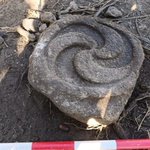
A Stone With Two Faces Found in Galicia: Triskelion on One Side, Petroglyph on the Other
Archaeologists at the Castro do Pico da Bandeira in Salcidos, A Guarda (Galicia, Spain) have found a granite stone with a finely carved triskelion on one face and a rougher petroglyph on the other.
It lay inside a large circular house occupied between the 1st century BC and the 1st century AD, among fragments of Roman amphorae. The triskelion stayed almost fresh because that face fell toward the ground. Archaeologist Benito Vilas says no other stone in Galicia is known to carry both symbols on opposite sides.
Were they carved together, or did the petroglyph come first and the stone get reused later? For now the answer is open, and more than half of the house is still unexcavated.


The Sahara’s Antennae Tomb at Lawash el Telli Finally Has a Date
On a gravel plain at Lawash el Telli in northern Western Sahara, a stone tomb stretches 54.5 meters (179 feet) across the desert. Two rows of slabs, called antennae, run east from a central mound like the arms of a V that never closes.
Archaeologists have now excavated it and dated the burial to between 4,100 and 4,400 years ago, around the time the Akkadian Empire rose in Mesopotamia. A young adult lay on the bare ground beneath the stones with four ostrich eggshell beads. The bones held too little collagen for standard dating, so the team dated the mineral part of the bone instead.
These are the first radiocarbon dates ever obtained for an antennae tumulus in the Atlantic Sahara. Why communities that once buried their dead underground began raising stone monuments pointing east remains unanswered.

ALT Aerial view of the excavated monument (tumulus, antennae and satellite stone mound)
This ram has moved twice in three thousand years. It was carved around 1356 BC for the avenue leading to Amenhotep III’s temple at Soleb in Nubia, one of twelve rams flanked by falcons and lions.
About six hundred years later a later king had it shipped north to Gebel Barkal. In 1844 Lepsius chose it as the best of the rams still standing there and sent it on to Berlin, where it stands today.

Troy’s first musical instrument has been found. A 2,800-year-old bone flute from the Archaic Period, the only instrument in 160+ years of excavations at Troy. Alongside it, a 4,500-year-old human-shaped idol head from the Troy II city gate.

The Assyrians left their own description of what these figures were for. One king writes that creatures like this turn back anyone arriving with bad intent, guard the steps and keep the king’s path secure.
Sargon II simply says he set animals of white stone at his gates. The threshold was designed to be a test.
What do you think a visitor felt first at a gate like that?
The face was eaten. Insects worked through the wood of this Old Kingdom head from Dendera for four thousand years and left the surface you see.
What they could not touch was the eyes, made of copper, hippopotamus ivory and dark stone, which is why a ruined face still looks straight back at you.
The head is about 15 cm high and is now in the Penn Museum.

This pillar came out of the ground beneath the courtyard in front of the seventh pylon at Karnak.
It was good enough that the excavators kept digging in the hope of finding more like it. What they hit instead was the Karnak Cachette, hundreds of stone statues and thousands of bronzes packed into the earth and pulled out of groundwater over the following years.
What else do you think is sitting under the courtyards at Karnak?
Look at who is crowning him. On one side Horus, on the other Seth, the god Egypt later turned into its own devil, both laying a hand on the same crown.
The reading is a double coronation. Horus gives Ramesses III the Nile valley, Seth gives him the deserts and the lands beyond the border, and the king takes both from the hands of two gods who spent most of Egyptian mythology at war with each other.
A 4.8 cm face looks out from the lid of a 1,900-year-old clay sarcophagus found near ancient Attouda in Denizli, Türkiye. It is Silenus, the aged teacher of Dionysus.
His bulging eyes and deep-cut grin may have guarded the dead against harmful forces. Beside him is a carved Greek Beta, probably a workshop mark. No other Anatolian terracotta sarcophagus is known with this relief.

ALT A 4.8 cm face looks out from the lid of a 1,900-year-old clay sarcophagus found near ancient Attouda in Denizli, Türkiye
Look at what the Eros is holding. A mirror, angled so the seated woman sees her own face while an attendant arranges her hair.
This is the closing section of the frieze in the Villa of the Mysteries at Pompeii, painted around 60 BC, and whatever the ritual is, the painter chose to end it with a woman looking at herself.
A tiny stone fish, under 5 cm long, was laid in a grave on the shore of Lake Baikal about 7,600 years ago.
Archaeologists found it in Burial 3 at Khuzhir-Nuge IX, in the Olkhon area of Siberia. The deceased lay on the right side with flexed legs, the grave was sprinkled with red ochre, and a flat ring of stones was set over it. Beside the body were a large bone tool and a set of stone tools.
The fish has a carved ring groove around its middle, most likely for tying it to a fishing line. The researchers read it as a lure. It appears to be the earliest known example in the region, 150 to 200 years older than similar stone fish dated to about 7,400 years ago.
Whether it also carried meaning for the person buried with it is still unknown. For the Kitoi hunters and fishers of Baikal, the lake was the center of life, and this small fish went with someone into the grave.

Navarra has its first Neanderthal fossils, and they come with DNA.
Six hand bones from Abauntz Cave in Spain’s Ultzama valley belonged to an adult man who lived around 46,000 years ago. Genetic tests confirmed he was a Neanderthal male, and carnivores gnawed some of the bones after his death.
The same cave holds an engraved stone map carved by Magdalenian hunters 13,660 years ago. About 32,000 years separate the two.

ALT Hand bones of the Abauntz Neanderthal, credit Maria D. Guillén / IPHES-CERCA
This figure was made to hang. The bell-shaped body was thrown on a potter’s wheel and flattened while the clay was still soft, the head and arms were modelled by hand, and holes were pierced through the sides so the legs could be strung on cords. There is a hole through the head as well.
It comes from Boeotia in central Greece, probably from Thebes, and was made between 720 and 700 BC.
Suspended from a line, the legs swing freely. That is the whole point of the design, and the thing a photograph never shows.

A 2,500 year old bronze object has archaeologists in Bulgaria stumped.
Inside a temple at the Thracian settlement near Vasil Levski, Karlovo, the team found a ring carrying four hooks. Each hook ends in a barb shaped like a fishhook, with small seats at the base. Director Kostadin Kisyov says it is the first mechanism of its kind known from this era.
Two readings are on the table. One is a hanging holder for oil lamps, though no chain has turned up. The other is a heavy fishing rig, and its size suggests the sea or a major river such as the Maritsa or Danube.
The setting adds to the puzzle. This is the “Golden City of the Thracians,” a 6th to 5th century BC site that may be the first capital of the Odrysian Kingdom, possibly the seat of Teres I. Its temple roofs carried glossy tiles finished with a golden mineral pigment, and imported amphorae from Chios, Samos and Thasos show how far its trade reached.
The city was abandoned suddenly yet methodically, with no sign of war or fire.
Lamp holder or fishing gear? Which reading do you trust?
Video: btv Bulgaria
Subtitles & Translation: Ancient Content
Behind the Sanam Temple at Napata in Sudan, archaeologists have found a faience workshop from about 650 BCE. It had three firing pits, two mudbrick basins and hundreds of beads.
A clay mould from inside the temple matches a green faience shabti from the workshop, and the same type of figurine turns up in the royal tombs at Nuri.
With no limestone in Nubia, the workers crushed Red Sea shells for lime. The paper by Lemos and Howley is in Antiquity.

ALT Faience Workshop Found Behind Kushite Temple
A painted bust from the eastern cemetery of Amphipolis still carries its color after more than 2,300 years.
Dated to the end of the 4th century BC, it was buried in a woman’s grave with sixteen other busts. Her robe, double necklace, the flower in her right hand, her hair and her lips are all painted red. Fine touches of black around the eyes give her a look of restrained sadness, set against a white coating that reflects the beauty ideals of the time.
Busts like this turn up in homes, sanctuaries and tombs as tributes to deities of fertility and the renewal of nature.
Today she is one of the highlights of the Archaeological Museum of Amphipolis in Northern Greece.

Psusennes I was buried inside four containers.
The outermost was a pink granite sarcophagus taken from the tomb of Merenptah, son of Ramesses II, who had been buried in the Valley of the Kings two centuries earlier. Inside that sat a black granite coffin, inside that a coffin of solid silver, and inside that the king with this gold mask over his face, gold caps on every finger and toe, and gold sandals on his feet.