

Gold • Silver • Macroeconomics | In Gold We Trust Report Data-dense charts & long-form threads on precious metals, mining & the monetary system.
Liechtenstein • Austria
Joined June 2017
- Tweets12.1K
- Following2.8K
- Followers38.7K
- Likes11.7K





Pinned Tweet
Fusion gold - a startup says it can make gold from mercury inside a fusion reactor. Here's what it means for the gold you hold.
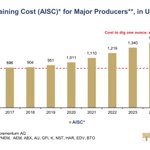
Digging one ounce already cost the big miners a record USD 1,578 in 2025. Making one in a reactor starts with a power plant nobody has built yet.
That bill would be ASTRONOMICAL... If gold were produced this way, every new ounce would cost more, not less!
More on how gold's costs shape its price below.


Last month, we demonstrated high-rate alchemy: turning mercury into real, stable gold, beating CERN’s record by a factor of 10.
Last week, we enriched isotopes in the world’s most powerful plasma centrifuge, beating the Soviet record that stood for 40 years.
Now, we’re building a fusion reactor in San Francisco to achieve record power density.
In Gold We Trust retweeted

Much agreed. One day Canada may again realize that #gold IS a "critical mineral” a “strategic metal" and add it back to the Bank of Canada's Tier 1 reserve asset mix => #Goldrush for the miners!

🇨🇦 Canada - a G7 nation, one of the world's five largest gold producers, and 0 tonnes of gold in its reserves.
@RonStoeferle at @DenGoldGroup's Mining Forum:
"It's a little bit like the winemaker who harvests the finest grapes and drinks cheap booze himself."
In Gold We Trust retweeted
🇨🇦 Canada - a G7 nation, one of the world's five largest gold producers, and 0 tonnes of gold in its reserves.
@RonStoeferle at @DenGoldGroup's Mining Forum:
"It's a little bit like the winemaker who harvests the finest grapes and drinks cheap booze himself."
🇨🇦 Canada - a G7 nation, one of the world's five largest gold producers, and 0 tonnes of gold in its reserves.
@RonStoeferle at @DenGoldGroup's Mining Forum:
"It's a little bit like the winemaker who harvests the finest grapes and drinks cheap booze himself."
@RonStoeferle's thesis, from the same clip: at some point, the gold-light countries, Australia, Japan and Canada, "will start buying gold."
The full keynote from Mining Forum Americas:
americas.miningforum.com/age…

In Gold We Trust retweeted

The World’s Largest Copper Mines in 2025, Compared With Reko Diq at Full Capacity 🌏
This chart compares Reko Diq at full planned capacity (Phase 1 + Phase 2) with the world’s largest operating copper mines by 2025 output. Reko Diq is still under development, so its figure is a projection.
Learn more about Reko Diq and Pakistan’s mineral sector at the Pakistan Minerals Investment Forum in Islamabad, 12 and 13 November. Register for PMIF26 at pakminforum.com
Sources: Wood Mackenzie (2025 production estimates), Reko Diq Feasibility Study (Reko Diq capacity and project figures).
#PMIF #PMIF2026

In Gold We Trust retweeted
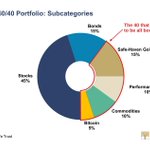
So how much gold in a portfolio?
From 1970 to 2024, a stock and bond mix holding 14% gold swung the least of all, less than one holding none. Beyond that, volatility climbed again. More below.


So how much gold in a portfolio?
From 1970 to 2024, a stock and bond mix holding 14% gold swung the least of all, less than one holding none. Beyond that, volatility climbed again. More below.
From The Psychology Behind Gold's Underallocation, IGWT'26. S&P 500 and US 10Y, 1970 to 2024: no gold, 8.28% annualized volatility; 14% gold, 7.81%. The chapter:
ingoldwetrust.report/nuggets…


In Gold We Trust retweeted
Nearly every ounce ever mined still exists, yours included. Some 220,000 tonnes sit above ground, growing roughly 1.8% a year.
By @michaeljmcnair's math, even 100 fusion reactors would add about 0.2% a year. And the people sitting on the pile hold it for one reason paper can't match: nobody can print more.
Geology, not monetary policy, sets the pace.
The full picture on gold's slow-growing stock is below.


This is NOT a risk to gold prices and the reason why explains an important lesson about gold and bitcoin that very few people understand.
There are obvious feasibility questions, but we can ignore those and even assume it pans out.
Based on Marathon’s estimated goal, a large reactor could produce 5t/yr. So even if you build 100 reactors thats 500 t/yr, equivalent to 14% of global mine production. But mine supply isn't what matters.
Other commodities are consumed. Oil gets burned, copper gets trapped in existing infrastructure, ect. So new production is required to meet continuing demand.
But gold (and bitcoin) are unique bc they aren't consumed. Nearly all the gold ever mined still exists and is available to be traded. So the relevant supply curve isnt the flow of newly mined supply, its the willingness of the holders of the existing stock to sell at a given price.
And even 100 reactors would only increase above ground supply by 0.2%/yr.
Price doesn’t go up to incentivize new production. It rises (or falls) to a level where enough existing holders are willing to sell to meet the demand of buyers.
Which is why the most explosive price appreciation in Bitcoin occurred when new coins were being mined significantly faster than today. Bc new issuance isn't driving price, its demand relative to the available stock.
*The fact that gold isn’t tied to marginal cost dynamics is also why goldminers have often struggled to earn adequate returns. But that’s a story for another time.
Nearly every ounce ever mined still exists, yours included. Some 220,000 tonnes sit above ground, growing roughly 1.8% a year.
By @michaeljmcnair's math, even 100 fusion reactors would add about 0.2% a year. And the people sitting on the pile hold it for one reason paper can't match: nobody can print more.
Geology, not monetary policy, sets the pace.
The full picture on gold's slow-growing stock is below.
This is NOT a risk to gold prices and the reason why explains an important lesson about gold and bitcoin that very few people understand.
There are obvious feasibility questions, but we can ignore those and even assume it pans out.
Based on Marathon’s estimated goal, a large reactor could produce 5t/yr. So even if you build 100 reactors thats 500 t/yr, equivalent to 14% of global mine production. But mine supply isn't what matters.
Other commodities are consumed. Oil gets burned, copper gets trapped in existing infrastructure, ect. So new production is required to meet continuing demand.
But gold (and bitcoin) are unique bc they aren't consumed. Nearly all the gold ever mined still exists and is available to be traded. So the relevant supply curve isnt the flow of newly mined supply, its the willingness of the holders of the existing stock to sell at a given price.
And even 100 reactors would only increase above ground supply by 0.2%/yr.
Price doesn’t go up to incentivize new production. It rises (or falls) to a level where enough existing holders are willing to sell to meet the demand of buyers.
Which is why the most explosive price appreciation in Bitcoin occurred when new coins were being mined significantly faster than today. Bc new issuance isn't driving price, its demand relative to the available stock.
*The fact that gold isn’t tied to marginal cost dynamics is also why goldminers have often struggled to earn adequate returns. But that’s a story for another time.
From The Renaissance of Gold Allocation, a chapter of the In Gold We Trust report 2026. The World Gold Council puts above-ground gold at about 220,000 t at the end of 2025, growing 1.8% a year over the past decade and 1.7% since 1900.
Michael McNair wrote this year's chapter on the end of the US dollar standard and why gold is filling the reserve role.
Read the chapter:
ingoldwetrust.report/nuggets…

In Gold We Trust retweeted

Gold dipped below USD 4,000 intraday this week, and headlines stopped there. Underneath, the Dutch central bank has moved about 86 tonnes of gold from New York and Ottawa to London since March, and London's vaults kept FILLING.
This week's Nugget follows the bars.
Read below.

In Gold We Trust retweeted
A central bank that moves its bars has decided whose custody it trusts. This year the Dutch moved about 86 tonnes of theirs from New York and Ottawa to London, and this week's Nugget follows the bars.

A central bank that moves its bars has decided whose custody it trusts. This year the Dutch moved about 86 tonnes of theirs from New York and Ottawa to London, and this week's Nugget follows the bars.
In Gold We Trust retweeted
IGWT Recap, week of Oct 23
Incrementum Active Aurum Signal: Defensive 🛡️
W/W change:
🥇 Gold (USD): 3,995.52 | -4.07%
🥈 Silver (USD): 53.89 | -5.46%
⚖️ G/S Ratio: 74.14 | +1.07
⛏️ GDX (USD): 80.20 | -8.56%
⛏️ SIL (USD): 74.06 | -10.23%
Gold closed below USD 4,000 for the first time since July, with Brent above USD 110 and a technology selloff pushing investors to sell metal for cash. Both mining lines fell about twice as hard as their metal.
Through all of it the bars kept moving. Gold held at the Bank of England rose roughly 192 tonnes between the end of June and the end of September, to about 5,782 tonnes, while the New York Fed's foreign-held pile shed 29.5 tonnes in August alone.
October hike odds closed near 7%. The FOMC decides on Wednesday.
New to the Signal? The Incrementum Active Aurum Signal is our rules-based model for timing exposure to gold mining equities - three modes: Offensive, Neutral, Defensive.
Full explainer: ingoldwetrust.report/journal…

In Gold We Trust retweeted
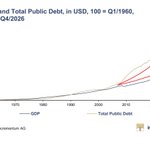
Making new gold takes a fusion reactor nobody has built. New debt only needs a vote, and your dollars carry the bill.
Since 1960, US public debt has outgrown the economy by 133%, no reactor required.
Here's what that means for the gold you hold.


Making new gold takes a fusion reactor nobody has built. New debt only needs a vote, and your dollars carry the bill.
Since 1960, US public debt has outgrown the economy by 133%, no reactor required.
Here's what that means for the gold you hold.
From The Renaissance of Gold Allocation, a chapter of the In Gold We Trust report 2026. By the end of 2025, total US debt had grown 133% more than GDP since 1960, and the CBO sees it heading toward 160% of GDP by 2045.
The chapter:
ingoldwetrust.report/nuggets…