

The world's premier platform for political parties, campaign experts, academics, and innovators shaping the future of political campaigns.
Joined October 2023
- Tweets955
- Following113
- Followers366
- Likes323



International Political Campaigns Expo retweeted

Why did we create the Political Campaigns Resource Hub (PCRH, @ResourceHub_HQ)?
Because "we are building a body of evidence drawn from real political campaigns and a platform to learn from it because most of what campaign teams know comes from the last election they worked on. It lives in people’s heads, gets retold as war stories, and leaves when they do.
"Meanwhile, the research that does exist usually arrives after the votes are counted, written for other researchers. So the people running campaigns learn by trial and error, often at the voter’s expense."
That's a costly gap, and we are closing it!
More: politicalhub.africa | icpc.africa
#PoliticalCampaigns #CampaignTools #CampaignStrategy


We are building a body of evidence drawn from real political campaigns and a platform to learn from it because most of what campaign teams know comes from the last election they worked on. It lives in people’s heads, gets retold as war stories, and leaves when they do.
Meanwhile, the research that does exist usually arrives after the votes are counted, written for other researchers. So the people running campaigns learn by trial and error, often at the voter’s expense.
At @ResourceHub_HQ, we are closing that gap with two projects designed to feed each other.
1. Political Campaigns Watch puts observers on the ground to document campaigns in real time. What was said, where, to whom, and what happened next.
2. UCT–PCRH Executive Training takes that evidence into the room, giving campaign leaders specialised skills built on what campaigns actually do, not what we assume they do.
One generates knowledge, and the other develops the people who can use it. Learn more at politicalhub.africa
#PoliticalCampaigns #CampaignStrategy #ICPC #Africa #PCRH #ProfessionalisingCampaigns
International Political Campaigns Expo retweeted

We’ve travelled to Abuja for the next edition of #CampaignWatch, where we follow political campaigns as they happen. How is Nigeria preparing for the 16 January 2027 election, and what strategies are parties deploying?
Stay tuned! 🇳🇬

Latest edition loading for @ResourceHub_HQ's Campaign's Watch in #Nigeria 🇳🇬
@DimphoLekgeu is on the ground, monitoring the campaign trail, in the lead up to the January 2027 elections.
Lookout for insights on the #MissingVoter 🎥
International Political Campaigns Expo retweeted
🧵
More than US$50 billion is spent globally on political campaigns every year, with over US$10 billion deployed across #Africa alone.
Yet, across many countries worldwide, 1.3 to 1.5 billion eligible voters refuse to cast a ballot. We are witnessing an unprecedented global electoral participation crisis. /
#MissingVoter #PoliticalCampaigns

There is a political constituency larger than many winning coalitions and campaigns often struggle to see it.
The #MissingVoter is the eligible citizen who never registers, and the registered
voter who never turns up.
In 2024: 85.9M eligible Americans did not vote. The winning candidate received 77.3M votes.
In the UK Roughly 19.5M registered voters did not cast a ballot. The party now governing with a commanding parliamentary majority received 9.7M votes.
In South Africa 11.5M registered voters stayed home. The party with the most votes received 6.4M votes (40.18%) of ballots cast.
Different countries. Different electoral systems. Different political cultures.
But one challenge for campaigns: How do you identify, understand and reach the people who are missing?
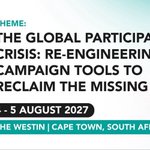
The #MissingVoter is not simply a turnout statistic. It is an electorate that campaigns often struggle to see, understand and mobilise. That is the challenge behind the third International Political Campaigns Expo #IPE27.
From 4–5 August 2027, campaign practitioners from around the world will examine how campaigns can redesign their data, systems and mobilisation engines to identify, understand and reach the #MissingVoter.
Because the next frontier of campaigning may not be finding more efficient ways to reach the voters you already know. It may be learning how to find the ones you don't.
4–5 August 2027
The Westin Hotel,
Cape Town, South Africa
#IPE27 #MissingVoter #PoliticalCampaigns #CampaignStrategy
International Political Campaigns Expo retweeted
Over the next 10 weeks, we will deconstruct how modern political power is built, tested, and sustained across #Africa and beyond.
Follow us (@ResourceHub_HQ | @UNDAfrica | @ShikamoCampaign | @IPE_Official_ | @CampaignPulse_) as we unpack the science of modern political campaigning.
website: icpc.africa
#MissingVoter #PoliticalCampaigns #CampaignStrategy

International Political Campaigns Expo retweeted

Most campaigns build a war room and call it done. Then wonder why decisions still take three days.
A war room is not the room. It is the rhythm inside it: monitor, verify, decide, respond, on repeat, every day of the campaign. Skip the rhythm and the room is just a space where people sit and wait.
At Shikamo, we build the rhythm first. The room is just where it happens.
#CampaignStrategy #WarRoom #PoliticalCampaigns #Shikamo
International Political Campaigns Expo retweeted

We are building a body of evidence drawn from real political campaigns and a platform to learn from it because most of what campaign teams know comes from the last election they worked on. It lives in people’s heads, gets retold as war stories, and leaves when they do.
Meanwhile, the research that does exist usually arrives after the votes are counted, written for other researchers. So the people running campaigns learn by trial and error, often at the voter’s expense.
At @ResourceHub_HQ, we are closing that gap with two projects designed to feed each other.
1. Political Campaigns Watch puts observers on the ground to document campaigns in real time. What was said, where, to whom, and what happened next.
2. UCT–PCRH Executive Training takes that evidence into the room, giving campaign leaders specialised skills built on what campaigns actually do, not what we assume they do.
One generates knowledge, and the other develops the people who can use it. Learn more at politicalhub.africa
#PoliticalCampaigns #CampaignStrategy #ICPC #Africa #PCRH #ProfessionalisingCampaigns
International Political Campaigns Expo retweeted
Three weeks ago we asked where Brazil's missing voters were. The runoff on 25 October gave a partial answer: about 2.5 million of them came back. Nearly 30 million did not.
The race was decided mostly by people who had already been voting, not by the ones who had been missing. We break down the numbers, what each campaign actually did, and what the Trump association really cost Bolsonaro.
#Brazil #CampaignStrategy #PoliticalCampaigns #Shikamo


International Political Campaigns Expo retweeted
In case you had missed it - check out Week 2 of Political Campaign Watch Nigeria 🇳🇬 . We don't track who's ahead. We track how campaigns try to get there.
Our @ResourceHub_HQ watchers report weekly from all six geopolitical zones.
One number frames everything: in 2023, 93.5 million Nigerians were registered to vote, but only about 27 percent showed up.
In Week 2, five tactics were observed in September:
1. The candidate sent someone else - Traditional rulers in Zamfara. A youth endorsement in Delta. The First Lady before thousands of women in Imo.
2. The backlash was made, not met - AI-generated images of anger at the APC in Kano and Sokoto. Neither event happened.
3. Reach was bought, not built - Opposition candidates chose Channels and Arise TV over the campaign trail.
4. The gifts got bigger - Tricycles and generators in Week 1. Freezers, gas cookers and grinding machines in Imo in Week 2. The items changed. The logic didn't.
5. The lists got longer - Names collected at markets and doorsteps in Rivers. Signs of a voter list behind an ADC roadshow in Kaduna, unconfirmed.
One question sits under all five: is it reaching the missing voter, or the base?
More campaign analysis at politicalhub.africa
#PoliticalCampaignWatch #Nigeria2027 #MissingVoter #PCRH #ICPC
International Political Campaigns Expo retweeted

Watched this clip of Mashaba a few times now.
The question was simple: what are you doing differently to reach young voters. What came back was a personal story and a line about budget. No numbers. No named places. No sense of where young voters actually are, or what it costs to move them.
That tells me more about the campaign than the answer was meant to.
A data driven campaign does not flinch at a question like this, because it already knows the answer. It knows which areas have the youth numbers, what it costs to reach them, and what's working. When a candidate reaches for a personal story instead of a number, it usually means the number isn't there to reach for.
Being under resourced is not an excuse I give much weight to. History is pregnant with examples of lean campaigns outperforming well funded ones, precisely because they know where every dollar needs to go. The issue here is not the budget. It is not knowing, and covering for it with biography. @ShikamoCampaign

International Political Campaigns Expo retweeted

HOPE OFFERS A FUTURE. FEAR WARNS YOU COULD LOSE IT.
Watching Obama on the campaign trail raises an uncomfortable question: when we respond to a political speech, are we evaluating an argument, or reacting to how it makes us feel?
His delivery invites us to consider the relationship between two powerful campaign emotions: hope and fear.
Hope asks voters to imagine what is possible. Fear asks them to consider what is at stake.
Placed together, they carry a compelling proposition: a better future is within reach, but it is not guaranteed.
This is where political communication becomes more than a presentation of policies. The contest becomes personal. It touches the life voters want for their children, the dignity they expect from government, and the uncertainty they feel about tomorrow.
A manifesto can explain a promise. A speech can make that promise feel urgent.
Yet we should be careful about assuming that emotional engagement amounts to manipulation. People’s hopes and fears are often grounded in lived experience. The parent worried about school fees, the graduate facing unemployment and the worker anxious about losing an income have legitimate concerns.
The ethical question is what a politician does with those concerns.
Does the campaign help citizens understand their choices, or exploit their anxiety to prevent them from questioning?
Hope deserves scrutiny when the promise has no credible route to delivery. Fear deserves scrutiny when opponents become enemies and every election is presented as the last chance to avert catastrophe.
There is also a practical tension. Hope can inspire participation, but an impression of inevitable victory can encourage complacency. Fear can create urgency, but a sense of inevitable defeat can leave people asking why they should bother.
Neither emotion guarantees a vote.
For me, this brings the discussion back to the missing voter. What does the speech offer the person who has heard promises before, experienced disappointment and quietly withdrawn?
A moving performance may capture that person’s attention. Rebuilding their belief that participation matters requires something deeper: credibility, authentic engagement and evidence that someone is listening.
This is the challenge behind the applause. A crowd can be emotionally engaged while the citizens beyond it remain unconvinced.
Obama’s appearance provides a useful lens through which to examine our own reactions to campaign communication. We should listen to the argument while also noticing the emotional journey we are being invited to take.
After a political speech moves you, ask: what have I been given reason to believe, what have I been encouraged to fear, and what evidence supports either?
#PoliticalCampaigns #PoliticalCommunication #VoterParticipation #CampaignStrategy
International Political Campaigns Expo retweeted

Political expression, including protest action, doesn’t always translate into votes.
In Episode 6 of Campaign Pulse, Dr Momar Dieng unpacks this distinction and why numbers, not just narratives, matter in political campaigns.
Listen to Episode 6 now: youtu.be/fKv0nVncem4?si=u5NV…
Dr Momar Dieng is an expert in election data analysis and quantitative campaign strategy.
#CampaignPulse #DecodingCampaigns #DefiningPower #PoliticalCampaigns #VoterBehaviour #PoliticalAnalysis
International Political Campaigns Expo retweeted
From 28 September to 2 October, @ResourceHub_HQ partnered with @UCT_news to train 27 ruling and opposition party leaders from 12 African countries at the UCT-PCRH Executive Short Course. For five days, they worked on the questions that decide elections. Each of them left with a plan built for their own party and country.
Watch @IEmemobong, National Publicity Secretary of Nigeria's @OfficialPDPNig 🇳🇬 speaking at our closing ceremony. He speaks about what the week meant to him and the 3rd cohort, and he thanks the @ICPCampaigns and our Group Lead, @glenmpani, whose vision drives this programme.
If your political party goes to the polls in 2027 or 2028, the decisions you make in the next twelve months will shape the result. We are inviting expressions of interest for the 4th cohort, which will run from 26 to 30 July 2027 in Cape Town.
For more details, contact: [email protected]
#UCTPCRH #PoliticalCampaigns #ExecutiveTraining #AfricanPolitics #CampaignStrategy #PCRH #ICPC
International Political Campaigns Expo retweeted
A candidate can give a hundred speeches. A trained mobiliser has one conversation on one doorstep, and it moves more votes than the speeches do. Mobilisation strategy should start before the candidate is even announced.
Here is why?
linkedin.com/pulse/why-mobil…
#CampaignStrategy #Mobilisation #Shikamo

International Political Campaigns Expo retweeted
Most people rarely think about political campaigns. Yet a campaign is a job interview for the people who will run the country and who will decide the price of bread, whether the clinic has medicine, whether your child’s school has a teacher, and whether there is work. Every one of those is shaped by who governs, and who governs is decided by a campaign.
At the @ResourceHub_HQ, we understand that campaigns are where voters meet politics: at a rally, on a door-knock, in an advert, on social media, in their WhatsApp groups, or through a promise.
We work to improve the quality of that encounter, and what it delivers for voters, by building the infrastructure for professional campaigning.
We have closed the gaps we keep running into in the field, and now provide:
🔹 Systems to organise and run campaigns: KampaignOS
🔹 Skills for the people who lead them: the UCT–PCRH Executive Short Course
🔹 Evidence of how campaigns really work: Political Campaigns Watch
🔹 Standards to measure campaign performance: the Global Political Campaigns Index
🔹 Knowledge that practitioners can apply: the International Political Campaigns Expo
That is the infrastructure of a profession, and we are building it. Find out more → politicalhub.africa
#PoliticalCampaigns #ICPC #MissingVoter #CampaignStrategy #PoliticalCommunication #PCRH #KampaignOS #PoliticalCampaignWatch #IPE27
International Political Campaigns Expo retweeted
Grassroots mobilisers don't give speeches, they have conversations. One voter, one doorstep, one language, one chance to listen before they talk.
That is the work that actually moves a vote, and it is the work most campaigns under-train and under-fund.
At Shikamo, we build it as infrastructure, not an afterthought.
#GrassrootsMobilisation #CampaignStrategy #VoterEngagement #Shikamo
International Political Campaigns Expo retweeted
Most of the people who run campaigns to decide who governs a country learn on the job, under pressure, and start from scratch every election cycle. We think that is backwards.
At the @ResourceHub_HQ, we treat political campaigning as a profession.
Here’s what we built in 2026:
Training. 27 senior leaders from 15 political parties across 12 African countries, all heading into elections, completed the 3rd cohort of the UCT-PCRH Executive Short Course with the @UCT_news.
Evidence. Our trained watchers filed over 500 field reports from live campaign periods in Zambia, South Africa, and Nigeria, recording how parties actually compete for votes on the ground.
Standards. We held the inaugural expert convening of the Global Political Campaigns Index with @MandelaUCT. It’s the first step toward a shared benchmark for what a good campaign looks like.
Tools. On #KampaignOS, we built campaign tools for party membership and voter verification, mobilisation, predictive analysis, public sentiment analysis, and election-day war rooms.
We build the infrastructure for professional political campaigning because we know that political campaigns shape countries, and we believe that they should be run like it.
#ProfessionalisingPoliticalCampaigns #PCRH #ICPC #PoliticalCampaignStrategy #MissingVoter
International Political Campaigns Expo retweeted
Money matters in political campaigns. 💰
Professor Steve Jarding cites a striking statistic: 92% of campaigns with the most money win. In Episode 5 of #CampaignPulse, the Harvard lecturer and veteran campaign strategist unpacks the relationship between funding, strategy and electoral success.
Watch Campaign Pulse Episode 5: bit.ly/3VZc3TT
#CampaignPulse #PoliticalCampaigns #CampaignStrategy #PoliticalCommunications
International Political Campaigns Expo retweeted
🇧🇷 Brazil has compulsory voting. Yet 33.4 million registered voters stayed home in the 4 October first round, a record number.
As our partners at the Political Campaigns Resource Hub (PCRH) show in the chart below, abstention rises with each new election.
Ahead of the 25 October runoff, both campaigns face the question we explored at the UCT–PCRH Executive Short Course: who is the missing voter, and what will bring them back?
👇 PCRH's analysis
#Brazil #Elections #Voter #Turnout @ResourceHub_HQ
Brazil votes today. Voting there is compulsory, backed by fines and sanctions. Yet millions still stay home, and the number keeps growing:
In 2014: 27.7M missing (19.4%)
In 2018: 29.9M missing (20.3%)
In 2022: 32.8M missing (21%), the most since 1998
If that rate holds, of 158.7M voters today ~125.5M will vote and ~33.3M will go missing.
Compulsion lifts the floor, but it can't create engagement. Missing voters are an engagement problem, not a legal one.
As polls close, we will be monitoring whether Brazil's political actors did enough to bring the missing voters to the polls this time around.

International Political Campaigns Expo retweeted

(1/5) #MemoriesMonday: Asafika Mpako (@AsafikaMpako), Afrobarometer’s communications coordinator for Southern Africa, presented findings on South Africans’ views of democracy and the country’s most pressing challenges at an event marking 30 years of South Africa’s Constitution.
The event was hosted by the Finnish Embassy, in collaboration with the Institute for Security Studies (@issafrica) and the European Union Delegation in South Africa (@EUinSA).
Here are some key findings.
#VoicesAfrica #SouthAfrica #SAConstitution #30thanniversary

International Political Campaigns Expo retweeted

🎯 Candidate positioning shouldn't start with a slogan.
Start with what voters care about and what the candidate can credibly own. Strategy first. Creativity follows.
#Candidate #Positioning #Political #Communication