
Siberian Federal University
Krasnoyarsk, Russia
Joined January 2020
- Tweets48
- Following70
- Followers36
- Likes344


Inna Kizhner retweeted

📢Digitization alert: The grammar of ornament / by Owen Jones. This stunning elephant folio was printed with precision in vivid, many-hued colour by Day & Sons in 1856. Explore the architectural details and decorative motifs online here: mcgill.ca/x/wS4

ALT title page reading "grammar of" decporated with elaborate penwork
Inna Kizhner retweeted

great theoretical reflection on place of LLMs in education. Now need empirical testing to go with it.

“[…] it is not the artefacts themselves that are central to learning (though they are certainly helpful for monitoring and assuring learning) - it is the doing of that reading and writing”
Great article on how poor use of LLMs harms academic literacies.
tandfonline.com/doi/epdf/10.…
Excited to be a part of the project 'Multi-view ontologies as a new research paradigm for online cultural heritage of minorities: An investigative case of the Jewish minority worldwide'. The ISF grant has been awarded to Maayan Zhitomirsky-Geffet.
2
66
Inna Kizhner retweeted

Keynote six: @melissaterras - Professor of Digital Cultural Heritage at the University of Edinburgh’s Design Informatics - articulated key themes from her professional search for AI that benefits libraries. 👏🎮
Click here: youtu.be/jOQxZDTuA-o
Inna Kizhner retweeted

Want to know how to create and maintain a digital archive of old postcards/diary records/tweets/poems/Ukrainian memes with little budget and little-to-no coding skills? Join our "DIY archives workshop" on July 7. Register here to attend: uni-potsdam.de/de/digital-hu…
Venue: @FontaneArchiv
Orgs: @danya_sko @peertrilcke @yaelnetzer
More details: digarxiv.org

Wonderful talk by Andrea Kocsis at EdCDCS about a conflict between reproducibility and reliability in approaching collections as data

3
54
Inna Kizhner retweeted

Are we reaching a dystopia of information in online environments? Asks Prof @melissaterras in @Jisc's new #ResearchTalk podcast mini-series on AI and the humanities...good news is, libraries can help! open.spotify.com/episode/5Su…
Inna Kizhner retweeted

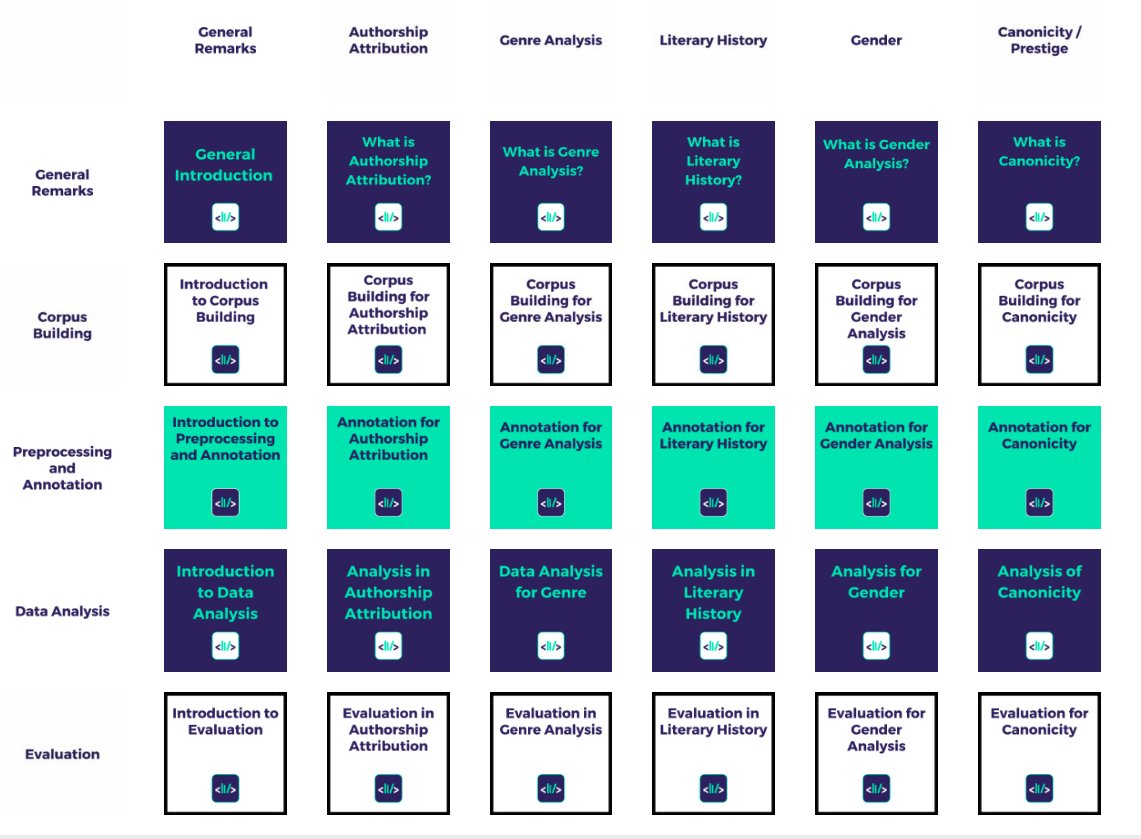
Check this out! I've wrote parts about analysis and evaluation in literary history, which required galloping over the vast field. Two things emerged:1) change in time is an open problem, we need better stats 2) simulations, the core of evaluation, are nonexistent (better stats!)

🧨⚡️Check out a brand new #CLS resource! This survey of methods and issues breaks down:
➡️Authorship Attribution
➡️Genre Analysis
➡️Literary History
➡️Gender Analysis
➡️Canonicity / Prestige
🤯🤯🤯
clsinfra.io/resources/d3-2-m…
Inna Kizhner retweeted

A new object detection and pose classification #MachineLearning dataset is now available via the @huggingface hub. The dataset contains more than 15,000 images, with cultural heritage specific bounding annotations 🤓
huggingface.co/datasets/bigl… #DH #ArtHistory #museums

Inna Kizhner retweeted

9.30am UK time on 17th Nov I'll be giving the #BuildingDH2022 #DigitalHumanities Keynote: "Searching for AI’s killer app in the Humanities" - which will be streamed for free online (and recorded for later viewing) - see more here and register in advance! web.cvent.com/event/811e389e…
Inna Kizhner retweeted
The map of where the Benin Bronzes ended up, in institutions, is quite something. digitalbenin.org/map#institu…

This Post is from an account that no longer exists. Learn more
Inna Kizhner retweeted

Our last work (w/ A. Brenon & @khetiwe24) on ‘Classifying encyclopedia articles: Comparing machine and deep learning methods and exploring their predictions’ has been published:
doi.org/10.1016/j.datak.2022…
Inna Kizhner retweeted

I'm giving a free online talk tomorrow about making interactive #dataViz at The Economist groups.google.com/g/antiquis…
⏰ 5pm UK time, Wed 28 Sep
👇 sign up link below
This Post is from an account that no longer exists. Learn more
Inna Kizhner retweeted

Our @WE1Sproject article in Daedalus is part of issue of the journal about "The Humanities in American Life: Transforming the Relationship with the Public": amacad.org/daedalus/humaniti…


Inna Kizhner retweeted

Proud to be part of this wonderful collaborative effort to lay the future basis for digital information about #NaturalScience specimens: ➡️academic.oup.com/bioscience/…
@GBIF @NSF @TDWG @BioCollNetwork @EntCollNet @iDigBio @AllianceforBio @atlaslivingaust @eurotaxonomy @Naturalis_Sci

Metadata as knowledge: A special issue of KULA: Knowledge Creation, Dissemination, and Preservation Studies kula.uvic.ca/index.php/kula/…
A new paper with Maayan Zhitomirsky-Geffet and Sara Minster "What do they make us see: a comparative study of cultural bias in online databases of two large museums" published in the Journal of Documentation tinyurl.com/yc7z7bd4
An excellent paper by Elizabeth Mansfield at the intersection of computer vision and art history, showing a scholarly perspective on how computer scientists and art historians interact, pursue, and fine-tune research questions together. An exciting read infolab.stanford.edu/~wangz/…
We have a chapter published in Global Debates in the Digital Humanities on the history and context of Digital Humanities in Russia. A hundred years of history inspired by structural thinking, sciences, and the models of change nevmenandr.net/personalia/Gl…