

Growth at reasonable valuations | Investor Disc: Don't Buy or Sell based on my tweets. I'm biased.
Joined December 2018
- Tweets2.6K
- Following208
- Followers3.8K
- Likes2.2K






Vaibhav Joshi retweeted
I will say this again: the correction in Microfinance stocks is overdone. Many will realise this after the December quarter business updates.
We are in November now, and from whatever I have heard across different players' concall summaries, the picture is quite clear.
Maharashtra will see some impact, but nothing to be worried about. Karnataka is similar. Except for these two states, the rest of India seems to be doing well.
Inflation worries and crude oil fears are overdone.
Every player's numbers suggest that the worst is behind us. Recovery and stabilisation are largely done, and acceleration should happen in H2.
Valuations are extremely cheap.
I still feel Satin is the best bet in the sector, followed by Arman and Muthoot Microfin.
Personally, I don't like Fusion and Spandana (arguably the worst player in the sector).
Anyone new to this sector must study it properly.
Yes, this is a cyclical sector. But these are exactly the times when you enter. You get out when you start seeing early signs of stress building up, not when everyone is already worried about it.

Vaibhav Joshi retweeted

Indian companies buying European cos should be viewed with a healthy dose of skepticism given European operations are rarely as profitable and if things get worse. Impairment costs can come..
In my books, it’s a yellow to orange flag on capital allocation


Vaibhav Joshi retweeted
Many retail investors try to study the real estate sector and give up because of the complex accounting followed by each player.
Some just look at the Screener P/E and call it expensive. Others argue that property prices are already too high and there is little scope for further appreciation.
But they often forget one thing. Real estate developers don't necessarily need property prices to keep rising to grow. They need to launch more projects, sell inventory and keep replenishing their pipeline.
And honestly, the balance sheets of several listed developers have become quite impressive. Tbh, too impressive to ignore.
I started looking at this sector after studying Raymond Realty and realised that many real estate developers are sitting on goldmines, both literally and in terms of future business opportunities.
Look at the presales numbers.
Across 12 major listed developers, annual presales grew from ₹73,679 Cr in FY23 to ₹1,61,800 Cr in FY26. That's a 30% CAGR over three years!
Collections have grown from ₹67,062 Cr in FY24 to ₹1,07,117 Cr in FY26.
Think about what this means. A significant amount of business is already getting booked, and the cash from these bookings flows in as construction progresses. These projects will eventually translate into recognized revenue and profits as they are completed.
Of course, bookings aren't the same as revenue or profit. Execution, cancellations and project economics matter. But the visibility into future business is much better than a simple trailing P&L might suggest.
Now let's talk about valuation. Before that, we need to understand how to actually value these businesses.
Under Ind AS 115, many developers recognize residential revenue only when the project is completed and possession is handed over. Meanwhile, launch costs, marketing expenses and overheads are incurred much earlier.
So a company can report strong presales but weak or even negative EBITDA today. And when handovers begin, reported revenue and profits can suddenly jump.
Looking at trailing P/E or EV/EBITDA in isolation can therefore be misleading.
I prefer looking at Core EV/Presales and Core EV/Embedded EBITDA, while also checking the land bank, sustainable project margins, debt and cash conversion. Embedded EBITDA is essentially current presales multiplied by a reasonable estimate of the margin the developer can retain over the project lifecycle.
Now look at how valuations have changed.
Before COVID, developers were often valued at 0.5 to 0.8 times NAV, with the market worried about debt, stalled projects and whether land would ever be monetised.
Then came the post COVID re-rating. Investors began valuing these companies as growth franchises rather than just land banks. Some leading developers traded at 6 to 11.5 times Core EV/Presales and 20 to 35 times Core EV/Embedded EBITDA.
Today, after the correction and a few years of strong growth, the 12 company cohort in my analysis trades at around 3.2 times FY26 Core EV/Presales and 11 times Core EV/Embedded EBITDA.
Read that again.
Presales have compounded at 30% while valuation multiples have compressed substantially from their peak.
This is what makes the sector interesting to me. You don't necessarily need another massive expansion in property prices or valuation multiples. Continued growth in bookings, timely execution and conversion of the existing pipeline into cash can itself create value.
The balance sheets have also improved significantly across several leading players. Customer advances help fund construction, while lower leverage reduces the risk that used to destroy shareholder value in the previous cycle.
But this is not a blanket bullish call on every developer.
A company with a valuable legacy land bank and high margins deserves to be valued differently from one that has to share most of its profits with landowners. A developer growing bookings rapidly but burning cash also deserves more scrutiny than one converting collections into free cash flow.
This is why Raymond Realty caught my attention. Its legacy Thane land and JDA pipeline offer years of development potential, but the real test is how efficiently it can convert that potential into profits and cash.
The opportunity, in my view, is to find companies where the market is still looking at today's reported earnings while the underlying business is building tomorrow's revenue.
Everyone talks about expensive property prices. Far fewer seem to be talking about the growth in presales, the visibility of future deliveries and the valuation compression that has already happened.

Vaibhav Joshi retweeted
I think cables theme hasn't peaked out yet we are in the middle of it. (Those who track the sector can give it a read 👇)
Polycab's concall gives more or less an accurate idea about where does the industry stands today.
Went through the Q2 concall. A few things stood out.
Polycab's Wires & Cables revenue grew 47% YoY, with domestic growth at 50%. But I was more interested in the volume commentary. Overall volumes grew in mid to high single digits, with cables growing in mid single digits and wires in early double digits. Last year, cable volumes had already grown around 20%, so the base wasn't easy either.
For me, the bigger story is the demand coming from power transmission, renewable energy evacuation, manufacturing capex and data centres. All of these require electrical infrastructure, and cables are an important part of that investment. This isn't dependent on just one sector or one capex cycle. If India's infrastructure buildout continues, the demand runway could be long.
Exports are another interesting piece. Polycab's exports grew 17% YoY in Q2, and management said the order pipeline remains strong. The company is present in 94 countries. I would watch how much of this translates into sustained growth, especially with geopolitical uncertainty and shipping disruptions.
Now comes the part where I would be a little careful: margins.
Wires & Cables delivered a 14.2% EBIT margin, but management's long term EBITDA margin guidance under Project Spring remains 11% to 13%. These are different metrics, so they shouldn't be compared directly. The point is that product mix, channel versus institutional sales, exports, operating leverage and commodity realisations can all change profitability. I wouldn't simply extrapolate the current margin profile.
One more thing I am watching, even though my primary interest is cables, is UltraTech's entry into wires.
Management estimates the Wires & Cables market at around ₹1.1 lakh crore, with wires accounting for roughly 30% and 30% to 35% of the wires market still unorganised. There is clearly room for organised players to grow, and Polycab highlighted its historical market share gains. It also said it hasn't taken pricing action in response to the new entrant so far.
Vaibhav Joshi retweeted

Two ways to make money in stocks:
One is to find a greater fool willing to pay a higher price than you did.
The other is to invest in a business that will be significantly bigger in future and hence will justify a higher valuation
During bad phases of market, thesis built on business fundamentals will survive than one built on finding the next buyer.
Vaibhav Joshi retweeted

JUST IN: Strait of Hormuz oil flows have rebounded to 80% of pre-war levels, with crude exports topping 14M barrels per day
Vaibhav Joshi retweeted

With Hormuz and Red Sea supplies moving higher and the East West pipeline operational Saudi Oil supplies are now above pre war levels.
Global supplies other than Iran also remain strong and higher prices have created some demand destruction.
As expected Brent prices have moderated and most likely will continue to fall unless there is another flare up between US and Iran.

Vaibhav Joshi retweeted
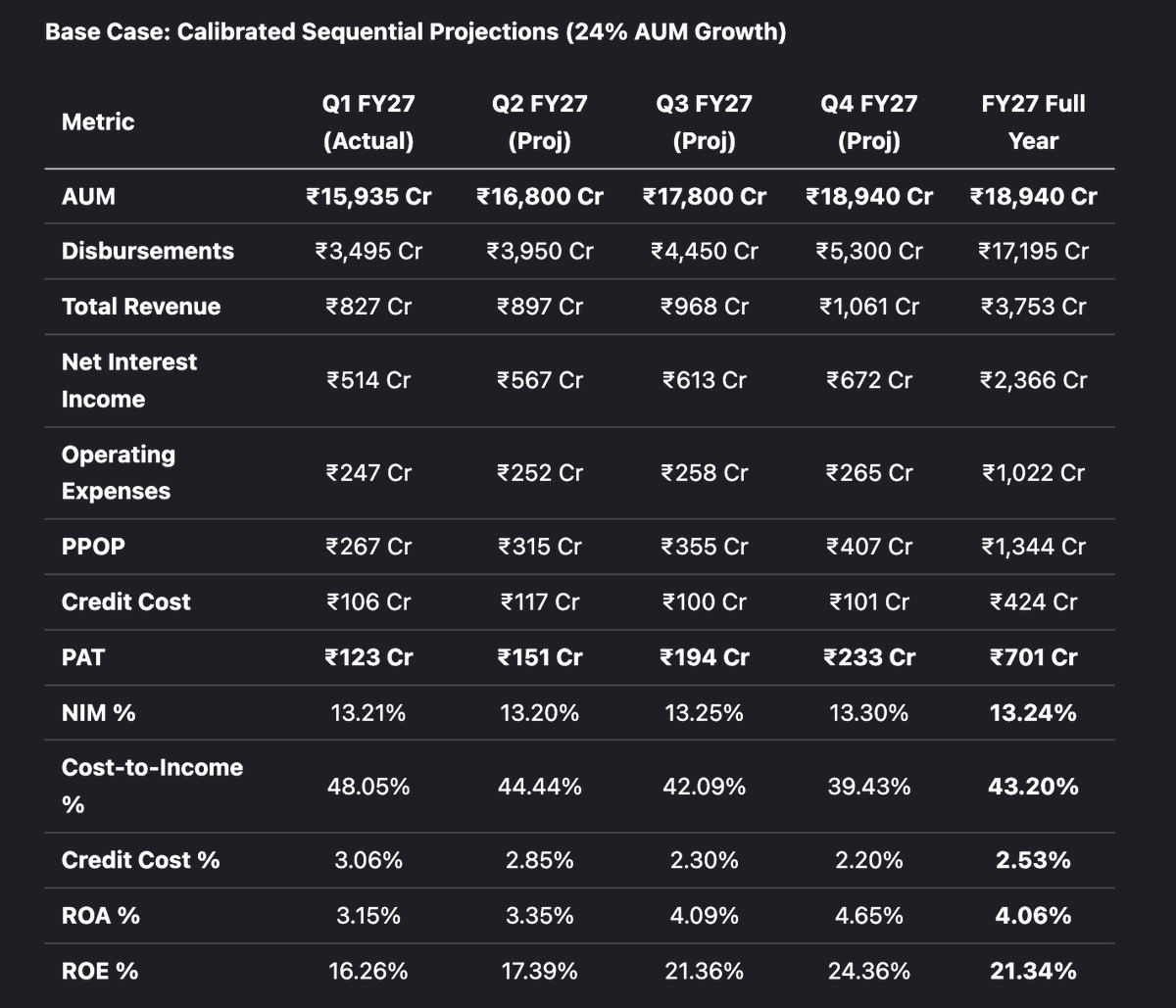
These estimates may sound a little aggressive but I think they are achievable.
Even at 18% ROE these valuations look like a steal.
At just 0.8x book value, there is a good margin of safety to absorb a blip or some miss in these estimates.
Added more on this fall. Let's see how it plays out.


Vaibhav Joshi retweeted
Margins should Expand from here for PNG as they will Expand more into North and Central India.

Vaibhav Joshi retweeted

Over leveraging concerns in #microfinance are behind us. The industry discipline has ensured that borrowers do not take multiple loans. #MFI industry is focusing on capacity based lending and looking to build a healthy and sustainable portfolio


Vaibhav Joshi retweeted
I believe Raymond Realty's rerating has just started and the story is only getting better with time.
The ₹8,500 Cr Parel JDA isn't just another project. It fundamentally strengthens the investment thesis.
Just think about how the story has evolved.
Initially, the market viewed Raymond as a company monetising its 100 acre Thane land bank.
Today, it has successfully entered Bandra, BKC, Sion, Wadala and now South Mumbai with Parel. That tells me prime landowners are increasingly trusting the Raymond brand for large scale redevelopment.
To me, that's a much bigger takeaway than the project itself.
With this announcement, Raymond Realty's total GDV has increased to nearly ₹52,000 Cr from around ₹42,000 to ₹43,000 Cr just a few months ago.
That's almost ₹10,000 Cr of additional revenue visibility through an asset light JDA model.
No expensive land purchases.
No reckless leverage.
Management continues to focus on 20%+ ROCE while keeping Net Debt below 1x.
The market rewarded Raymond for executing on its Thane story.
I believe the next leg of rerating will come from the market recognising that this is no longer just a Thane developer. It is steadily becoming one of the strongest premium real estate platforms across MMR.
The story is evolving. The opportunity is getting bigger. And in my view, the market is still underestimating where this business could be over the next 5 years.
Vaibhav Joshi retweeted
Satin should get rerated to at least 2-2.5 times price to book. In past cycles, Satin did worse because of its geographic concentration, but just look at the last cycle: its ROA and asset quality in FY25 and FY26 are almost close to Credit Access.
They improved a lot on book quality. They will be doing 17-18% ROE this year at least.
And given the consistency since FY25, I see no reason that markets won't recognize it.


Vaibhav Joshi retweeted

Trump: I’m attacking Iran. I’m not attacking Iran. I’m attacking Iran. I’m not attacking Iran.
Markets:
Vaibhav Joshi retweeted
Zaggle’s revenue looks confusing at first, but it becomes simple once you understand the accounting.
Under Ind AS 115, Zaggle is treated as a Principal because it buys and controls the vouchers before giving them to clients. So accounting rules force the company to show the full voucher value as revenue, while also showing the voucher cost as an expense.
That is why revenue looks very large even though the actual margin in the Propel business is only around 7 to 10%.
The real money comes from the SaaS side:
Program and SaaS fees have margins of around 94 - 95%
Zoyer helps companies manage vendor payments and earns subscription plus transaction income
Zatix gives AI based spending insights and brings recurring income
Zagg Money cross sells financial products to 3.7M+ salaried employees
Regarding the type of business- think of it like this Domino's sell Pizzas at 69 Rs they don't make any profit there initial days of operation people only buy 69 Rs pizzas thinking this is true value but once customer gets mature they buy Pizzas where High margins are there like cheese burst etc.
Similarly Zaggle enters a corporate house with a low margin gift card business and give their software for analytics later when that corporate matures they will gradually buy other high margin services and softwares.
So the low margin rewards business is mainly the entry point. The high margin SaaS and fintech products are the real long term value drivers.
And at the end of the day it's not just propel which is growing the entire business is growing.
Vaibhav Joshi retweeted

Congratulations to India, to Prime Minister @nardendramodi and to the scientists & engineers on this important technological achievement after many years of development
This reactor will use much less nuclear fuel than other reactors and lay a pathway towards a closed fuel cycle

Today, India takes a defining step in its civil nuclear journey, advancing the second stage of its nuclear programme.
The indigenously designed and built Prototype Fast Breeder Reactor at Kalpakkam has attained criticality.
This advanced reactor, capable of producing more fuel than it consumes, reflects the depth of our scientific capability and the strength of our engineering enterprise. It is a decisive step towards harnessing our vast thorium reserves in the third stage of the programme.
A proud moment for India. Congratulations to our scientists and engineers.



Vaibhav Joshi retweeted

BREAKING: Oman's oil prices extend losses to -46% from their peak, now down -$80/barrel in just 9 days.
Markets are pricing-in an end to the Iran War.


