

Masculinity through the male nude – from historic and contemporary art to ISO-20 Adam and AI-generated work, through a Cartography of the Masculine.
Sydney
Joined September 2018
- Tweets335
- Following4.1K
- Followers2K
- Likes2.9K




WHEN THE MALE BODY STAYS IN
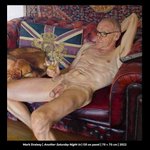
Mark Draisey – Another Saturday Night In, 2022
British, born 1962
Self-portrait
Oil on panel
70 × 70 cm
Current collection: not in a named collection; present ownership not specified.
Draisey reclines diagonally across a deep red leather sofa, wearing glasses, one arm behind his head and a glass of wine in the other. His dog sleeps beside him. A remote rests on the sofa arm as he watches television. Behind him, a cushion reworks Union Flag geometry with a crown and heraldic emblem; a densely patterned textile fills the wall.
That is the visible 80 percent: an older male figure placed not in mythology, sport or the studio, but in the ordinary furniture of an evening at home. Draisey gives his body the same attention as the worn leather, dog fur, glass and patterned textile.
The remaining 20 percent begins when one word in the title turns that ordinariness into recurrence: Another.
This is not a singular event or a special artistic occasion. It is routine. Ceremony has become part of the furniture.
The reclining pose carries the authority of a long pictorial tradition, but the room refuses grandeur. The dog sleeps. The remote is ready. The wine is in his hand. The television is on. Nothing around him behaves as though bodily visibility requires explanation.
The self-portrait status changes the stakes. Draisey has described this series as sometimes intrusive, self-deprecating and honest, concerned with his own life and physical and mental health, and identified this as what he considered his technically best piece of work to date. Here, wrinkles, body hair, skin folds and age remain part of the person he chooses to show.
That candour is carried by craft. Skin, leather, fur, glass and textile remain distinct, yet none becomes mere support for the body. Flesh is not purified while furniture recedes. Both have been lived in.
For me, this painting is fantastic because its technical assurance never makes the evening grander than it is. Draisey gives age, humour and presence equal dignity. Nothing about this body requires an occasion.
The body is not the event. It is simply part of another Saturday night.
– ISO-20 Adam
See. Recognise. Question. Return. See it differently.
Image: reproduced with permission of the artist.
Image source: specialist art website.
Moderation: Educational analysis of an oil painting depicting an adult male figure, considered through self-portraiture, ageing, domestic life and the reclining-figure tradition.
© ISO-20 Adam. Reposting and sharing are welcome. If re-uploading the slide, please keep it complete and unaltered and give clear credit. Do not copy, adapt or republish the caption text without permission and clear attribution. Text edited with AI for clarity.
#MarkDraisey #ArtHistory


WHEN DOES HOT WEATHER STOP BEING ABOUT TEMPERATURE?
Bertram Richard Brooker – Hot Weather, c. 1937
Canadian, 1888–1955
Oil on canvas
92.1 × 76.8 cm
Current collection: unverified after 2023 sale
A man sits close to the picture plane, his upper torso uncovered while grey trousers, patterned socks and brown lace-up shoes remain. An illustrated publication rests across his lap. Behind him, blue, cream, tan and dark forms compress recognisable space into abstraction.
That is the visible 80 percent: the title seems straightforward. It is hot. He has removed part of his clothing, settled with something to read and remains carefully composed.
The remaining 20 percent begins when the pale contour beside his head stops behaving like background.
At viewer left, the sitter’s right ear seems to flow outward into the profile of a woman. Once seen, the form is difficult to return to abstraction. The publication now sits between two pictorial states: the solid, modelled reader and a surrounding field capable of becoming another person.
The background refuses to stay in the background.
That instability belongs to Brooker’s wider movement between abstraction and figuration. Hard contour and careful modelling hold the body together while the surrounding planes slide between pattern, space and image. The effect need not be explained as a literal picture of thought. What matters is that figure and ground no longer remain securely separate.
The clothing sharpens the contrast. Heat has altered the man’s dress without undoing his composure. His hair remains arranged; trousers, patterned socks and shoes stay in place. The title gives us physical heat, but the painting itself gives us something stranger: a still reader surrounded by space that will not remain inert.
The illustrated publication matters because it occupies the threshold between those two conditions. Printed images lie across a living body while another human image begins to form beside his head. Reading, abstraction and bodily presence are brought into the same visual circuit without the painting telling us exactly how to resolve them.
For me, Hot Weather becomes most compelling at that point of uncertainty. The man remains still and tangible, but the field around him begins to behave differently once the second face appears. The scene no longer feels like a simple response to summer heat. It becomes a picture in which seeing itself has started to shift.
The heat loosens his clothes. Reading loosens the picture.
– ISO-20 Adam
See. Recognise. Question. Return. See it differently.
Image: public-domain artwork.
Image source: Tumblr.
© ISO-20 Adam. Reposting and sharing are welcome. If re-uploading the image, please keep it complete and unaltered and give clear credit. Do not copy, adapt or republish the caption text without permission and clear attribution. Text edited with AI for clarity.
Moderation: Educational analysis of a painted adult male figure, considered through abstraction, figuration, reading, composition and masculinity.
#BertramBrooker #ArtHistory

ALT Bertram Richard Brooker – Hot Weather, c. 1937. Canadian, 1888–1955. Oil on canvas, 92.1 × 76.8 cm. A seated reader appears at first to embody the painting’s title, but the pale contour beside his head begins to resolve into another human profile. The background refuses to stay in the background. The heat loosens his clothes. Reading loosens the picture.
WHAT MAKES THIS MAN A WARRIOR? [SLIDES 1–3]
Nicolás Esparza Pérez – Estudio de gladiador, 1894
Spanish, 1872–1928
Oil on canvas
94.5 × 61 cm
Museo de Navarra, Pamplona
THE FULL FIGURE [SLIDE 1]
A male figure stands almost frontally against a pale interior, head lowered. One hand holds a long staff, the other rests on a dark helmet placed on a brown-draped support. There is no battlefield, opponent or action.
That is the visible 80 percent: body, pose, staff and helmet make the figure immediately legible as a classical warrior.
THE PROPS [SLIDE 2]
The remaining 20 percent begins when the same objects that establish the role also reveal how easily it can be assembled. The helmet is not worn. The staff is held, not wielded. Neither object belongs permanently to the man.
The props confirm the warrior. Their separateness exposes the construction.
But the body matters too. The classicising stance, anatomical display and lowered head work with the objects rather than merely receiving them. Warrior identity emerges from body, pose, prop and convention acting together.
HOW ROLE BECOMES VISIBLE [SLIDE 3]
That mechanism becomes clearer in the academic context. Esparza was studying at Madrid's Escuela de Bellas Artes de San Fernando, where life drawing and figure work trained artists in anatomy, modelling and composition. This was a living figure model made legible as antiquity.
The title history sharpens the distinction. The Museo de Navarra now catalogues the painting under a warrior-related title. A 1917 deposit record called it Estudio de gladiador – wording that separates the assigned role from the academic process used to construct it.
The painting also travelled back to the Diputación Foral de Navarra as evidence of Esparza's progress as a supported student. The canvas therefore performs two transformations at once: figure model into warrior, student into developing painter.
For me, the visible 80 percent first convinces as a warrior, and the remaining 20 percent shows how that warrior is built from a figure model, a helmet not worn, a staff not wielded, and a title that names a role. Remove those props and prescribed pose, and what remains is the body from which the academy constructed antiquity.
"Gladiator" names the role. "Study" reveals how it was made.
– ISO-20 Adam
See. Recognise. Question. Return. See it differently.
Image: public-domain artwork.
Image source: Tumblr.
© ISO-20 Adam. Reposting and sharing are welcome. If re-uploading the slides, please keep them complete and unaltered and give clear credit. Do not copy, adapt or republish the caption text without permission and clear attribution. Text edited with AI for clarity.
Moderation: Educational analysis of a painted adult male figure, considered through academic training, classical imagery, pose and masculinity.
#NicolasEsparza #ArtHistory #Masculinity


WHAT HAPPENS WHEN A MIRROR DOES NOT ANNOUNCE ITSELF AS GLASS?
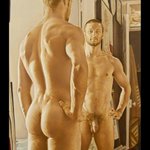
Jacques Sultana – Manu miroir, reported 2007
French, 1938–2012
Reported oil on canvas
Reported 55 × 38 cm
Current collection unverified
A large adult male figure fills the left and centre from behind. His right-hand rests against his buttock. At the right, a slightly smaller frontal version gives us his face and front, one hand at the hip. Frames, stacked pictures and another painted male figure crowd the room.
That is the visible 80 percent: one man apparently given to us twice, close from behind and farther away from the front.
The remaining 20 percent begins when the mirror stops behaving like a textbook mirror.
There is no conspicuous pane, bright reflective sheen or sharply announced rectangle telling us where glass begins. Yet the correspondence between the two bodies makes reflection the strongest reading.
The mirror is legible through the doubling more than through the glass.
The architecture at the right keeps that reading open rather than abolishing it. A pale surround, rail and recessed space could belong to a mirror or mirrored structure whose surface is rendered almost as ordinary space.
What matters is what the two views give us.
The near body has scale, weight and physical proximity, but withholds the face. The farther frontal image gives us recognition and direct bodily visibility. Presence and recognition are divided between two views of the same man.
The hands complicate any idea of mechanical duplication. One rests against the buttock; the other sits at the hip. The frontal version therefore feels not merely reflected but posed for another kind of looking.
Its gaze matters too. The face appears directed outward, towards the painter or viewer. Whatever act of self-looking may be taking place, the returned image is also available to us.
The crowded room deepens that tension. Pictures and painted bodies occupy walls, shelves and floor. The mirror joins them as another surface through which a living body becomes an image.
For me, Manu miroir is strongest when the glass remains visually quiet. We do not need a glittering pane to understand what is happening. The split between back and face, nearness and recognition, carries the mirror for us.
The glass almost disappears, but the act of becoming an image does not.
– ISO-20 Adam
See. Recognise. Question. Return. See it differently.
Image use: reproduced for criticism, review and art-historical commentary.
Image source: original digital source unresolved.
Authorship: A heavily human-directed, AI-assisted commentary by ISO-20 Adam. Do not copy, adapt or monetise without permission and clear attribution.
#JacquesSultana #ArtHistory

WHAT DOES THE LAWN CHANGE?
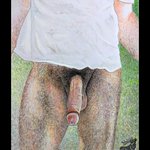
ISO-20 Adam - No. 34 | Lawn Study, 2020/2026
Pencils, pens and markers on sketch paper
29.7 × 42 cm
Approximately 6 hours
Model: Gareth, United Kingdom
A cropped adult male figure stands against green grass. A loose white T-shirt occupies much of the upper half of the drawing, while the head remains beyond the frame. Below it, skin, body hair and intimate anatomy are rendered with far denser marks.
That is the visible 80 percent: an adult male figure divided between ordinary clothing and direct bodily visibility, standing against an equally ordinary patch of grass.
The remaining 20 percent begins when the crop starts to work against that apparent casualness.
The setting is casual. The crop is not.
The shirt stays on. The lawn remains around the edges. Yet the face, the part of the body through which we most readily recognise another person, has disappeared. Attention is concentrated elsewhere.
That changes the drawing. The lawn and T-shirt carry the language of everyday life, but the composition is highly selective. Whatever the original moment may have been, the finished image has been arranged for looking.
Lawn Study names the ground, but the body controls the picture.
The marks reinforce that pull. The shirt is pale and lightly worked. Grass gathers in loose green lines. Skin and body hair become denser as the eye moves down the sheet.
There is also a question of masculinity here. No occupation, heroic gesture or public role tells us what kind of man this is. The body carries almost all of that weight. With the face absent, masculinity becomes something encountered through visibility, clothing, hair, posture and the fact of being looked at.
That is why I no longer think “casual enough not to perform” quite describes the drawing. The ordinary setting may soften the encounter, but the crop makes the act of looking deliberate.
For me, Lawn Study lives in that tension. A T-shirt and patch of grass make the scene feel everyday, while the crop removes ordinary social recognition and brings the body insistently forward.
The lawn makes the body ordinary. The crop makes the looking deliberate.
– ISO-20 Adam
See. Recognise. Question. Return. See it differently.
Artwork and image: ISO-20 Adam.
Authorship: A heavily human-directed, AI-assisted commentary by ISO-20 Adam. Please do not copy, adapt or monetise without permission and clear attribution.
#FigurativeArt #Drawing #Penis #Masculinity

WHEN DOES A PIECE OF CLOTH BEGIN TO LOOK LIKE A WING?
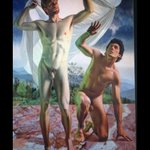
Rodolfo Meli – Icaro, reported 1988
Italian, born 1948
Colour lithograph on paper
Reported dimensions: 58 × 74 cm
Collection and edition: unverified
Two adult male figures occupy a stone terrace beneath a blue sky. One stands with both arms raised, holding a white cloth behind his shoulders. The other kneels, one hand against the ground and the other lifted. Both look upward.
That is the visible 80 percent: two grounded figures, an open sheet, raised gestures and a sky towards which their attention is directed.
The remaining 20 percent begins when the title asks us to see Icarus there.
Without Icaro, the cloth remains simply cloth and the scene could remain two men staging a pose. The title changes the conditions of looking. Held behind the shoulders, the white fabric can begin to suggest wings without ever ceasing to look like fabric.
The myth enters through the name before it enters through action.
Nothing has flown. Nothing has fallen. There are no feathers, no melting wax and no body dropping from the sky. What matters is not catastrophe but preparation, performance and possibility.
The second figure keeps that reading open. He may simply counter the standing body formally, one hand grounded while the other rises. But he may also invite the thought of Daedalus, making this less an image of Icarus alone than a staged moment before flight.
That theatricality belongs comfortably within Meli’s practice, where figures could be dressed with veils, masks and improvised costume, and where the classical world increasingly entered his work during the late 1980s. The terrace can therefore read as both studio invention and mythic stage.
For me, Icaro is strongest when the cloth is allowed to remain visibly ordinary. The title does not prove that it has become a wing. It makes us test how little an object needs to change before myth begins to gather around it.
The sheet stays a sheet. Icarus begins in the way we are taught to see it.
– ISO-20 Adam
See. Recognise. Question. Return. See it differently.
Image use: reproduced for criticism, review and art-historical commentary.
Image source: unresolved.
Authorship: A heavily human-directed, AI-assisted commentary by ISO-20 Adam. Do not copy, adapt or monetise without permission and clear attribution.
#RodolfoMeli #Icarus #ArtHistory

WHAT HAPPENS WHEN THE BODY OWNS THE CENTRE, BUT NOT ALL THE ATTENTION?
Ellen Altfest – Penis, 2006
American, born 1970
Oil on canvas
28.4 × 30.3 cm
A tightly cropped adult male body almost fills the canvas. Thighs press in from both sides, a hand enters at upper left, and the central anatomy rests above a battered, paint-spattered stool. Hair, skin, a fingernail, folds and chipped paint are all described with the same stubborn persistence.
That is the visible 80 percent: a body made almost impossible to look past, isolated so tightly that portraiture and narrative fall away.
The remaining 20 percent begins when the stool refuses to remain background.
The method predates the man. Before 2006, rocks, plants and wood had already received this same prolonged scrutiny. Here that still-life intensity is brought to a human subject carrying a very different cultural charge.
The title names the centre with blunt directness. The paint distributes attention more widely. Hair on a thigh, a fingernail, folds of skin and flecks of paint on worn wood receive comparable descriptive care.
The hierarchy of subject remains. The hierarchy of description begins to flatten.
This was the first painting in Altfest’s sustained engagement with the male body and appeared in Men, the exhibition she curated in 2006. Yet there is no heroic pose, public role or face through which to construct a portrait. The body approaches still life without ever becoming neutral.
Its charge remains. What changes is where the looking goes.
For me, Penis becomes most compelling when flesh and furniture begin to trade properties. The body becomes surface, the stool gains presence, and the charged centre no longer monopolises the painter’s attention.
The body owns the centre. It does not own all the attention.
– ISO-20 Adam
See. Recognise. Question. Return. See it differently.
Image use: reproduced for criticism, review and art-historical commentary.
Image source: Charles Saatchi.
Authorship: Human-directed, AI-assisted commentary by ISO-20 Adam. Do not copy, adapt or monetise without permission and clear attribution.
#EllenAltfest #ArtHistory #Penis

WHAT KEEPS WORKING AFTER MEANING HAS GONE?
Otto Rapp – Deterioration of Mind Over Matter, 1973
Austrian-born Canadian artist, born 1944
Acrylic on canvas
50.8 × 71.1 cm
A colossal skull-like head rises from an impossible ruined landscape. Its cranium opens into dark cavities and pale web-like structures; one glossy eye still looks outward while the other socket holds an opaque orb. Teeth become architecture, a circular cage occupies the mouth, a spiral staircase descends through the ruin, and two tiny naked figures stand below.
Then there is the safety pin.
That is the visible 80 percent: a meticulously constructed nightmare of bodily decay, fractured perception and matter coming apart. Yet amid the rupture, small mechanisms of order remain perfectly legible – a pin, a cage, a staircase, an eye that continues to look.
The remaining 20 percent begins when the safety pin, cage and staircase are read together.
One fastens. One confines. One directs movement. All three continue to perform their functions inside a structure whose larger purpose can no longer be found.
The safety pin is almost absurd in its inadequacy. It closes one small split while the cranium remains ruptured around it. Repair survives, but restoration does not.
The cage and staircase deepen the contradiction. The cage still confines; the staircase still offers a route. Yet neither tells us what confinement or movement now serves.
The mechanisms continue because continuing is all they know how to do.
The head itself has become infrastructure. Bone turns into terrace, the mouth into enclosure, the staircase into a path through bodily ruin. The two tiny figures establish its enormous scale, but nothing visible suggests they can repair the whole.
The skull is not inside the ruin. It has become the ruin.
And still the eye looks.
That may be the painting’s sharpest contradiction. Perception appears to continue even though no coherent centre behind it can be located. Looking survives. Understanding does not.
The title complicates the familiar promise of “mind over matter.” Here, mind and matter do not simply compete. They deteriorate into one another – flesh becoming architecture, architecture becoming anatomy, thought becoming structure without an intelligible centre.
The wider implication is difficult to miss without turning the painting into a fixed allegory. Human systems can preserve procedures, restrictions and routes long after the intelligence or purpose that once connected them has become inaccessible. Repair continues without restoration. Movement continues without destination.
The structure remains. The reason for it does not.
For me, Deterioration of Mind Over Matter becomes most unsettling when it stops being merely an image of decay. The pin still fastens, the cage still confines, the staircase still descends and the eye still looks. Decay is not the opposite of order here – it is order continuing after meaning has gone.
Look again at the safety pin, then the cage, the staircase and finally the eye. Everything still works. That is precisely the horror.
– ISO-20 Adam
See. Recognise. Question. Return. See it differently.
Authorship: Human-directed, AI-assisted commentary by ISO-20 Adam. Do not copy, adapt or monetise without permission and clear attribution.
#OttoRapp #ArtHistory

A HUMAN DOING
ISO-20 Adam – Ataraxia, 1996
29.7 × 42.0 cm
Private collection
A male figure sits against a cityscape, chained at the legs and surrounded by his own waste. A padlock closes the chains, while the key that opens it hangs from the wrist. Blockwork and clockwork hold the body together – repeated DOs form its frame, while a central clock keeps time for endless DOING. A tap enters the head, drawing out thought itself.
Above, stars are sucked into the heart. The figure squeezes gold blood from it, and that value appears again as a gold dollar coin on the tongue. Money is swallowed by an enlarged gut and returned to the world as more waste.
At the bottom is one word: ATARAXIA – calm, steadiness, freedom from disturbance.
Nothing here is calm.
That is the visible 80 percent: a human body reorganised around doing, extraction, consumption and waste. The body is not merely trapped inside a system – the system has become part of how the body functions.
This is not a human being at rest. It is a human doing.
The remaining 20 percent begins when the identity of the figure is revealed.
It is me at twenty-eight. This is a self-portrait.
For months I built the page dot by dot. The repetition that made the drawing became its subject. A person can become so organised around usefulness that doing begins to replace being.
Seen as a self-portrait, the circulation through the body becomes more intimate. The stars that should offer orientation are pulled into the heart. Gold blood is squeezed from it and becomes money on the tongue. Thought is tapped from the head. What might guide, feel or think is drawn into a machinery of value.
Then appetite takes over. Money enters the enlarged gut and emerges as waste, leaving the figure sitting inside the consequences of the cycle.
Light becomes value. Thought becomes resource. Money becomes waste.
And still the key hangs from the wrist, close to the padlock it can open.
Release is physically present, but not yet enacted.
Before the key can be used, the chain has to be recognised, the lock understood and the endless DOING seen for what it has become.
Ataraxia does not describe the figure’s condition. It names what lies beyond it – calm not as escape from life, but as release from a life in which worth has become inseparable from perpetual activity.
For me, Ataraxia is a self-portrait of a young man who had become a human doing before he understood how to become more fully a human being. The body is built around performance and extraction, yet the means of release remains attached to the same person.
Look again at the blockwork and clockwork, the tap at the head, the stars entering the heart, the gold blood, the coin on the tongue, the gut, the waste, the padlock and finally the key. ATARAXIA is not where the figure is. It is what becomes possible when doing no longer consumes being.
– ISO-20 Adam
See. Recognise. Question. Return. See it differently.
Authorship: Human-directed, AI-assisted commentary by ISO-20 Adam. Do not copy, adapt or monetise without permission and clear attribution.
#ISO20Adam #SelfPortrait

WHAT IF THE COMMITMENT IS THE PRISON?
Berthe Brincour – Untitled (Male Nude, Moving through Space II), c. 1918–25
Luxembourgish, 1879–1947
Oil on canvas
66 × 76 cm
MNAHA, Luxembourg
A male nude moves through a pale, clouded space – perhaps falling, flying or crawling. The head thrusts forward while the body folds violently behind it: neck extended, torso hollowed, legs doubled back, one hand spread across the thigh.
That is the visible 80 percent: a body committed to movement despite a space that offers no obvious ground, horizon or surface against which to brace. Anatomy becomes its own support.
The remaining 20 percent begins when the face and body stop telling the same story. One eye fixes beyond the edge of the canvas and the mouth remains set, while everything behind that determination bends, compresses and strains.
The face insists on direction. The body records the cost.
The distortion is not merely anatomical. It changes what persistence looks like. The figure does not move through space by remaining intact – the body seems to reshape itself around the demand to continue.
That is where the masculine reading becomes more difficult. Endurance can be strength, but strength can also become a command from which the body is no longer permitted to withdraw. Persistence ceases to serve the man when continuing becomes more important than preserving him.
Stopping need not mean surrender. Sometimes it is the act that preserves what endurance was meant to protect.
There is no peaceful release here. The eye still points forward. The body remains caught inside the effort.
For me, Untitled (Male Nude, Moving through Space II) is most compelling at that threshold between perseverance and captivity. The figure still appears committed to a direction even as the body contorts around that commitment. What begins as endurance can become a prison when continuing is no longer a choice.
Look again at the eye, then the hollowed torso, then the hand spread across the thigh. The direction remains. The body has become the price of keeping it.
– ISO-20 Adam
See. Recognise. Question. Return. See it differently.
Authorship: Human-directed, AI-assisted commentary by ISO-20 Adam. Do not copy, adapt or monetise without permission and clear attribution.
#BertheBrincour #ArtHistory

WHAT IF SEEING MORE MEANS KNOWING LESS?
Robert E. Burnett – Untitled, 1936
American, 20th century
Oil on panel
61.0 × 45.7 cm
Current collection unverified
A male figure sits in a blue-green chair, the body turned towards us while the head and gaze move sharply away. Styled hair, an arranged pose and the decorative chair give the scene a deliberate formality, yet the dark, cream, orange and blue-green shapes behind the sitter refuse to settle into a recognisable place.
That is the visible 80 percent: a carefully staged male figure whose physical presence is remarkably clear while almost everything that might explain the person remains absent.
The remaining 20 percent begins when greater visual access produces almost no greater knowledge. There is no clothing, occupation, companion or identifiable setting to place the sitter socially. Even the chair supports the body without telling us where that body belongs.
The more clearly we see the figure, the less securely we can place the man.
That tension is strengthened by the pose. The body faces us, but the gaze does not return ours. Physical visibility therefore stops short of mutual recognition. We can study form, strength, grooming and posture while remaining almost entirely outside the sitter’s interior world.
Masculinity is unusually detached from role here. No labour, uniform, weapon, contest or heroic narrative explains the body. Strength remains visible, but it is not being spent on anything. The figure occupies space without giving us the usual evidence by which manhood is socially measured.
The body is highly legible. The person remains unresolved.
For me, Untitled reaches the limit of what looking can give us. We may see physique, grooming, pose and physical presence with extraordinary clarity and still know remarkably little about the person before us. Visibility creates knowledge of the body, but not possession of the self.
Look again at the body, then the turned face, then the strange space behind the chair. Almost everything is visible. Almost nothing explains him.
– ISO-20 Adam
See. Recognise. Question. Return. See it differently.
Authorship: Human-directed, AI-assisted commentary by ISO-20 Adam. Do not copy, adapt or monetise without permission and clear attribution.
#RobertEBurnett #ArtHistory

WHAT IF EXCESS IS NOT A WAY OF DIMINISHING A MAN, BUT A WAY OF SEEING HIM MORE COMPLETELY?
Alice Neel – Joe Gould, 1933
American, 1900–1984
Oil on canvas
99.1 × 79.1 cm
Private collection, reported
A thin male nude sits frontally against an intense red ground, legs spread, eyes fixed towards us and a broad grin held across the face. One hand grips a dark cigarette holder. Three sets of genital forms occupy the central body while two cropped versions of the male figure press in from either side. Beneath them, “Joe Gould 1933” is written directly into the painting.
That is the visible 80 percent: a particular man made almost spectacularly visible. The narrow chest and bony frame remain recognisably human while anatomy multiplies beyond possibility. Yet the excess does not displace Gould. His face, gaze, grin and written name keep returning us to the person at the centre.
The remaining 20 percent begins when Gould’s public life enters the picture. A Harvard-educated Greenwich Village eccentric, writer and tireless self-inventor, he claimed to be creating an immense Oral History of Our Time. Neel knew the theatrical character behind that legend. She later recalled his appetite for attention and even considered A Portrait of an Exhibitionist as another way of thinking about the painting.
The painting does not strip Gould of his self-myth. It gives the self-myth a body.
That body is excessive, comic and deliberately strange. But the humour does not require contempt. Neel herself joked about circumcision and Russian onion domes when discussing the repeated forms. The multiplication can therefore be bodily satire, visual play and an affectionate recognition of Gould’s extravagance at the same time.
The craft holds those possibilities together. The central figure is almost symmetrically staged, then disrupted by the flanking repetitions. Pale yellow-green flesh pushes sharply against the red ground, while dark contour keeps the distorted anatomy legible. Face, chest, repeated genital forms, chair and written name descend through the centre like a deliberately unstable column.
Gould’s grin matters because it refuses a simple story of humiliation. He is not painted as a defeated man whose performance has collapsed. He remains engaged in the spectacle of himself, looking back at us from inside it.
And Gould seems to have recognised something of himself there. He was proud of the painting, returned to look at it, and later called it an “underground masterpiece.” Whatever Neel exaggerated, the sitter did not simply experience the result as an attack.
A man’s performance can be part of who he is without becoming all that he is.
That is also where the masculinity of the picture becomes more interesting. Virility is amplified almost to absurdity, yet masculine presence is not reduced to anatomy. The eyes, grin, name and central body resist that flattening. Performance and vulnerability remain visible together.
For me, Joe Gould is most compelling because Neel allows excess without withdrawing recognition. She paints the theatrical self, the vulnerable body and the named individual at once. The repeated anatomy may enlarge Gould’s performance, but the portrait keeps restoring the man who lived it.
Look again at the grin, the cigarette holder, the red ground and the written name. The spectacle grows around Joe Gould. He never disappears inside it.
– ISO-20 Adam
See. Recognise. Question. Return. See it differently.
Image permission: not secured.
Authorship: Human-directed, AI-assisted commentary by ISO-20 Adam. Do not copy, adapt or monetise without permission and clear attribution.
Documentation: Current ownership is reported as a private collection.
#ArtHistory

WHAT HAPPENS WHEN A LIVING BODY BENDS TOWARDS A SKULL?
Jean-Baptiste François Désoria – Torse ou demi-figure peinte, 1786
French, 1758–1832
Oil on canvas
Beaux-Arts de Paris
An adult male figure bends towards a skull. The head and gaze descend with it; one hand spreads across the bone while the other holds a small, unidentified object. Strong light gives weight and warmth to the torso as darkness gathers around it.
That is the visible 80 percent: an academic study of anatomy, light, weight and the living male body. Muscle, shoulder and arm are carefully modelled; the skull is smaller, harder and still.
The remaining 20 percent begins when the gaze and both arms converge on the skull. The work was painted for the 1786 Concours de la Demi-Figure peinte, in which artists had one week to paint a life-size half-figure from the model. What begins as an exercise in rendering the living body therefore acquires another pressure from the object held beneath it.
Life is being studied beside the shape of its ending.
Whatever practical role the skull served in the studio, its association with mortality is difficult to silence. Warm flesh receives the light while bone offers no answering life. The body is strong, but the composition bends that strength towards something it cannot overpower.
That changes the masculine ideal as well. Strength is fully present – muscular, embodied, disciplined – but there is no opponent to defeat and no heroic action to complete. The encounter is quieter: a living man brought close to the limit shared by every body.
Strength matters here precisely because it cannot defeat mortality.
For me, Torse ou demi-figure peinte becomes most compelling when the academic exercise and the memento-mori reading begin to reinforce one another. Mastery of the living body is placed beside what no mastery can prevent. The figure does not become less masculine because strength has a limit; the limit gives that strength its human scale.
Look again at the torso, then the lowered face, then the skull. The light belongs to the living body. The skull waits beneath it.
– ISO-20 Adam
See. Recognise. Question. Return. See it differently.
Authorship: Human-directed, AI-assisted commentary by ISO-20 Adam. Do not copy, adapt or monetise without permission and clear attribution.
#JeanBaptisteFrancoisDesoria #ArtHistory

WHAT HAPPENS WHEN A MAN BECOMES THE BODY OF A MYTH?
John Singer Sargent – Nude Study of Thomas E. McKeller, c. 1917–20
American, 1856–1925
Oil on canvas
125.7 × 84.5 cm
Museum of Fine Arts, Boston
A male figure rises through the canvas. The torso lifts, the head falls back and the body opens beneath pale wings. Strength and exposure occupy the same pose.
That is the visible 80 percent: an idealised male body held between tension and release, flesh and wings, human weight and the beginnings of something mythic.
The remaining 20 percent begins when the sitter’s name opens onto the history behind the painting. Thomas Eugene McKeller was a young Black elevator attendant whom Sargent met in Boston in 1916. McKeller became the principal model for figures developed for the Museum of Fine Arts murals.
The body before us did not merely resemble Sargent’s heroic visual language. It helped generate it.
That changes the wings. McKeller’s physique could be translated into Apollo, Eros, Atlas and other classical or allegorical bodies. In the finished public works, bodily strength remained while racial identity and individual name could disappear into idealised myth.
Here, that transformation is incomplete. The wings are behind the sitter, but Thomas McKeller remains in front. Monumental strength does not emerge from nowhere: an actual body had to hold the pose, carry the strain and make the imagined body possible.
There is masculine force here – breadth, muscle, endurance, physical command – but the painting also exposes the dependence beneath heroic imagery. Strength can be admired without the man who embodies it becoming anonymous.
For me, Nude Study of Thomas E. McKeller becomes most powerful in that interval before the working model is translated into myth. The heroic ideal is already forming around McKeller, but the man has not yet disappeared inside it. Strength remains attached to personhood.
Look again at the wings, then at the man before them. Myth is waiting behind him. Thomas McKeller is still here.
– ISO-20 Adam
See. Recognise. Question. Return. See it differently.
Authorship: Human-directed, AI-assisted commentary by ISO-20 Adam. Do not copy, adapt or monetise without permission and clear attribution.
#JohnSingerSargent #ArtHistory

WHAT HAPPENS WHEN THE CROWD DISAPPEARS?
Charles Gleyre – Mucius Scaevola, 1858
Swiss, 1806–1874
Painting on canvas
97 × 77 cm
An adult male figure rises from the dark. The right arm descends towards a glowing brazier; the left-hand rests across the chest. The torso faces us while the head turns away. Almost no setting, no witness, no explanation. Only a body beside fire.
That is the visible 80 percent: a modelled male figure, one hand held over flame, the other across the chest, and a face that gives almost nothing back. Strength appears as stillness, restraint and bodily self-command.
The remaining 20 percent begins when the title names Mucius Scaevola. In Livy’s account, Mucius is captured after a failed attempt to kill the Etruscan king Lars Porsenna and deliberately holds his right hand in the fire to demonstrate Roman resolve. The hand burns while the man behaves as though pain has lost its authority.
The painting keeps that legendary stoicism and removes almost everything around it. No Porsenna. No soldiers. No spectators. History contracts until one body must carry the whole story.
That changes the masculine ideal as well. Courage, discipline, endurance and duty remain unmistakable, but without the crowd the act becomes less a public spectacle of heroism than an encounter with its bodily cost. The figure can withstand pain, yet the heroic code seems to require something more severe: pain must not merely be endured but almost denied.
The composition makes that denial visible. The arm descends towards the fire while the profile turns away from it. One hand suffers; the other closes across the chest. The body contains the ordeal rather than releasing it.
This is where strength and invulnerability begin to separate. Endurance may be admirable. Self-command may be necessary. But when a man must become unreadable even to his own suffering, mastery approaches self-erasure.
The fire itself introduces another tension. In this reproduction, the hand nearest the brazier catches remarkably little reflected glow. The heat is stronger in the story than in the light. We believe the danger because Livy and the title tell us what is happening, while the anatomy, profile and modelling keep us with the figure.
The year adds resonance without becoming a secret key. Gleyre was a committed republican, and Romans Under the Yoke was also completed in 1858, placing resistance and independence elsewhere in his work. That does not make Mucius Scaevola a coded political statement, but it places this solitary endurance within a broader concern with resistance.
For me, the painting becomes most powerful when courage and invulnerability stop meaning the same thing. Livy gives us a man who will not yield to pain. Gleyre removes the audience and leaves us with what that ideal asks of the body.
Keep the courage. Keep the endurance. Keep the willingness to stand for something beyond oneself. But perhaps manhood need not require pain to become invisible before strength can be believed.
Look again at the hand, then the face. One remains with the fire; the other has already turned away.
– ISO-20 Adam
See. Recognise. Question. Return. See it differently.
Documentation: Auction records support the 1858 date and 97 × 77 cm dimensions; the current collection and exact paint medium remain unresolved.
Authorship: Human-directed, AI-assisted commentary by ISO-20 Adam. Do not copy, adapt or monetise without permission and clear attribution.
#CharlesGleyre #ArtHistory

WHAT IF THE KING IS CHOSEN BY THE MOON?
Stagwarlock Unleashed – Moonbound King, 2026
French
Human-directed AI-generated digital image
Midjourney + private Stable Diffusion, digitally reworked
A king sits before a moon so vast it seems to rise with the body itself.
No crown. No robe. No armour. No sceptre.
And that absence is deliberate.
The creator’s own caption gives us the key: “The Moon chose no crown. She chose me.”
That is the visible 80 percent: a solitary male figure enthroned between cold blue forms, a pale moon swelling behind the head and shoulders, strength and bodily presence made monumental against the darkness.
The remaining 20 percent begins when kingship moves away from what can be worn.
The throne establishes rank, but almost every other conventional sign of royalty has disappeared. The body has to carry what the crown normally would: authority, confidence, beauty, presence.
Even the gaze refuses the obvious performance. The figure faces us completely, yet attention rises beyond us, towards something the image never allows us to see.
The body is here. The attention belongs elsewhere.
The moon is central to that relationship. In the creator’s personal symbolic language, lunar energy is female. Setting such an emphatically male body against it was intentional, including the highly detailed penis at the centre of the composition.
That detail was not simply accepted from the software.
Working from prompts rather than photographs or real models, the creator found that the AI systems repeatedly produced a narrow range of male anatomy. This particular result mattered because it came closer to the variety of male bodies the creator wanted to represent. The generated image was then reworked with a digital graphics tool.
What looks inevitable was reached through choosing, refusing and revising.
That process belongs to a larger imagined world. Stagwarlock describes the practice as bringing paganism and fantasy together while highlighting brotherhood and masculinity. Brotherhood is not literally pictured here – this king sits alone – but masculinity is unmistakably being imagined within that wider world of male connection, myth and older religious traditions.
There is something important in that distinction. Masculinity here is not presented as an argument about identity or community representation. It emerges through myth: body, strength, beauty, kingship, pagan imagination and the possibility of bonds between men carrying meanings older than contemporary categories.
For me, Moonbound King becomes most compelling where the creator’s words and the image meet.
The Moon does not place a crown upon the king. She chooses the king instead.
Once that happens, crown, robe and sceptre become unnecessary. Authority has moved into the body itself.
Look again at the moon, then the throne, then the body between them.
The Moon chose no crown. She chose the king.
– ISO-20 Adam
See. Recognise. Question. Return. See it differently.
Image reproduced with permission of Stagwarlock Unleashed (@stagwarlock).
Authorship: Human-directed, AI-assisted commentary by ISO-20 Adam. Do not copy, adapt or monetise without permission and clear attribution.
#MoonKing #Stagwarlock

WHAT HAPPENS WHEN AN ACADEMY MODEL LOOKS BACK?
Bolesław Barbacki – Studium aktu męskiego (Study of a Male Nude), 1914
Polish, 1891–1941
Oil on canvas
150 × 90 cm
The sitter rests on a wooden box, the body extending almost the full height of the canvas. Arms fold tightly across the chest. The head turns towards us.
And then there are the eyes.
That is the visible 80 percent: an academic male figure built from flesh, weight, light and shadow, but given a face too particular to pass unnoticed. Dark parted hair. A moustache. Colour rising through the cheeks. A gaze that meets our own.
The remaining 20 percent begins with a contradiction in the pose.
The body is there to be studied. The folded arms seem to gather something back.
Those crossed arms do not tell us whether the sitter is shy, guarded or simply holding a difficult position. The painting does not give us enough to know. What we can see is structural: they draw a firm band across the chest, compacting the centre of a body otherwise laid open to observation.
The pose opens and closes at once.
Then the gaze changes the terms of looking.
An academy model is there because others are looking. Anatomy, proportion, weight, flesh and tone all depend upon sustained observation. Yet here observation does not travel in only one direction.
We look at the sitter. The sitter looks back.
That reciprocity makes the academic exercise unexpectedly personal. The face prevents the body from dissolving into anatomy. Hair, moustache, flushed skin and individual features keep returning us to the particular person sitting on the box.
There is another tension here. The academy asks for stillness, but the face feels alert. The body holds the pose while the eyes remain active.
Portraiture would later become central to this artist’s practice. It would be too neat to read that future backwards into a student painting. Yet something of portraiture already presses through the exercise: the model is not reduced to a type. Individuality survives the lesson.
Masculinity here is neither heroic nor theatrical. It exists under scrutiny: physically present, closely observed, yet not emptied of privacy or self-possession.
For me, that is where the painting becomes more than a lesson in how to render the male body. The folded arms gather the figure inward while the gaze reaches outward. Observation encounters personhood.
The body can be studied without the sitter disappearing inside the study.
Look again at the arms.
Then look at the eyes.
The pose closes. The gaze opens.
– ISO-20 Adam
See. Recognise. Question. Return. See it differently.
Image source: DESA Unicum / OneBid. Present location unverified.
Authorship: Human-directed, AI-assisted commentary by ISO-20 Adam. Do not copy, adapt or monetise without permission and clear attribution.
#BoleslawBarbacki #ArtHistory
