

CEO & co-founder @Neuraan. AI agents that run enterprise field operations. Writing about the 3 in 4 jobs that don't happen at a desk.
Mexico
Joined August 2009
- Tweets14.8K
- Following2.6K
- Followers1.5K
- Likes2.9K





Early look at what we’re testing with a few @neuraan customers.
Three buttons. That’s the whole interface.
Every interface is custom, for each company and each user.
This is how we think software should work now: it does the work and only asks you what a person needs to decide.

El año pasado, en este mismo café, me encontré con Ben Horowitz, cofundador de Andreessen Horowitz (@a16z ). Estaba tomándose un café antes de irse a una comida. Me acerqué, platiqué con él y me presenté.
Hoy arranca la @MexicoTechWeek: más de 600 eventos en la ciudad, con fundadores, corporativos e inversionistas. Si puedes darte una vuelta, ven.
#MexicoTechWeek
Last quarter we learned a lot about field operations and the challenge of coordinating work that today happens over WhatsApp, SMS, phone calls, and countless spreadsheets.
We're very excited about the next version of the product.

We promised a pilot in 28 days and it took four months. Operations validated it; the day the annual proposal arrived, leadership paused it. We hadn’t signed a closing plan. Step 3 of the guide is that: write the decision before you start.


I’ll be at @MexicoTechWeek in CDMX, Oct 26-30, to meet COOs, CTOs and CIOs with lots of people in the field: technicians, drivers, crews, route supervisors.
At @neuraan we coordinate field work, the kind that doesn’t happen at a desk. DMs open.
Nobody puts this job on the org chart, but every field operation depends on it: someone chasing each case so the process moves.
We're building agents that carry the case, so she can spend her day on what the rules don't cover.
The script is ours. Characters, scenes and voices are AI.


I'm amazed about what foundational models now technically allow us to do, and to standout you need passion, ambition, and taste... incredible times to be alive and build stuff that matters.
Israel Cauich Viñas retweeted

Dusting off this tweet from April because this gap in shared understanding of LLM capability is *widening*. It's now less "two groups of people speaking past each other" and more a sharp funnel.
- Napkin math somewhere around 6B people (~75% of the population) have barely come in contact with LLMs at all.
- Around 1-2B (~20%) are casual and infrequent users of free-tier ChatGPT-like products. This group sees derpy chatbots and treats them a bit like a better Google search, a writing aid, or etc. Maybe an agent tries to book you a flight. I have non-tech friends who (reasonably, imo) say they have not much use for it at all. Even many professionals outside of math&code are in this tier. For example, execs and many other functions spend a lot of their time talking to other people, so while they understand what is happening intellectually, it is still second-hand and a bit abstract.
- Now we get to professional use of frontier-grade LLMs in math&code. Somewhere around 20M people (0.2%) see first-hand that large, complex projects that used to take them weeks/months can now be completed by agents with a prompt. Building apps, copying apps, translating apps, decompiling apps from binaries... This has all happened very quickly and recently - less than 1 year ago, I was writing code manually by hand, typing memorized computer code commands into a code editor character by character, occasionally pressing Tab to autocomplete a little chunk of code.
- And finally we get to the ~5,000 people (~0.00006%) with access to frontier-grade systems internally. The external world has seen the preview. It looks like swarms of thousands of agents collaborating over weeks on software mega projects: minting zero days, running cyber attacks and defenses at machine speeds, discovering new science, advancing the frontier of mathematics. Things that would have taken top professionals in the industry years of work. Meanwhile, human review and comprehension are starting to fall behind. For example, people are still involved in the "archeology" of the OpenAI-HF incident from many months ago. Mathematicians may be poring over the 722 manuscripts on frontier mathematics for a while.
The funnel is driven by a combination of factors:
1. The impact scales with ambition, problem size, and horizon. A question with a paragraph answer barely stresses the system. You need a reservoir of big, difficult problems that you really care about. This aspect drives the consumer / professional dimension of the funnel.
2. The jaggedness of the system (which I have written about a lot separately). Capability peaks in domains that are digital, verifiable and economically valuable. This is because LLM capability emerges from reinforcement learning on verifiable rewards on a curated environment mixture driven by revenue potential. This aspect primarily drives the area (e.g. math&code) dimension of the funnel.
3. Access. Free-tier, paid-tier, internal.
So this is the weirdness of the moment. The general public has mostly not interacted with these systems. When they have, it looks like a derpy chatbot. The majority of professionals still see only a modest uplift. And a small sliver of professionals are experiencing the vertigo of the curve going vertical. And it is all happening at the same time.

Judging by my tl there is a growing gap in understanding of AI capability.
The first issue I think is around recency and tier of use. I think a lot of people tried the free tier of ChatGPT somewhere last year and allowed it to inform their views on AI a little too much. This is a group of reactions laughing at various quirks of the models, hallucinations, etc. Yes I also saw the viral videos of OpenAI's Advanced Voice mode fumbling simple queries like "should I drive or walk to the carwash". The thing is that these free and old/deprecated models don't reflect the capability in the latest round of state of the art agentic models of this year, especially OpenAI Codex and Claude Code.
But that brings me to the second issue. Even if people paid $200/month to use the state of the art models, a lot of the capabilities are relatively "peaky" in highly technical areas. Typical queries around search, writing, advice, etc. are *not* the domain that has made the most noticeable and dramatic strides in capability. Partly, this is due to the technical details of reinforcement learning and its use of verifiable rewards. But partly, it's also because these use cases are not sufficiently prioritized by the companies in their hillclimbing because they don't lead to as much $$$ value. The goldmines are elsewhere, and the focus comes along.
So that brings me to the second group of people, who *both* 1) pay for and use the state of the art frontier agentic models (OpenAI Codex / Claude Code) and 2) do so professionally in technical domains like programming, math and research. This group of people is subject to the highest amount of "AI Psychosis" because the recent improvements in these domains as of this year have been nothing short of staggering. When you hand a computer terminal to one of these models, you can now watch them melt programming problems that you'd normally expect to take days/weeks of work. It's this second group of people that assigns a much greater gravity to the capabilities, their slope, and various cyber-related repercussions.
TLDR the people in these two groups are speaking past each other. It really is simultaneously the case that OpenAI's free and I think slightly orphaned (?) "Advanced Voice Mode" will fumble the dumbest questions in your Instagram's reels and *at the same time*, OpenAI's highest-tier and paid Codex model will go off for 1 hour to coherently restructure an entire code base, or find and exploit vulnerabilities in computer systems. This part really works and has made dramatic strides because 2 properties: 1) these domains offer explicit reward functions that are verifiable meaning they are easily amenable to reinforcement learning training (e.g. unit tests passed yes or no, in contrast to writing, which is much harder to explicitly judge), but also 2) they are a lot more valuable in b2b settings, meaning that the biggest fraction of the team is focused on improving them. So here we are.
Prompt engineering, 2026: "Make it really good." @bcherny just made the meme canon.


After several AI pilots in field operations, we learned what makes them move forward.
First, involve the people who run the process every day. We know what middle and senior management want to achieve, but the people on the ground are the ones who know the real operation. They're the ones who will use the solution, and they teach us the unwritten rules, how the process actually gets done.
Second, the person who holds the budget needs to be there at two moments. In the first session, where we define the success KPIs, always aligned with what they already measure. And in the last one, where we present the results.
When that happens, the project moves forward and it's clear where the ROI comes from.
When it doesn't, the same thing repeats: nobody follows up, nobody feels urgency to validate that it works, and approval drags on for months because the project has to be sold all over again inside the company.
That's why, before starting any pilot, we confirm who will be sitting in those two sessions.
If your company is exploring AI solutions, I hope this post is useful. And if there are other topics you think matter for a pilot to work, tell me in the replies.
If you design operations software for the 28% of Mexico that works behind a desk, you're missing most of the operation.

Most enterprise processes are not documented. They are continuously repaired by people who know where the exceptions are.
"When we talk about how AI is changing work, we're almost always talking about the other 25%: email, code, slide decks."
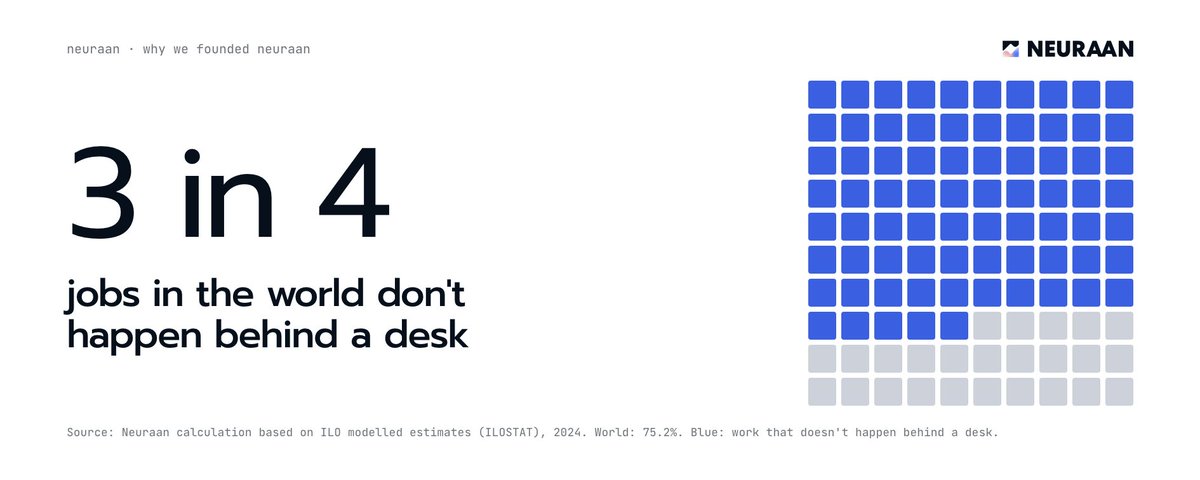
Five lessons we learned implementing AI in our clients' field operations. #2 surprised me most: this kind of operation breaks when information stops flowing, between people, between systems, or between both.

Cinco lecciones que aprendimos implementando IA en operación de campo con clientes reales. La 2 me sorprendió: la operación se rompe cuando la información deja de fluir, entre personas, sistemas o ambos.

The Meta’s VR glasses look incredibly appealing. I hope they have a long-lasting battery.

🚨 META JUST UNVEILED THE VR GLASSES
100 grams on your face - about the weight of a deck of cards. Meta says it has “the best display system that we have ever made,” and people in the demo were literally saying “it is like a computer” and “you could edit a whole movie just using the table.”
As Mark explained this is cinema, computer, and a game console all in one, with 3D space, virtual screens, hand occlusion, and DisplayPort over USB-C.
James Cameron’s reaction is probably the best quote in the whole segment “I’m inspired by what you’ve created. I’d like to see my work in these glasses.”
I am completely one shotted these look amazing!
Over the last 90 days, we focused on understanding the orchestration problems of field work in companies across Mexico, where that work is executed by people today. But with the acceleration in robotics investment and the infrastructure to support AI models, I'm sure field work in the next decade won't be exclusive to people anymore: we'll have digital agents and robots operating in the field alongside them as one team, and @neuraan will be the orchestration layer.
I'm excited to work on a challenge this fun because of the complexity we're simplifying, in industries like fleet telematics, beverages, paint and hardware retail, and financial services.
If you work at a company where people today have to wait for different systems to deliver information, or chase someone down to know the status of an operation, we can help. I'd love to connect.
