






Ivan Milenkovic retweeted

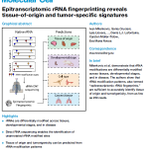
I’m thrilled to see my artwork on the #cover of @MolecularCell!
A study by @IvanBeki et al used epitranscriptomic rRNA fingerprinting to identify tissue-of-origin and tumor-specific signatures. @NovoaLab @CRGenomica
#sciart #scicomm #science #cancerresearch

Some take-home messages: 1) rRNA modifications are not only species-specific; 2) rRNA reads are not noise; 3) epitranscriptomic fingerprints can be used to identify cells, tissues, dev. stages and disease. (10/11)
Many thanks to our collaborators from Heidelberg and Bruxelles who made this possible! @LabTidow @LafontaineLab
And thanks to @QueraltTolosa for this amazing illustration of epitranscriptomic fingerprints :}

I am very proud to share that our ‘epitranscriptomic fingerprinting’ manuscript is now published in @MolecularCell ! You can access the article here: authors.elsevier.com/c/1kF25…; for highlights see the thread below. (1/11)


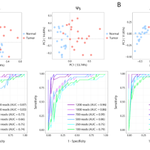
These tumor-specific fingerprints were then used for another machine learning model, which could accurately classify the matched samples as ‘normal’ or ‘tumor’ from as few as 250 reads! (8/11)

We also looked at epitranscriptomic fingerprints of matched normal-tumor lung tissues from human donors, and found tumor specific patterns. (7/11)

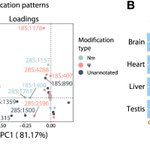
We then trained a machine learning model to predict tissues based on rRNA modification patterns (what we call here ‘epitranscriptomic fingerprints’), and it performed really well! (6/11)

Turns out that these modification patterns represent tissue specific #fingerprints (eg. some sites are more modified in the brain, while others are more modified in the liver). (5/11)

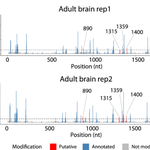
Some of the identified sites were not previously annotated, so we validated them using an orthogonal method. (4/11)

We observed that the identified dynamic sites had specific patterns across stages and tissues. (3/11)

We used @nanopore direct RNA sequencing to look at rRNA modification dynamics across several tissues and developmental stages, finding 31 differentially modified sites. (2/11)

Ivan Milenkovic retweeted

VERY excited to share SeqTagger with the world! If you want to learn more about our super-fast and accurate demultiplexing tool for direct RNA-sequencing (DRS), check out the thread below. bit.ly/3ClVYxG (1/15) 🧵
Into (r)RNA modifications? Check out the new review article by @EvaMariaNovoa and me, out today in @TrendsCellBio!


rRNA modifications are proving to be more dynamic than we used to think! Time to embrace these extra layers of complexity—cell type, developmental stage, or disease state—when analyzing rRNA mod patterns. They're not only species-specific #RNAresearch #MolecularBiology
Ivan Milenkovic retweeted

Interested in #rRNA #modifications? Pls take a look at our latest preprint, a work beautifully led by @IvanBeki, examining rRNA mod #heterogeneity across tissues, cell types, developmental stages and disease. PS. they also show promise as #biomarkers! biorxiv.org/content/10.1101/…

Ivan Milenkovic retweeted
My first preprint with the lab is out 🎉!
We benchmarked the ability of our own basecalling models to detect RNA modifications using @nanopore direct RNA sequencing.
Grab a coffee and check out the thread below 🧵!
bit.ly/40Xgugz
1/10