


JCVCrypto retweeted

Smart contract developers, please run Ultrafuzz on your contracts!! It's open source and available to anyone, consolidating many years of learnings from @aviggiano
github.com/monad-developers/…
If you run into any issues, Antonio is eager for feedback, DM him

JCVCrypto retweeted
Quantum Cadence is a step forward for consensus, delivering the properties that we think blockchains really need: quantum-security, extreme pipelining, and censorship-resistance.
We've published a primer, starting with the fundamentals:
monad.xyz/blog/quantum-caden…

JCVCrypto retweeted
.@HarryAlford3 calling his shot right now - onchain business banking will be one of the big narratives of 2027


JCVCrypto retweeted
Today, @category_xyz is sharing the full whitepaper for Monad Private Settlement Domains (MPSDs)
Quick summary:
* transactions encrypted for the domain, ordered by Monad
* operators execute in Monad’s order; no separate domain consensus
* operators submit attestations and state commitments to Monad
* contracts exchange asynchronous messages across private domains and with public Monad
* contract access rules written in Solidity
MPSDs position Monad for a future where institutions move more of their financial operations onchain. Those institutions will need privacy and control, alongside access to shared liquidity and other applications.
The design puts Monad at the center of that activity. Institutions run their applications privately while using the public network for transaction ordering and settlement.
We are building for where institutional demand is heading, so Monad can support that growth while delivering the best of all worlds between privacy, compliance, and composability.
Whitepaper link in the next tweet

Last month, we introduced Monad Private Settlement. Today, we're publishing the technical white paper.
It details private execution domains, shared sequencing on Monad, cross-domain messaging, and configurable access controls.
Read the research: category.xyz/mpsd-whitepaper
JCVCrypto retweeted

Quantum-resistant consensus without sacrificing performance
Another big step toward a post-quantum future from @category_xyz
Today we are releasing Quantum Cadence, a post-quantum version of Cadence, our consensus protocol with multiple concurrent proposers. Quantum Cadence uses no quorum certificates, and its safety and liveness do not depend on signatures.
Most modern consensus protocols, Cadence included, rely heavily on signatures and quorum certificates, which a large-scale quantum computer could forge. Simply replacing today's signatures with post-quantum ones would make certificates too large for every validator to send around in a high-performance blockchain. Quantum Cadence instead draws on Forget-IT, a recent signature-free consensus protocol co-developed by researchers at Category Labs.
Quantum Cadence still keeps the overall architecture and core guarantees of Cadence, so our Cadence prototype was easy to carry over: an AI was able to adapt it to Quantum Cadence in a few hours, and an early prototype now runs on an internal test network.
We designed Quantum Cadence to be practical for a high-performance blockchain. In our simulations, its latency is similar to Cadence's, and it scales better with the number of proposers.
Interactive explainer: category.xyz/quantum-cadence.
Full paper: arxiv.org/abs/2610.32803.
Joint work by @MohammadMJalal1, @TobiasKlenze, and @komasito55
JCVCrypto retweeted
Congrats to the @crshmarket team
Livestream prediction markets on Monad

CRSHMARKET has raised a $3.5M Seed round to build the first livestream prediction market.
This round was led by @6thManVentures , with participation from @recvcx, @lattice_fund, and @startinglinevc.
We’re building a new way to interact with live content, where anyone can predict what happens next with 60 second settlements.
JCVCrypto retweeted

Last month, we introduced Monad Private Settlement. Today, we're publishing the technical white paper.
It details private execution domains, shared sequencing on Monad, cross-domain messaging, and configurable access controls.
Read the research: category.xyz/mpsd-whitepaper
JCVCrypto retweeted

.@monad is a high-performance, institutional-grade Layer 1 blockchain enabling open access to fair financial markets on neutral ground.
The B1 Token Transparency Filing received 1 gap.
MON live since November 24, 2025.

JCVCrypto retweeted
I am a technology optimist. I believe:
1. decentralization and censorship-resistance (real versions of these properties, not larps) matter to human freedom in the coming age of AI
2. self-sovereign money, implemented by code and maintained through decentralized consensus, is the final form of money. But it needs to be truly decentralized -- cut out every possible weakness, trust assumption, keeper, etc. Of course there will be connectors to the real world - harden those maximally
3. AI will write most smart contract code. Spec-driven development with Formal Verification will be how new contracts are written rigorously. FV will also be crucial to securing all the infra including the blockchain itself
4. AI will harden our surfaces, with some unfortunate hacks in the process, but ultimately the crypto and financial industries will come out stronger
5. properly-constructed and properly-indexed data lakes will enable agents to build software far more productively
6. governments will move to restrict AI usage in the future, causing true decentralization and CR to matter in dramatic fashion
7. quantum security will be a must for any ledger where people trust their assets. And specifically, blockchains will need to deliver quantum-resistance while retaining programmability and performance. Again, no larping
8. ZK will be an important part of the puzzle too, as it'll be increasingly important to prove off-chain computation and utilize the result on chain. But again, performance and effortlessness for users will be the differentiator
9. pragmatic and composable privacy will be the missing piece for real adoption. People will use apps that stack together stablecoins, DeFi, blockchain settlement, passkey or MPC authentication, and friction-free onramps, but the part that gets fintechs over the line is knowing that user balances will remain private while still being able to tap into shared liquidity
10. blockchain will serve as the global, universal marketplace, for anyone anywhere to get the best opportunities. For that we will need guarantees of fair execution, protection from frontrunning, and a convergence of all of the best assets
At @category_xyz and the @monad Foundation, we are assembling all of these missing pieces in parallel with extreme urgency, and I hope this is clear from our actions. See you in the future


JCVCrypto retweeted
The result introduces some interesting new protocol techniques.
Dolev–Strong makes each newly convinced participant send its full evidence to everyone. In the expensive case, many participants send large, redundant sets of signatures.
The new protocol changes who does the work:
- A convinced participant announces acceptance with its own signature
- Unconvinced participants retrieve the missing evidence from multiple sources
- A procedure called Bisect assigns distinct missing signatures to sources, which limits duplicate data
- Ladder increases request sizes gradually. This limits how much communication a malicious source can waste
Commitments to sender lists, combined with graph-based checks, stop a malicious receiver from telling many sources that each must supply all the evidence.
The important difficulty is controlling costs when either side of the retrieval is malicious. The paper supplies a novel method that addresses both sides.
The cryptographic requirements are also relatively modest: signatures, a public-key infrastructure, and vector commitments that can use Merkle trees. The result does not require SNARKs or threshold signatures.
It's a major research result resolving a longstanding question in Byzantine broadcast. Super cool!
JCVCrypto retweeted
Wow, here is a substantial advancement in theoretical consensus research from @komasito55 (of @category_xyz), @ElodinStorm and Ling Ren!
It resolves a long-standing open question and improves on the previous-best O(n^3) communication complexity of the Dolev-Strong algorithm published in 1983. The new algorithm is near-quadratic while tolerating any number of faulty participants below the total
Category Labs is making fundamental research progress as they continue to improve Monad through exceptional pragmatic algorithm engineering
Dolev–Strong is arguably the best-known consensus protocol, and for roughly 45 years, no deterministic protocol improved on its O(n³) communication.
A new paper by @komasito55, Yuval Efron and Ling Ren improves that bound to O(n² log⁴ n) for Byzantine Broadcast, tolerating t < n faults in O(t) rounds.
After thinking about the problem on and off for years, they started leveraging AI models. The paper is the result of a month of human experts digesting and simplifying the discourse with AI.
JCVCrypto retweeted
More info about the Formal Verification effort on Monad: category.xyz/blogs/finding-b…

JCVCrypto retweeted
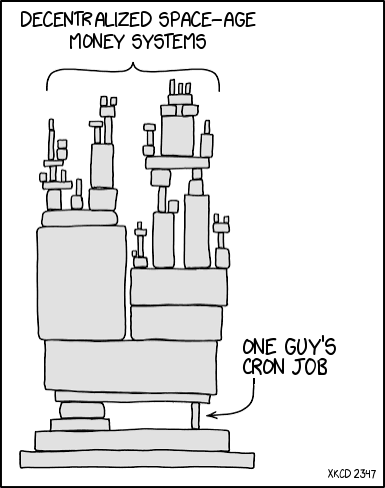
Yesterday's Railway issues, and an increasing stream of cloud provider incidents, highlight a major issue: decentralized apps have no way of scheduling or automating smart contract calls. Someone needs to run that cron on a server, which are becoming increasingly unreliable in the age of AI.
The point of decentralized systems is that we shouldn't need to rely on a single server to maintain an invariant that protects the correctness and solvency of self-sovereign money protocols. Automation needs to move to the blockchain, where a network of distributed nodes brings fault-tolerance and checks-and-balances.
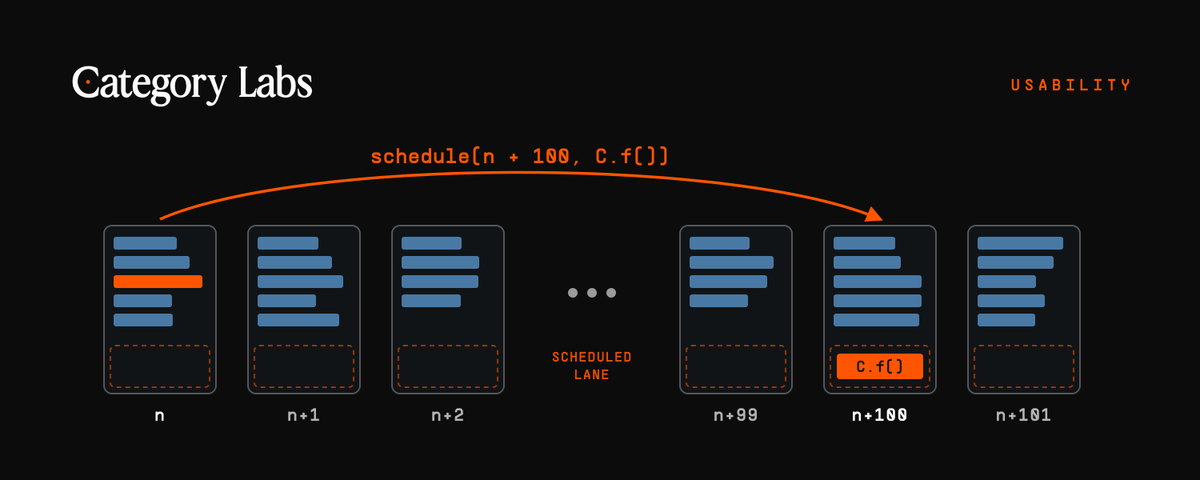
Scheduled Transactions are how we accomplish that.
Scheduled Transactions are far more than a replacement for keepers. They let users and applications alike set up interactions that recur on a cadence, happen once at a chosen moment, or follow from something that happened earlier.
Check out the details below, as well as a few examples of what you can build with Scheduled Transactions, such as on-chain keepers, recurring payments, long-running (asynchronous) computations, automatic refunds in atomic swaps, and order-book cleanup.
JCVCrypto retweeted
Welcome to Monad 🤝

ONyc is coming to @Monad through nONYC.
Built by @onrefinance, ONyc gives onchain exposure to reinsurance-backed yield, with returns generated from underwriting premiums and collateral rather than crypto-native incentives.
Until now, ONyc has been available only on Solana. nONYC packages the asset through Plume Vaults, making it deployable across supported EVM networks and opening access to new sources of capital and liquidity.
With more than $225M deployed across Solana DeFi, ONyc has already established itself as a significant RWA onchain.
Now, it’s moving beyond its original ecosystem.
This is what RWA distribution looks like: taking institutional assets that already exist and making them accessible across the networks where capital is already moving.

JCVCrypto retweeted
Metropolis submissions closed with 885 teams, 1,256 participants, and builders from 76 countries
Thank you to everyone who participated. Winners will be announced in early November

Introducing the Metropolis global hackathon
Six weeks to build the next generation of startups on Monad.
4 tracks. Over $250K in prizes for builders.
Submissions end October 13th.
monad.xyz/metropolis