

All data is valuable, all evidence is statistical, all explanation is diachrony, all inquiry is permissible. Doing Uralic (pre)historical linguistics.
University of Helsinki
Joined January 2022
- Tweets10K
- Following158
- Followers1.3K
- Likes10.6K


Pinned Tweet
In my own recent work, I have gotten carried away into outlining a first sketch reconstruction of Proto-Surmic (w/ various tangents on language contacts)
protouralic.wordpress.com/20…

Of course some other macroareal roots I think would be better approached as mainly just old areal borrowings, like "pan-African" ♯kuru for 'turtle'; turtle shells are a trade item useful for crafts!
— & I wonder if we could loop into this somehow also Late PIE *kar- 'crab'.
This phenomenon keeps mystifying me, because yeah that doesn't look like a natural Wanderwort and even within families these roots tend to be somewhat irregular; but in languages with actual ideophones I've never seen one quite to this effect for 'fly, flap, buzz etc.'


(This Hesburger fact brought to you by a long-suffering Carrols loyalist. IYKYK)

As usual, a lot of references to wanting to find things like a "glorious" past or "uplifting" the nation. Why _does_ the past need to do this? Is there not anything, or enough things, people find in modern Hungary that would be worth taking pride in?
"We descend from illiterate hunter-gatherers" is, besides, not any kind of a specific embarrassment, it is the universal human condition. Civilization is a recent development; anatomically modern humans spent hundreds of millennia in wilderness before drifting into the Neolithic.
Reading a new article from Laakso once again outlining pseudohistorical paradigms in Hungary. These sort of works are informative but I find they usually fail to ask actually relevant questions. Namely, *why* do Hungarians dislike a Uralic linguistic relationship?
Ooo, plenty of interest here: also e.g. Mous–Kießling–Rapold developing a theory of Oromo loans in West Rift and its implications, and G. Starostin on the methodology of reanalysing proposed Altaic evidence as often contacts


I would leave space to consider that "West" Rift started off as a back-expansion to the north, before eventually heading west-by-southwest (perhaps at first: *driven* that way by the Maasai, the last leg of the Nilotic expansion).
More low-hanging fruit in Cushitic: a sketch on classifying of the "recently found" Girirra language. It should be obvious it's Somali-adjacent for anyone familiar with the field I think, but this might not be currently actually argued for in literature.
protouralic.wordpress.com/20…

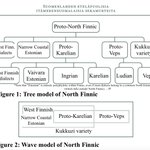
As this is not only a new Finnic classification result but also has interesting theoretical implications on "mixed" dialects, I offer here a translation of the figures from Kallio 2024 on the position of Kukkuzi and Coastal Estonian

ALT From Kallio, Petri 2024: Suomenlahden eteläpuolisia itämerensuomalaisia sekamurteita. Translation and footnote mine. https://doi.org/10.33341/sus.965.1335
Reading an interesting talk on Kilen, an intra-Tungusic mixed language. Reminds me also that all cases of "mixed languages cannot be classified in a tree model" are *reconstruction problems*; the lack of knowledge, not a known fact.
academia.edu/179245716/Monop…

And I think some better known cases may suggest that abandoning some assumptions can help for resolving some case after all. E.g. for another in-family example, the Kukkuzi dialect of "either Ingrian or Votic" was recently argued by Kallio to be really an old independent lineage.