

https://nitter.gq/t.co/pBuwO5SiFa Masterclass in Trading
Denver, CO
Joined September 2008
- Tweets24K
- Following103
- Followers9.9K
- Likes9.1K





Pinned Tweet
Trading is part mechanics
leavittbrothers.com/mastercl…
And part art
leavittbrothers.com/guidelin…


Thanks @jaredtendler So much good stuff here.

Still struggling to control your emotions? You're not alone...
Five years ago, along with several industry partners, I surveyed traders from around the world and uncovered a massive 57 point gap between the traders who could see the cost emotions had on performance (91%) vs. those with a concrete strategy to manage, control, or correct their reactions (only 34%).
I decided to run it back and see if anything has changed.
While 45% now report having a concrete strategy, I thought that number would be a lot higher.
Far too many traders still lack the ability to control their emotions. Many have a wish that mental game improvement should happen easily.
You can’t get bigger muscles from reading a book on physical fitness, nor will reading my book, or any trading psychology book, give you a stronger mentality.
The Mental Game of Trading has been out for over 5 years and I often get comments about how much they enjoyed reading it. While I’m thrilled, I also wonder if they've implemented the material and developed a strategy, or if they hoped reading the book was enough.
For those still struggling to control, manage, and correct their emotions, here are the most common reasons traders listed for why they're struggling, along with some advice, links and next steps.
“It’s hard to grasp that losing days WILL happen. It’s unlike any other profession in that sense.”
Trading is unlike anything else – the variance involved, the speed with which conditions change, the lack of a clear roadmap for success, the nature of losing – all make trading a truly unique competitive endeavor, even compared to poker. But if attempts to force-feed yourself these facts don’t work, then you need to understand why you’re resisting reality.
Your entrenched perspective, such as a hatred of losing or a desire for control, can block any attempts for trading realities to fully integrate in your mind. Like throwing a piece of paper into a fan, only to have it blown back in your face.
Overreacting to losing highlights the gap between reality and what you believe. Luckily, bridging that gap isn’t rocket science. You just need deeper problem solving. This video from an old episode of Office Hours can help: youtube.com/watch?v=A6eCImWH…
“Emotions arrive unannounced.”
If emotions arrive unannounced, one of two things is true. First, you lack the recognition for the subtle rise in emotion. They appear to come out of nowhere, but you just don’t see the steady buildup. Second, if intense emotions actually arrive instantly, it’s an indication of a longer term buildup of accumulated emotion that instantly floods your mind.
In the first case, you should work on mapping your emotions jaredtendler.com/controlling… so you can see the incremental rise and take action before they are too intense. In the second case, you need to work through the old emotion by doing the deeper problem solving I mentioned in the previous section. youtube.com/watch?v=A6eCImWH… While you build more mental skill or work through your old emotions, consider sizing down to something small enough to not elicit such intense reactions.
“Fear from many past failures over many years I can’t seem to get past. Past negative experience in trading and elsewhere.”
Painful memories in trading and elsewhere can leave a mark, kind of like a bruise on your shoulder that won’t heal. We can call this scar tissue or trading trauma, and it’s not unlike physical scar tissue in your body. The body has a way to protect us from further injury and in the same way, the brain helps you cope with painful experiences through denial, excuse-making, and other proactive measures. These strategies can be useful in the short term, but when relied upon too long they interfere with the brain’s ability to fully process the memory.
You’re protecting against those failures, or pain points, from happening again, more than you’re leveraging past experience for insights that make you stronger. In this video I show you a simple way to work through the scar tissue and begin to regain full mental function: youtube.com/watch?v=2H8_ipmJ…
“Hard to maintain energy with a job and family responsibilities.”
Hard does not mean impossible, but sometimes being aware of the difficulty creates more resistance, which does make it harder. Plus, you make it even harder if you came into trading with hopes that it would be easy to make money and haven’t recalibrated your mind to the challenge. Take a step back and re-assess what it’ll take to be successful given your work and family responsibilities. Create a plan that seems do-able, even if it’s still hard. Remember, Anything this valuable is unlikely to come easily.
When you burn both sides of the candle, burnout can also become a hidden factor that makes it harder to sustain a performance standard. Check out this blog on how to deal with burnout: jaredtendler.com/burnout-bas…
“Haven’t gone deep enough.”
I’m happy you’ve recognized that a surface-level understanding isn’t enough to solve complex problems. Here’s a blog that will help you go deeper: jaredtendler.com/find-the-ro…
“I don’t stick to one thing long enough to master it or have the data to support a valid conclusion on whether the strategy/plan is viable, or whether I’m not executing it well enough.”
You should be able to see mental game progress within two weeks. If you’re not, something in your strategy or plan is not working. Most often it’s because you haven’t gone deep enough, as referenced above. But another common issue is not taking the time to properly train your Injecting Logic Statements to become potent enough to impact your emotions in real time: jaredtendler.com/be-your-own…
On the other hand, if you saw progress immediately, but it disappeared, you found a placebo, not a real correction. Real corrections produce steady improvements. Placebos are ideas that sound nice in theory but become ineffective once the novelty wears off.
“I haven’t yet simplified a mental game strategy into concrete steps.”
Appreciate the honesty. Here’s a quick guide to the overall strategy that I lay out in The Mental Game of Trading so you can make the most of the book and build your strategy step-by-step: nitter.gq/jaredtendler/status/14…
“I stopped consistently working on my mental game, that’s the only reason.”
It’s easy to make progress and then have that progress slip away. Knowing when you’ve truly mastered or resolved something is hard. You’ll know when you can stop once progress is easy and automatic, even under the most trying or difficult circumstances. For some of you that might mean working consistently for 6 to 18 months. Consistently doesn’t mean spending hours and hours a day. It just means that it has to stay on your radar long enough to prove that you can retain that progress without focusing on it. Until then, keep working the muscles of your mind. Check out this blog to understand the stages of learning you must progress through: jaredtendler.com/learning-mo…
“I’m looking for shortcuts.”
Realistically you know you can’t expect to make money every day, or be a success overnight, but somewhere deep down there is a wish that you can get where you want to be without the necessary work. Explore this blog on wishing and hoping for how to tackle this one: jaredtendler.com/the-dangero…
“My problem is that I can’t commit to a set plan to manage my emotions, especially when there’s a period without identifiable progress.”
Just like the trader looking for shortcuts above, I think there’s a deeper part of you that wishes that the changes would come easily and more quickly. And, ironically, by continually jumping around you’re preventing yourself from truly making progress. Follow my system and if you’re not seeing progress after two weeks, it’s not a reason to abandon ship. It’s an indicator to go deeper: nitter.gq/jaredtendler/status/14…
“Overwhelmed by how much is wrong and by all the educational input.”
Being overwhelmed is far better than being ignorant or naive to what’s plaguing you. List out everything you’ve got to deal with and if you find a confidence issue, start there. Confidence is the foundation to your mental game. If it’s weak, then every other mental game problem becomes magnified. Strengthening your confidence to become more stable and consistent doesn’t guarantee immediate improvements elsewhere, but it does give you a fighting chance: jaredtendler.com/when-confid…
*****
There’s no reason not to have a robust mental game strategy that helps you manage and correct your emotions in real time.
The answers are out there. Consistently put in the work and you can steadily improve. I’ll continue to be here helping wherever I can.


Maybe I live in an echo chamber. I have yet to hear a single person think the 24-team college playoff is a good idea.

Jason Leavitt, LeavittBrothers.com retweeted
State of the Market
youtu.be/oq-T75D2H-c?si=vgjZ… via @YouTube
Here are my favorites.


Everything I learned for trading is in these books. @markminervini @jaredtendler @Deepvue @RichardMoglen @AmeetRai @RossHaber @NickSchmidt
Special mention @OliverKell_ as I don't have his book. @gilmoreport as well but his 3 books are in Singapore for study next trip back there.
Got another 80 or so trading books but these are the key ones if you wanna learn how to trade.


That’s four top 20 wins for Texas. No one else can say that. #hookem
2
674

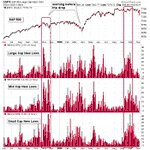
When new lows spike at an innocent time, it's a warning. Not for the moment, but for the next couple months.

8
671


I'd like to see this overlaid with the S&P. Crazy numbers.

Over the past month, the $SPX moved 1.1%, while the average stock moved 13.2%.
This spread ranks in the 100th percentile over the past 30 years.
The only higher return spreads were during the Dot Com Bust and GFC.

1
2
587

