

Content Creator - Web3 Marketing
Joined July 2025
- Tweets207K
- Following6.2K
- Followers10.1K
- Likes2.6K


Pinned Tweet
Relying on a single layer of defense when handling private user data is an architectural gamble that modern protocols cannot afford.
Even if an encryption formula is mathematically sound, vulnerabilities in proof generation speed or runtime execution environments can still compromise the system.
I track @primus_labs closely because they designed a multi-layered cryptographic pipeline where each component reinforces the next.
At the entry boundary, Primus zkTLS verifies private internet data without breaking user privacy, operating up to 10× faster than competing verification protocols.
Next, private records are encrypted and processed inside the Primus FHE engine, which leverages SOTA algorithms and GPU acceleration to balance high throughput with sustainable compute costs.
Finally, Trusted Execution Environments (TEEs) secure the runtime environment itself, protecting sensitive cryptographic materials across the network.
Smart contracts can finally verify and compute over private Web2 data in a completely trustless manner.
True confidentiality requires defending data during verification, computation, and runtime execution simultaneously.

Looking at that minimalist two-button setup from PERPTools reminds me how bloated most DeFi trading terminals have become.
When volatility spikes, twenty overlapping indicators and clunky wallet pop-ups do nothing except slow down your reaction time.
I appreciate how @perptools strips the interface down to pure intent, whether I am taking a fast manual scalp or letting autonomous strategies run inside AI Arena.
Reducing execution to a single tap removes hesitation when a clean level hits.
Simplicity is a serious advantage in leveraged markets.


29
23
233
Good morning ☀️
Connecting your first phone to @Acurast takes two minutes, yet one tiny pairing step trips up a lot of newcomers.
When I set up my device, I opened the Acurast Hub on my laptop screen first and clicked "Add New Device" to pull up the QR code.
Then I opened Processor Lite on my phone, tapped "Connect to Hub," and scanned that code instead of skipping straight through the welcome screen.
Once paired, I opened the Phones tab on the Hub to confirm my status flipped to Attested and watched the Last Seen timer update after the first 30-minute heartbeat.
I even turned on the management endpoint under advanced functions to check battery health remotely.
Getting that link right on day one ensures every hour counts toward your dashboard.


Relying on a single layer of defense when handling private user data is an architectural gamble that modern protocols cannot afford.
Even if an encryption formula is mathematically sound, vulnerabilities in proof generation speed or runtime execution environments can still compromise the system.
I track @primus_labs closely because they designed a multi-layered cryptographic pipeline where each component reinforces the next.
At the entry boundary, Primus zkTLS verifies private internet data without breaking user privacy, operating up to 10× faster than competing verification protocols.
Next, private records are encrypted and processed inside the Primus FHE engine, which leverages SOTA algorithms and GPU acceleration to balance high throughput with sustainable compute costs.
Finally, Trusted Execution Environments (TEEs) secure the runtime environment itself, protecting sensitive cryptographic materials across the network.
Smart contracts can finally verify and compute over private Web2 data in a completely trustless manner.
True confidentiality requires defending data during verification, computation, and runtime execution simultaneously.
Putting sensitive healthcare records directly on a public ledger is a non-starter for patient privacy.
On the flip side, keeping everything locked inside isolated databases kills interoperability.
I like the hybrid setup @Cere_Bree is building with Cognie and the Oracle Blockchain Platform.
Sensitive patient data stays strictly off-chain where it belongs, while patient consent, data provenance, and audit trails are verified on-chain.
That structure gives AI companions like Cognie the wider context needed to coordinate workflows across providers without ever exposing private medical records.
Real enterprise adoption happens when blockchain handles trust and verification quietly in the background.

Most people chase pumps after the chart turns green. By then, you are just exit liquidity for early insiders.
I missed the zETH early window, and watching the top Miner pull a 20x stung a little.
Now zBASE is live on @zerufinance , and I am paying attention.
Only 780 people are in the race right now, and the supply is already down to 971.7M from the initial 1B.
You get one shared price and an actual shot before the crowd arrives.
Early positioning beats chasing momentum every single time.

Miners go first.
In zETH, the first Activity Market, they got an early bidding window, one shared price and a USDC bonus. The top Miner made 20x.
Now zBASE is open. Supply starts at 1,000,000,000 and drops constantly.
Register: zaps.markets
Your own firewall means nothing if the network you plug into stays wide open.
That is the real catch with quantum deadlines in banking. We treat security like an isolated company checklist.
Colton from @quipnetwork pointed this out clearly in Blockwest. Shared payment rails link institutions globally.
When one bank drags its feet on post-quantum upgrades, every partner on that rail inherits the risk.
High-level adversaries are already scanning for the slowest institution to make an early target.
True resilience requires the entire financial rail to upgrade before the deadline hits.

Quantum risk doesn't stop at your own systems.
If one bank on a shared payment rail doesn't upgrade, everyone on that rail is exposed. @cadillion on the quantum deadline for banks, in @blockwestco.
→ blockwest.co/quip-colton-dil…
Managing multiple wallets just to keep trading strategies separate is a massive waste of time.
I used to juggle one account for perps, another for spot, and a third for testing.
Switching tabs and moving funds killed my focus.
@perptools adding native sub-accounts is a huge upgrade for my daily routine.
One login now lets me create up to 10 sub-accounts with custom nicknames. I label them by timeframe or risk level and switch in seconds.
Less time managing logistics means more time reading charts.Your setup should reduce friction, not create it.

GM frens ☀️
When someone asks what makes @Acurast different from simple cloud rentals, I look at what happens under the hood when a developer runs a job.
Developers can launch self-hosted language models, automated community scam filters, or WebAssembly tasks across more than 320,000 connected phones in 175 countries.
Every deployment gets verified through the phone's hardware Trusted Execution Environment so neither side has to blindly trust the other.
Plus, the ACU fees developers pay get burned on-chain once the task completes.
Real compute demand drives both network utility and token scarcity at the same time.

Early Web3 task platforms often failed because they lumped discovery, execution, and dispute resolution into a single monolithic smart contract.
When something went wrong with a deliverable, funds remained frozen indefinitely because there was no structured escalation path.
That architectural flaw is why @termix_ai is modular role separation in AACP stood out during my technical review.
AACP divides the lifecycle of every onchain job across four specialized functions on agent.family.
The Client initiates demand and supplies liquidity, while the Provider supplies specialized execution.
Instead of relying on self-reporting, the Evaluator acts as an objective verification layer before any stablecoin balance unlocks.
And when complex technical disagreements occur, the Arbitrator provides a dedicated dispute-resolution mechanism backed by staking incentives.
This clear division of labor mirrors real-world institutional checks and balances, translated into deterministic smart contract logic.
TermiX gives builders a resilient commercial foundation where every participant knows their exact permissions, duties, and economic guarantees.

If you want to try @quipnetwork without risking a single dollar, start with the practice board first.
Open Quip through my link, head straight to the Points page, and select the Paper swaps quest card.
You do not need to move real assets or worry about gas fees to get started.
Once you open QuipSwap in practice mode, look at the very first listing on the screen.
Read what the maker is offering, check what asset they ask you to give back, and run one simulated fill.
You will earn your first 1 QP right away and see how the order book settles before ever touching live mode.
Try running that first practice listing and reply below with whichever step felt unclear,I will walk you through it. 👇
app.quip.network/?ref=0x8751…

Slow order execution ruins good setups in volatile crypto markets. Waiting seconds for an onchain confirmation costs real money.
I think @perptools is taking the right approach by building on LayerZero ATLAS.
Instead of patching old tech, they are launching with high-throughput infrastructure from day one.
Traders get the fast fills they expect from centralized venues.
At the same time, every trade remains verifiable onchain and your keys stay yours.
I will definitely be testing this out on November 30.
Fast execution and self-custody should always go hand in hand.
PERPTools 🤝 LayerZero
PERPTools, built on @LayerZero_Core ATLAS.
Exchange grade speed. Onchain verifiability. Your keys, your trades.
Nov 30 ⚡

69
71
1,096
It is rare to see a protocol prove its tokenomics on day one instead of hiding behind a vague roadmap.
I checked the numbers on @zerufinance is first buyback, and the execution is clean.
5.99M zETH is gone for good, backed by 5.13M zETH bought directly off the Uniswap pool.
For me, the biggest takeaway is consistency.
Daily buybacks powered by live trading fees mean supply shrinks every time the platform sees volume. No manual interventions or governance drama required.
Strong products turn user activity into direct value capture. That is how you build staying power in this space.
The first zETH buyback is complete.
5.99M zETH burned forever, including 5.13M bought directly from the @Uniswap pool.
Buybacks will continue daily as new trading fees come in.
Explore here ↓

GM frens
When someone asks if @Acurast is just another passive farming app, I show them what real developers are deploying across the network right now.
Beyond the Laya Tetris demo, builders are running Node.js backends, WebAssembly modules, data scrapers, and automated scam filters for community chats directly on smartphone CPUs.
Whenever a developer deploys a task, the ACU fees they pay get burned on-chain upon execution.
Every real workload simultaneously boosts the active phone's reward weight by 10% and permanently reduces token supply.
Real usage turns everyday smartphones into productive cloud infrastructure.

69
55
1,153
I always track which tokens refuse to drop when the rest of the market is in full retreat. Those charts usually tell you where smart money is hiding.
Right now, @rntprotocol is putting up numbers that are hard to ignore.
Look at the 30-day performance on CoinGecko:
Bitcoin is down 22.5%. Ethereum is down 26.1%. RNT is up 5.4%.
The 7-day trend tells the exact same story.
While the overall crypto market lost 11% and the RWA sector dipped 5.4%, RNT held steady and traded flat. Over a 12-month horizon, RNT has delivered a 106% increase.
As tokenization gains real traction, protocols bridging physical value with DeFi are separating themselves from speculative hype.
You do not need hype when the price action speaks for itself.

The last 30 days in crypto, according to CoinGecko:
BTC: -22.5%
ETH: -26.1%
RNT token: +5.4%
Over the last week the global crypto market is down 11% and RWA tokens are down 5.4%, while the RNT token is flat.
Over twelve months, the RNT token is up 106%.
Already in $RNT?

44
50
1,693
Quick tap games usually lose my interest once they start feeling repetitive. Once you tap without thinking, it turns into noise.
Seeing @perptools roll out Golden Cells on Tap Prediction brought back some real focus for me.
Doubling your payout multiplier when you spot one makes every cell on the board feel a bit more consequential.
Instead of guessing at random, I catch myself looking for clean spots where a doubled payout actually matters.
It is a straightforward mechanic, and honestly that is why it works. You do not need ten complicated rules to change how someone plays.
Just pay attention and pick your moments. That simple shift makes a big difference.
Your Multiplier Just Got a Boost
Spot a Golden Cell on Tap Prediction? Your payout multiplier doubles!
Keep your eyes open, make your prediction, and don't miss the golden opportunity!

31
32
1,199
Clicking through endless threads only gets you so far in this market.
I like watching how builders explain Activity Markets and Zaps without hiding behind buzzwords.
ZeruAI putting a dedicated night together in Bangkok shows clear intent around onchain participation.
Too many people wait until narratives are already crowded.
Mark November 29, 6–10 PM ICT in Bangkok.
Listening closely to how @zerufinance shapes the conversation gives better context than reading summaries later.
Good rooms change how you read the market.

Good morning
People often assume any old Android phone pulled out of a drawer will qualify to earn rewards on @Acurast .
I checked the hardware requirements before wiping a backup device for Acurast Processor Core.
Your phone needs to run Android 12 or newer, have no root access, and keep its bootloader locked.
Rooted devices or unlocked bootloaders fail hardware attestation, which blocks the phone from verifying its Trusted Execution Environment and joining the compute pool.
You also want a device with decent available RAM since memory capacity carries 46.15% of the benchmark weight.
Checking those settings takes thirty seconds and saves you from resetting an incompatible phone.

Whenever I browse early Web3 AI projects, I notice the same recurring flaw: hundreds of listed agents, yet zero infrastructure for real commercial execution.
Listing an agent profile on a webpage means nothing if clients cannot securely hire that bot, verify its output, and settle payment onchain.
I wanted to see how an actual end-to-end operational layer looks, so I dug into the architecture of @termix_ai .
TermiX operates as the commerce and settlement infrastructure for the emerging AI agent economy.
Everything runs on AACP, the core protocol powering task escrows, execution rules, and deterministic payouts.
Through agent.family,the AI Agent Marketplace built directly on AACP,service discovery connects seamlessly to real economic activity.
I don't just look at static profiles, I see real jobs being posted, claimed, and verified onchain.
Every completed delivery updates the provider's immutable onchain reputation before settlement clears in stablecoins.
A real market needs enforcement, verification, and payment rails,not just a catalog of links.
TermiX supplies the complete commercial backbone required for autonomous agents to work and get paid reliably.

You do not need four screens to stay connected to real onchain activity.
I used to think serious DEX tracking required sitting at my desk all day. Every time I went out, I felt disconnected from liquidity shifts and pool volume.
Putting the @GeckoTerminal app on my phone proved me wrong.
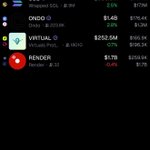
It brings live DEX pools, price action, and token metrics straight into a clean mobile layout. My Watchlist holds the exact pairs I follow so I can check the market while grabbing lunch or waiting in line:
> Core liquidity pools give me an instant read on broad market depth.
> Sector-specific tokens show me whether my favorite narratives are holding steady volume.
> Native DEX pairs let me watch ecosystem liquidity shifts in real time.
Instead of guessing from price alerts alone, I see the actual pool numbers right in my hand. Having all my research organized in one mobile tab saves hours every week.
This is just my personal tracking list, not financial advice. Clarity on the go beats staring at charts all night.
Check out my Watchlist screenshot above and reply with your go-to mobile research habit.

Auctions usually leave you guessing where your unspent funds went.
I appreciate when a protocol keeps settlement clean and transparent.
@zerufinance just made zETH claiming and trading live on Uniswap v4.
The pool opened at the final auction price of $0.0000166. I checked the final supply breakdown, and the math is ruthless.
Out of a 1B starting supply, nearly 578M tokens were burned between the race and unsold auction allocation. That leaves just 180,742,949 tokens sold through the auction.
Grab your tokens and pull your leftover USDC back to your wallet.
Clean mechanics always outlast empty hype.
