

Asst. Prof: BCM. Barely Cognitive , poser neuroscientist.
Minneapolis, MN
Joined June 2018
- Tweets403
- Following386
- Followers188
- Likes1.4K




I just finished my first full set of models in numpyro: hierarchical, empirical bayes priors and insanely easy to switch between VI and mcmc . Never going back. 🧑🍳
Justin Fine retweeted

I'm hiring a postdoc to work with me on problems related to meta-learning and probabilistic representation learning in the brain.
Perks:
i) the amazing research community at @bcm_neurosci and @RiceNeuro.
ii) Houston food is DELICIOUS (and cheap)
jobs.bcm.edu/job/Postdoctora…
Justin Fine retweeted

Finally! This is the version of record; it's also the version to read, thanks to the review process at eLife. The finding was out of reach before macaque Neuropixels. @eLife: Direct observation of the neural computations underlying a single decision doi.org/10.7554/eLife.90859.…

Justin Fine retweeted

When does modular structure emerge in neural networks?
What are the consequences of this structure for learning and behavior?
New work with @StefanoFusi2 answers these questions and more: doi.org/10.1101/2024.09.30.6…
see 🧵below (1/11)
Will be @SfNtweets from tomorrow till Tuesday. Giving a talk on Tuesday as well. DM if you wanna chat or 🍺 or both.
We frame rational inattention theory to encompass stationary environments by considering it from the purview of Foraging theory. Foraging theory points us to treat recent reward outcomes (history) as reflective of temporally local richness, which should motivate attention 5/n
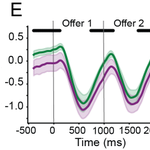
Attention also increases dynamic coding of offer value representations. With more attentional effort, neural populations transition faster between representational schemes. We speculate this amplifies the signal to noise of value signals, ie non-normal networks (Goldman, 09')

Sometimes, choice is obvious - $5 or a punch in the face? But sometimes, evaluating options takes serious mental energy. The general principle is the foundation of rational inattention theory (Sims, 2003), which has been a driving force in behavioral economics 3/n
Sometimes making the worse choice is the better choice. Investing more [attentional] energy into evaluation your options an and choosing results in a better choice. However, the benefit doesn't always outweigh costs--making it better to evaluate options less precisely 2/n.
Hot new preprint just dropped w/@NeuroPolarbear and @MorenoBote , on where we explore “Rational Inattention" and how it drives optimally irrational choices and neural coding of value. 1/n
biorxiv.org/cgi/content/shor…
Justin Fine retweeted

The macaque brain can link action to value in a choice task through neural population subspaces, balancing reliable binding of action to value and generalization to novel stimuli
@wjeffjohnston @JustFineNeuro @NeuroPolarbear
nature.com/articles/s41593-0…

Justin Fine retweeted
How does the brain bind action to value?
How does it navigate a tradeoff between this binding and generalization to novel situations?
Out today in Nature Neuro! rdcu.be/dUbMd
@JustFineNeuro @NeuroPolarbear @BecketEbs @neuromochi
See original 🧵 + updates below

How does the brain represent multiple different things at once in a single population of neurons? @JustFineNeuro, @NeuroPolarbear, @BecketEbs, @neuromochi and I show that it uses semi-orthogonal subspaces for each item.
Preprint here: arxiv.org/abs/2309.07766
Tweets below! (1/n)
Great read.

Successor representations (SR) is often cited as a model of hippocampus. I often get qns about SR, often attributing it properties it doesn't have.
Here I collate my misgivings about SR, arguing why it can't be a model of place cell learning. 1/
blog.dileeplearning.com/p/a-…

Justin Fine retweeted
Very excited to have our work on the neural basis of swap errors in working memory published! A swap error is when the subject makes a high precision report... of the wrong thing. We ask how this happens. See Matteo's tweet thread describing the results. doi.org/10.1073/pnas.2401032…

We live with the limitations of our memory, but don’t really know where they come from. Our new paper (doi.org/10.1073/pnas.2401032…) studies "swap errors", which we argue arise during memory manipulation – see thread for more! @timbuschman, @MattPanichello, @wjeffjohnston

Justin Fine retweeted

Neuroscience needs research engineers, but orgs are not ready for this. I agree wholeheartedly with Gaelle and Olivier.
1. RSEs should be inside of a ladder/org where they can learn from each other. A lone RSE in a lab is a recipe for isolation, skill atrophy, low mobility. 1/

With neuroscience datasets and scientific collaborations growing in size, Gaelle Chapuis and Olivier Winter explain why neuroscience needs to create a career path for software engineers.
thetransmitter.org/craft-and…
