

Christ ✝️ USA 🇺🇸 Food 🍔 Sports ⚾️ Travel ✈️ | 💙💜💛 I like to debate 🤓 I like to troll 🤡
Houston, TX
Joined May 2026
- Tweets2.3K
- Following110
- Followers182
- Likes117




Pinned Tweet
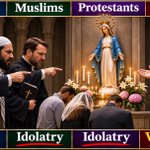
Catholics bow and kneel before statues supposedly representing Jesus and Mary, performing the same outward rituals pagan Romans practiced before statues of their gods. Given the documented pagan influence on the early Church, it only makes sense to examine what these gestures meant to the pagans themselves.
The Catholic defense is that these gestures originated from Roman customs of honoring emperors and their statues. Yet this overlooks the historical fact that many Roman emperors were deified, particularly after death, and received religious worship, not merely respect.
Catholic altars, with crucifixes, candles, and incense, also bear striking similarities to Confucian ancestral rites involving offerings, incense, and reverence before ancestral tablets. These rituals are not simply about remembering deceased relatives, as ancestors are deified after death and revered as ancestral gods in traditional Confucian-influenced cultures.
As controversy over the religious use of images intensified, the Catholic Church formally defended the practice at the Second Council of Nicaea in 787. The Council established an official distinction between veneration and worship, allowing the Church to justify and preserve its tradition of honoring graven images.
Ever since, Catholics have blindly accepted and recited back the Church’s theological defense to justify these practices, rather than critically examining their historical origins and pagan influences.


Despite everything, I must admit that Catholic cathedrals do look absolutely magnificent.
Still pagan.


Catholics bow and kneel before statues supposedly representing Jesus and Mary, performing the same outward rituals pagan Romans practiced before statues of their gods. Given the documented pagan influence on the early Church, it only makes sense to examine what these gestures meant to the pagans themselves.
The Catholic defense is that these gestures originated from Roman customs of honoring emperors and their statues. Yet this overlooks the historical fact that many Roman emperors were deified, particularly after death, and received religious worship, not merely respect.
Catholic altars, with crucifixes, candles, and incense, also bear striking similarities to Confucian ancestral rites involving offerings, incense, and reverence before ancestral tablets. These rituals are not simply about remembering deceased relatives, as ancestors are deified after death and revered as ancestral gods in traditional Confucian-influenced cultures.
As controversy over the religious use of images intensified, the Catholic Church formally defended the practice at the Second Council of Nicaea in 787. The Council established an official distinction between veneration and worship, allowing the Church to justify and preserve its tradition of honoring graven images.
Ever since, Catholics have blindly accepted and recited back the Church’s theological defense to justify these practices, rather than critically examining their historical origins and pagan influences.
33
I’ve told you multiple times that debating you isn’t worth wasting my weekend, yet you keep making up whatever narrative helps convince you I’m running away, just so you can sleep at night with some peace of mind.
Whenever you’re ready to focus on the actual debate, come back and answer my question anytime:
“If Catholics claim that their rituals, which bear striking resemblances to pagan practices, did not originate from pagan traditions, where exactly did they originate?”
@Rhetorary

You can’t even make this 💩 up.
This Catholic is openly putting Church tradition ABOVE Scripture because he doesn’t even trust the Bible to stand on its own as God’s Word 💀 @Rhetorary

음악에 귀가 트이고 신체를 ‘악기화’시킨다는 게 무슨 말인지 몸소 깨우치고 느낀 바, 나훈아는 노래를 진짜 잘한다. 음을 가지고 노는 게, 확실히 가수이며, 노래를 맛깔나게 부른다는 게 뭔지 표본으로 보여주는 아티스트다.

70
The more I see Catholics resorting to ad hominem attacks instead of logically defending why the rituals they practice are supposedly rooted in Church tradition rather than pagan tradition, the more convinced I become that many lack the ability to think critically and independently. Even when the evidence is right in front of their eyes, they would rather blindly submit to the authority of the papacy than question what they’ve been taught. Blind obedience.
Yall mad because yall know I’m right. Deep down, even you know it makes no sense. That’s why you can’t come up with a logical counterargument. So instead, you resort to mockery and insults.
@Rhetorary @Sacramentshow @Guilcat96Lewis @Brosephos @MassAesthetic @Verita_dirigit1 @SpartanApostle
🤖 Made with AI

Dismissing the possibility of any pagan or Mithraic influence on the development of post-apostolic Catholic liturgy, calendar, iconography, and institutional forms simply because direct documentary evidence of transmission is scarce is historically shortsighted. Institutional Catholicism took shape over centuries inside a Roman Empire whose religious landscape was saturated with mystery cults, sun god worship, and imperial ritual. Mithraism was one of the most prominent of these coexisting and competing cults.
The observation that New Testament texts predate the bulk of surviving Mithraic archaeological evidence correctly rules out direct apostolic copying of Mithraic doctrines, but it does not address the later question. The issue is whether, in the centuries after the apostolic period, Christian communities operating inside that shared Roman environment absorbed, adapted, or reinterpreted certain ritual forms, calendar practices, or symbolic habits from the surrounding culture. Early Christian writers themselves, including Justin Martyr and Tertullian, explicitly noted ritual parallels (communal meals involving bread and drink, forehead marking, certain initiatory elements) and felt compelled to explain them as demonic imitation rather than dismiss them as coincidental.
In the study of ancient religion, the absence of an explicit “we borrowed this” text does not establish cultural isolation. Surviving records are fragmentary on all sides. Religious traditions routinely absorb, reframe, or compete with elements of their ambient culture without leaving a clear documentary trail of the process. Shared features such as ritual meals, initiation rites, or solar associations appear across multiple Mediterranean cults of the period; their presence therefore does not prove specific derivation, but their complete absence of any interaction is equally an assumption that requires evidence.
Serious historical inquiry applies the same standards in both directions: it does not treat superficial similarities as proof of pagan derivation, nor does it treat the mere lack of a smoking-gun document as proof that no cultural influence occurred. The primary matrix of earliest Christianity remains Second Temple Judaism and the claims about the historical Jesus; that fact does not by itself demonstrate that every subsequent Catholic development was sealed off from the Roman religious environment in which it was formed. Skepticism is properly directed at maximal claims of direct Mithraic origins for core doctrines and at maximal claims of total isolation alike.
Mic drop 🎤
Have fun at the debate, guys 👋
@Rhetorary @Sacramentshow @Guilcat96Lewis @Brosephos

9
2
672
Dismissing the possibility of any pagan or Mithraic influence on the development of post-apostolic Catholic liturgy, calendar, iconography, and institutional forms simply because direct documentary evidence of transmission is scarce is historically shortsighted. Institutional Catholicism took shape over centuries inside a Roman Empire whose religious landscape was saturated with mystery cults, sun god worship, and imperial ritual. Mithraism was one of the most prominent of these coexisting and competing cults.
The observation that New Testament texts predate the bulk of surviving Mithraic archaeological evidence correctly rules out direct apostolic copying of Mithraic doctrines, but it does not address the later question. The issue is whether, in the centuries after the apostolic period, Christian communities operating inside that shared Roman environment absorbed, adapted, or reinterpreted certain ritual forms, calendar practices, or symbolic habits from the surrounding culture. Early Christian writers themselves, including Justin Martyr and Tertullian, explicitly noted ritual parallels (communal meals involving bread and drink, forehead marking, certain initiatory elements) and felt compelled to explain them as demonic imitation rather than dismiss them as coincidental.
In the study of ancient religion, the absence of an explicit “we borrowed this” text does not establish cultural isolation. Surviving records are fragmentary on all sides. Religious traditions routinely absorb, reframe, or compete with elements of their ambient culture without leaving a clear documentary trail of the process. Shared features such as ritual meals, initiation rites, or solar associations appear across multiple Mediterranean cults of the period; their presence therefore does not prove specific derivation, but their complete absence of any interaction is equally an assumption that requires evidence.
Serious historical inquiry applies the same standards in both directions: it does not treat superficial similarities as proof of pagan derivation, nor does it treat the mere lack of a smoking-gun document as proof that no cultural influence occurred. The primary matrix of earliest Christianity remains Second Temple Judaism and the claims about the historical Jesus; that fact does not by itself demonstrate that every subsequent Catholic development was sealed off from the Roman religious environment in which it was formed. Skepticism is properly directed at maximal claims of direct Mithraic origins for core doctrines and at maximal claims of total isolation alike.
Mic drop 🎤
Have fun at the debate, guys 👋
@Rhetorary @Sacramentshow @Guilcat96Lewis @Brosephos
🤖 Made with AI
@Sacramentshow
Debate topic: does the catholic church incorparate paganism and idolatry
Me vs @KFoodieHTX . You moderate. This saturday. What time?
BAHAHA 🤡🤡💀💀 THESE MORONS THINK THEY’RE SOME SORT OF RELIGIOUS INFLUENCERS TELLING ME TO COME DEBATE THEM LIVE ON A YOUTUBE CHANNEL W/ 500 SUBS 🤣🤣🤣
I HAVE A LIFE GUYS HAHAHAHA @Rhetorary @Sacramentshow


We do the rebuttal this saturday, on @Sacramentshow livestream, moderated, opportunity to make slides and make your case. This saturday. If you run away, thats on you.
Dear Catholics,
If you’re still not convinced that pagan sun-god rituals have long infiltrated your religious traditions, I don’t know what to say.
If it’s the truth you seek, then seek Christ instead of blindly following the papacy and its nonsense.
🤖 Made with AI

Lucifer’s association with the sun and light is no secret.
The more I examine the parallels between Mithraism and Catholic traditions, the more convinced I become that the Catholic Church we know today is the product of Satan’s infiltration of the early Church through paganism.
🤖 Made with AI


Davi | 다비 🇰🇷🇺🇸 retweeted

Where in the USA 🇺🇸 is this?
A. Dallas, Texas
B. Atlanta, Georgia
C. Los Angeles, California
D. Houston, Texas

Some poor soul stepped on fresh dog turd today.
If you’re THIS ducking lazy about picking up after your dog, you don’t deserve to have one.
This complex got bombarded with dog shits, Cheetos bags and drink pouches ever since they started accepting Section 8 applicants.

193
People close to Muhammad who left Islam for Christianity
@grok Grok, fact check please.
🤖 Made with AI

Congrats New York,
Yall have shittards who know nothing about our Constitution wanting to play ‘Lord of the Flies’ in your city 💩🗽
1
126
This is the average post of a Korean “patriot.”
No logic nor political education — just ad hominem. Doesn’t know a thing about the American culture, but loves flashing the Stars and Stripes out of “alliance.”
And Koreans wonder why the rest of the world labels us as racists.
unavailable
