
Ex-NBU Governor (2020–22). Preserved banking stability in the first months of the full-scale war. FX, reserves, Donornomics. Independent view.
Joined August 2024
- Tweets7.3K
- Following284
- Followers10.9K
- Likes2.8K







Pinned Tweet
Ukraine has discovered a new economic sector: the anti-corruption industry.
It has its own investigators, prosecutors, specialised courts, private foundations, NGOs, investigative media outlets, international consultants, donor-funded projects, conferences, annual reports and, of course, an impressive collection of acronyms.
NABU. SAPO. HACC.
And this industry is hardly a start-up anymore.
Ukraine’s specialised anti-corruption infrastructure has been developing for 11 years. NABU and SAPO were established in 2015, while the High Anti-Corruption Court began operating in 2019.
Eleven years is a respectable age. Long enough to move beyond start-up presentations and begin asking serious questions about performance.
As a former central banker, I have a professional weakness for performance indicators.
According to NABU’s own figures, in the first half of 2026:
360 new investigations.
107 individuals notified of suspicion.
76 people convicted under judgments that entered into force.
UAH 2.06 billion in reported economic impact.
These are real results. But after 11 years, an obvious economic question arises:
What is the return on investment in Ukraine’s anti-corruption infrastructure?
And then there is another interesting financial innovation: private charitable foundations as beneficiaries of criminal plea agreements.
In one reported case, the agreement provided for:
UAH 400 million to Come Back Alive.
UAH 100 million to the Sternenko Community Foundation.
UAH 600 million to the state budget, payable over 2.5 years.
The funds are intended to support Ukraine’s Armed Forces. That is an important objective.
But the financial arrangement raises legitimate questions.
Why are private foundations selected as beneficiaries of criminal settlements? Who determines the recipients? Who independently audits the use of these funds? And why is compensation to the state spread over several years?
In banking, we distinguish between gross revenue and net profit, between loans issued and loans actually repaid.
Perhaps anti-corruption statistics deserve the same discipline.
How much public money was actually recovered? How much corruption was prevented? What did the institutions cost taxpayers and international donors over those 11 years?
Opening investigations is an activity. Recovering stolen assets is an outcome. Preventing corruption in the first place is an even better outcome.
Otherwise, we risk creating the world’s first industry whose long-term business model depends on the continued existence of the problem it was established to eliminate.
And unlike most industries, it can always explain disappointing results by requesting a larger budget.
Eleven years in business. Perhaps it’s time for an independent performance audit — including the money flowing through private foundations.
#Ukraine #NABU #SAPO #HACC #Governance #Donornomics

A major consolidation is reshaping the US natural gas industry.
EQT has announced an all-stock acquisition of Range Resources, creating a combined business with an enterprise value exceeding $50 billion.
The companies expect more than $325 million in annual synergies within two years.
The transaction reflects a broader structural shift: natural gas is becoming increasingly important for electricity generation, LNG exports and industrial energy security.
But scale alone does not guarantee shareholder value.
The real test of this merger will be capital discipline, sustainable free cash flow and returns across the commodity cycle.
#Energy #Mergers #CorporateFinance

Visa and Mastercard face a new multi-billion-pound legal challenge in the UK over consumer card interchange fees.
The proposed collective claims cover payments made between October 2020 and October 2026.
This is not yet a judicial finding of wrongdoing. But it raises an important economic question.
Payment networks provide security, convenience and global interoperability. They also exercise considerable influence over the cost of accepting payments.
Competition in payment infrastructure should be measured not only by innovation, but also by pricing transparency and the ability of merchants to choose alternatives.
Efficient payment systems should reduce transaction costs across the economy, not simply redistribute them.
#Payments #Competition #Fintech

Austrian Chancellor Christian Stocker raises several important questions about the European Commission’s proposed €1.985 trillion budget for 2028–2034.
His concerns deserve serious consideration, particularly at a time when European governments are under increasing pressure to consolidate public finances.
The contrast is noteworthy: Austria plans to reduce its administration by 2,600 positions, while the Commission proposes adding 2,500 posts.
Stocker has also indicated that Austria could withhold its approval of the budget if its concerns are not adequately addressed.
I find his emphasis on fiscal discipline and the effectiveness of EU spending particularly relevant.
Europe undoubtedly faces substantial investment needs. But these should encourage a more rigorous assessment of spending priorities, administrative efficiency and the economic returns on public expenditure.
The discussion should therefore be about more than the overall size of the EU budget. It should also address how effectively European institutions allocate resources and demonstrate results.
#Austria #EUBudget #FiscalPolicy

.IMF: tokenization is growing, but traditional markets still dominate.
According to the IMF’s October 2026 Global Financial Stability Report:
Tokenized repo transactions: $300–350 billion per day.
Other tokenized asset trading: approximately $65 billion per day.
Traditional US repo market: approximately $13 trillion per day.
The technology is no longer just an experiment.
Tokenization can reduce settlement friction, automate collateral management and allow financial assets to trade around the clock.
But technology alone does not create a functioning financial market.
Investors still need enforceable legal rights, reliable settlement assets, sufficient liquidity and effective regulation.
There is also a paradox.
Faster settlement may reduce certain operational risks while allowing liquidity shocks to spread more quickly.
Tokenization will not succeed by replacing financial regulation with computer code. It will succeed when programmable infrastructure can operate safely within a credible legal and monetary framework.
#IMF #Tokenization #Fintech #CapitalMarkets

Oil prices are retreating this morning.
After Brent crude reached approximately $116.72 per barrel on Friday, prices declined in Monday’s early trading.
At one point this morning:
Brent: approximately $110 per barrel.
WTI: approximately $102 per barrel.
The market remains highly sensitive to supply disruptions and geopolitical developments in the Middle East.
For central banks, the important question is not whether oil falls by 1% or 2% on a particular trading day.
It is whether higher energy costs become embedded in transport prices, industrial production, food prices and inflation expectations.
An energy shock can weaken growth while increasing inflation — an especially uncomfortable combination for monetary policy.
Raising interest rates cannot restore disrupted oil production.
But ignoring persistent second-round inflation effects can be equally dangerous.
The real monetary-policy challenge is distinguishing a temporary relative-price shock from the beginning of a more persistent inflation cycle.
#Oil #Energy #Inflation #CentralBanking

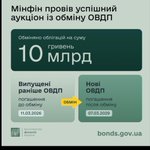
Ukraine has exchanged UAH 7 billion (approximately €138.5 million) in domestic government bonds. A useful debt-management operation — but not a reduction in public debt.
On October 21, Ukraine’s Ministry of Finance conducted another bond-switch auction.
The transaction replaced securities maturing on November 4, 2026, with bonds maturing on April 18, 2029.
The weighted-average yield on the new securities was 11.96%.
Extending maturities reduces immediate refinancing pressure and can improve the government’s liquidity position.
That is particularly important during a war, when budgetary needs remain exceptionally high and external financing is critical.
But maturity extensions do not eliminate debt obligations. They redistribute repayments over time and affect future interest costs.
This distinction matters for Ukraine’s fiscal sustainability.
International assistance, domestic borrowing and debt-management operations serve different purposes. They should not be treated as interchangeable sources of fiscal strength.
A successful debt strategy must be measured not only by how much financing the government raises today, but also by the costs and obligations it leaves for tomorrow.
#Ukraine #GovernmentBonds #PublicDebt #Donornomics

Happy National Day, Austria! 🇦🇹
As a Ukrainian, I deeply admire the wisdom and diplomatic skill of the Austrian people, who, after a decade of post-war occupation, succeeded in restoring their sovereignty and securing permanent neutrality.
Austria’s ability to preserve its independence, neutrality and prosperity through decades of geopolitical challenges deserves profound respect.
A remarkable lesson in diplomacy, national resilience and the value of peace.
My warmest congratulations to the Austrian people!
Alles Gute zum Nationalfeiertag, Österreich!
#Austria #NationalDay #Neutrality

The Bank of Japan has issued an important warning about the financial risks of the AI investment boom.
Its new Financial System Report, published on October 23, examines how AI-related investment could transmit shocks through global financial markets.
The mechanism is worth understanding.
Large technology companies are increasing investment in data centres and computing infrastructure.
Traditionally, much of this investment was financed internally.
Now corporate bond issuance, long-term lease commitments and financing from private funds are becoming increasingly important.
That creates additional connections between technology companies, banks and non-bank financial institutions.
The BOJ specifically warns that disappointment over AI profitability could trigger portfolio adjustments by investment funds, amplify market corrections and affect Japanese financial institutions.
The central bank’s stress tests nevertheless indicate that Japan’s banking system has sufficient capital and funding to withstand severe scenarios.
That distinction matters.
Identifying a systemic vulnerability does not mean predicting a financial crisis.
But it does mean recognising that AI investment is becoming part of the global credit cycle.
We should be watching not only AI company valuations, but also leverage, bond issuance, private credit exposures and the liquidity of institutions financing this expansion.
The technology may be revolutionary.
Its financing still follows the familiar rules of financial risk.
#Banking #AI #FinancialStability #BOJ #CreditMarkets

Ukraine has taken another step towards reducing state ownership in its banking sector.
On October 23, the Ministry of Finance announced the appointment of Rothschild & Co as financial adviser for the planned privatisation of Ukrgasbank and Sense Bank.
The mandate includes due diligence, bank valuations, attracting potential investors and preparing the sale process.
For me, this is more than just another banking-sector announcement.
When I was CEO of Ukrgasbank, I brought the International Finance Corporation (IFC), part of the World Bank Group, into the bank through a convertible loan arrangement designed to pave the way for IFC to become a shareholder.
Later, as Governor of the National Bank of Ukraine, I continued to pursue the same policy: reducing state ownership in the banking sector, attracting credible international investors and strengthening corporate governance.
I remain convinced that excessive state ownership is not a sustainable long-term model for an competitive banking system.
That is why I sincerely wish Ukraine’s Ministry of Finance success with these transactions.
However, the timing is far from ideal.
Selling banking assets during a full-scale war, amid substantial country risk and uncertainty about future economic conditions, makes it extremely difficult to obtain a fair price for the Ukrainian state.
Potential investors will inevitably factor those risks into their valuations, regardless of the banks’ underlying financial performance.
The challenge is not simply to find buyers. It is to avoid selling valuable state assets at a substantial discount to their long-term economic potential.
Privatisation is an important objective. But so is protecting the financial interests of Ukrainian taxpayers.
The quality of the deal matters just as much as the decision to privatise.
#Ukraine #Banking #Privatization #IFC #CorporateGovernance

Europeans expect higher inflation and weaker economic growth.
The ECB’s latest Consumer Expectations Survey, published on October 23, provides some revealing figures.
Expected inflation over the next 12 months:
August: 3.0%.
September: 3.1%.
Expected inflation three years ahead: 2.9%.
Expected inflation five years ahead: 2.5%.
Meanwhile, consumers’ expectations for economic growth over the next 12 months deteriorated from −1.2% to −1.5%.
Expected unemployment increased from 11.0% to 11.3%.
These are survey expectations, not official forecasts of actual economic outcomes.
Nevertheless, they matter for monetary policy.
Inflation expectations influence wage negotiations, consumption decisions, saving behaviour and the pricing decisions of businesses.
The combination of higher expected inflation and weaker expected growth is particularly uncomfortable for a central bank.
The ECB cannot eliminate an external energy shock.
But it must prevent higher inflation from becoming embedded in expectations and domestic price formation.
The Governing Council meets again on October 29.
These survey results strengthen the case for maintaining a cautious monetary-policy stance.
#ECB #Inflation #Eurozone #MonetaryPolicy

An important signal came from the US Treasury market on Thursday.
As technology stocks sold off, investors moved into government bonds.
The US 10-year Treasury yield fell approximately 19 basis points in a single session.
That is an unusually large move for the world’s benchmark government bond market.
It also tells us something about changing investor expectations.
For months, markets have been concerned about inflation, government borrowing and higher interest rates.
Now doubts about AI investment returns are creating a competing force: demand for safer assets.
When risk appetite deteriorates, capital can move quickly from equities into government debt.
But the underlying fiscal and inflation risks have not disappeared.
One day of falling yields does not resolve the longer-term challenges facing the US bond market.
#USTreasuries #Bonds #Markets #FederalReserve

South Korea’s central bank has paused its tightening cycle.
On 22 October, the Bank of Korea unanimously kept its policy rate unchanged at 3.0%, following two consecutive increases.
The decision reflects a difficult balance.
South Korea is benefiting from strong semiconductor exports and improving economic growth.
But inflation remains a concern, leaving the possibility of further rate increases.
This is an important example of the uneven impact of the AI investment cycle.
Demand for advanced chips supports Korean exports and industrial production.
At the same time, stronger activity can complicate inflation control.
For central banks, rapid growth in a strategically important industry does not automatically justify easier monetary policy.
#SouthKorea #CentralBanks #Inflation #Semiconductors

France is facing a serious sovereign debt market warning.
On 22 October, the yield on French 10-year government bonds rose above 5%, reaching levels not seen since 2002.
The spread over comparable German government bonds widened to approximately 164 basis points.
That spread is particularly important.
France and Germany share the same currency and monetary policy. Yet investors are demanding a substantially higher return for holding French debt.
This is a fiscal credibility issue, not an exchange-rate issue.
Higher yields increase the cost of refinancing government debt and gradually put additional pressure on the budget.
The euro protects its members from currency fragmentation.
It does not eliminate sovereign credit risk.
#France #Eurozone #Bonds #ECB

Wall Street is beginning to question the economics of the AI investment boom.
On Thursday, the Nasdaq fell 2.6%, its steepest daily decline since early June.
Meta lost approximately 7% as investors reassessed the cost of building AI infrastructure.
For several years, the market rewarded companies for announcing ever-larger AI investments.
Now the questions are changing.
How much capital will these projects consume?
When will they generate positive cash flow?
What returns will shareholders actually receive?
This is a familiar investment cycle. Expectations rise first, capital expenditure follows, and profitability is tested much later.
AI may transform productivity. That does not mean every company financing the transformation will earn an attractive return.
Technology can succeed while individual investments fail.
#AI #Nasdaq #Investing #CorporateFinance

A remarkable milestone for Austria: household financial assets have exceeded €1 trillion for the first time.
New data from the Austrian National Bank (OeNB):
Total financial assets: €1.011 trillion.
Annual growth: 7%.
Bank deposits: €341 billion.
Investment funds: €132 billion.
Listed shares: €63 billion.
Debt securities: €47 billion.
Over the past decade, Austrian household financial assets have grown by 60%.
The composition of savings is changing too.
Bank deposits remain the largest individual category, but households are increasingly investing in securities and funds.
There is another important number: household financial liabilities amount to only 21% of financial assets, compared with 26% across the euro area.
Austria has a substantial pool of private financial wealth.
The challenge is mobilising more of those savings for productive investment without compromising household financial security.
#Austria #OeNB #Investing #CapitalMarkets

Financial literacy matters. But income matters too.
A new Austrian National Bank survey reveals a striking difference in investment participation.
Among people with both high income and strong financial literacy, 57% reported investing in securities during the previous year.
Among those with low income and limited financial literacy, only 14% did so.
The average financial literacy score in Austria was 69 out of 100.
Almost 30% of surveyed investors did not know that buying a bond means lending money to its issuer.
These figures reveal two separate problems.
People need the knowledge to make informed investment decisions.
But they also need sufficient disposable income to invest in the first place.
Financial education can improve decisions.
It cannot, by itself, eliminate income inequality.
#Austria #FinancialLiteracy #Investing #OeNB
Austria has a more powerful passport than the United States.
The October 2026 Henley Passport Index ranks Austria 5th globally, with access to 185 destinations without a prior visa. The US ranks 10th, with 180.
Here is the global top 10:
Singapore — 193
Japan, South Korea, UAE — 188
Sweden — 187
Belgium, Denmark, Finland, France, Germany, Ireland, Italy, Luxembourg, Netherlands, Norway, Spain — 186
Austria, Greece, Malta, Portugal, Switzerland — 185
Hungary, Malaysia, Poland, UK — 184
Australia, Canada, Czechia, Latvia, New Zealand, Slovakia, Slovenia — 183
Croatia, Estonia — 182
Liechtenstein, Lithuania — 181
Iceland, USA — 180
For reference:
Ukraine ranks 32nd, with access to 142 destinations.
Russia ranks 50th, with access to 114.
The US and UK jointly held first place in 2014. Today, neither is in the top five.
The interesting point is that economic size does not automatically translate into freedom of movement.
Austria’s economy is a fraction of America’s, yet its citizens enjoy broader visa-free travel access.
Passport strength reflects diplomatic relationships, international trust and economic integration — not simply GDP.
For businesses and individuals operating internationally, mobility is an economic asset.
#PassportIndex #Austria #USA #GlobalEconomy

Europe’s public debt is increasing again.
New Eurostat figures show that eurozone government debt reached 88.8% of GDP in Q2 2026.
The EU-wide ratio was 82.9%.
Several major economies remain far above 100%.
Greece: 140.8%.
Italy: 139.9%.
France: 119.1%.
Belgium: 110.2%.
Spain: 101.4%.
Total eurozone government debt now exceeds €14.4 trillion.
The problem is not simply the current level of debt.
It is the combination of large financing requirements, higher borrowing costs and limited fiscal flexibility.
European governments face growing demands for defence, infrastructure, energy security and social expenditure.
These priorities must compete for increasingly expensive capital.
For the ECB, sovereign debt sustainability remains an important part of the financial-stability environment.
A common currency does not eliminate differences in national fiscal risks.
#Eurozone #Bonds #FiscalPolicy #ECB

A power failure at a Google Cloud facility has exposed a major vulnerability in European banking.
On 20 October, cloud-service disruptions affected customers of Revolut, Lloyds, HSBC and other institutions.
Google’s incident history records service disruptions lasting almost eight hours.
The UK Parliament has requested explanations from the Bank of England and the FCA.
This is more than a technology problem.
Banks increasingly depend on a small number of global cloud providers for essential infrastructure.
That concentration creates operational risks which cannot be measured through traditional capital or liquidity ratios.
A bank may have excellent capital adequacy, strong liquidity and a healthy loan portfolio.
But if customers cannot access payments, transfers or their accounts, confidence can deteriorate rapidly.
Cloud infrastructure is now part of financial infrastructure.
For supervisors, operational resilience and third-party concentration risk must be treated as core financial-stability issues.
#Banking #GoogleCloud #FinancialStability #OperationalRis
