

🕺🕺
Nairobi, Kenya
Joined July 2012
- Tweets1.8K
- Following1.4K
- Followers367
- Likes227



Kevin Ochwedo retweeted

Thanks to BVBD 2025 participants, your testimonies are greatly appreciated. Part 1. #BVBDcommunity
@ui_IHHE @Kecwdo @uidaho


Kevin Ochwedo retweeted

South African Doctor Prof 'Mashudu Tshifularo' became the first Surgeon on Earth to successfully perform surgery to cure deafness.

Kevin Ochwedo retweeted

In our January issue: The #type2 #immune response in #gut #homeostasis & parasite #transmission in #malaria, authored by Nora Céspedes, Renée Tsolis, Adrian Piliponsky & Shirley Luckhart. @uidaho @UCD_MMI @ucdavis #Bacteremia #Immunity #Immunoregulatory
cell.com/trends/parasitology…


Our 2025 January issue bit.ly/2N9R8Es reviews type2 immunity in gut homeostasis & Plasmodium transmission, malaria elimination in Thailand, male & female schistosome interactions, placental malaria & CSP-specific immunity, community ecology of invasive ticks, & more.

Kevin Ochwedo retweeted
Three weeks left! Take advantage of the opportunity to win one scholarship to attend the Biology of Vector-borne Diseases course in 2025. Apply before December 31, 2024.@ui_IHHE #BVBDcommunity @LASOVE_ @ApsEpidemiology #PlantHealth2024 @AmerSocVirol #LoveVirology

Kevin Ochwedo retweeted

VectorBuilder’s Sequence Alignment tool allows you to not only directly compare two sequences at the DNA or protein level, but also compare two DNA sequences based on translation. 🌟
Try it out today: vectorbuilder.com/tool/seque… 🧬

Kevin Ochwedo retweeted
Applications are opened! - Biology of Vector-borne Diseases course 2025. #postdocs
@AmerSocVirol #LoveVirology #ENTSOC24 #BVBDcommunity #PlantHealth2024 @RafaelKCampos @APerez2104 @MarianaGeffroyL @DavidAjileye @HeidyGamarra9 @cmalmstrom14 @MayoDaScientist @GoodmanLabWSU

Kevin Ochwedo retweeted
The next annual Biology of Vector-borne Diseases course is scheduled for Monday through Saturday, June 16-21, 2025.
Kevin Ochwedo retweeted
Thanks to BVBD 2024 participants, your testimonies are greatly appreciated. Part 1 #BVBDcommunity @ui_IHHE @RafaelKCampos @APerez2104
@MarianaGeffroyL @AnnAmmugauan
@DavidAjileye @HeidyGamarra9
@heidygamarra40 @Kecwdo


Kevin Ochwedo retweeted
Thanks to all for joining us to BVBD course2024
@RicardoRH_IDB @RafaelKCampos @APerez2104 @MarianaGeffroyL @AnnAmmugauan @DavidAjileye
@piliffq @OkothAbworo @GoodmanLabWSU @AnthonyMabele @ShirleyLuckhart @EdwinLe76476599 @uidaho @cmalmstrom14 @MayoDaScientist @ui_IHHE @marobertvt

Kevin Ochwedo retweeted
Welcome BVBD participants 2024 - See you on Monday, June 10
@ui_IHHE @uidaho #BVBDcommunity @iids_uidaho

Kevin Ochwedo retweeted

Promising Results from New mRNA Malaria Vaccines - lab studies done on mice show sustained immune responses, with over 99% transmission reducing activity for 4 months.
~
Here is some interesting news regarding efforts to create new malaria vaccines based on the mRNA technology. These scientists (Duffy's lab at NIH) designed mRNA vaccines that stop the malaria parasite from developing inside mosquitoes, thereby preventing its spread (Transmission Blocking Vaccines, TBVs). They conducted lab experiments on mice and tested multiple versions of the vaccine, expressing two key malaria antigens (Pfs25 & Pfs230D1). Their results show that some of these vaccine candidates induced very strong immune responses in the mice - and were more potent compared to older vaccine types. One of the vaccines remained highly effective (with over 99% transmission-reducing activity) for four months.
~
Scaria et al 2024: This research suggests that mRNA vaccines could be a powerful new weapon in the fight against malaria, with the potential to significantly reduce its transmission: nature.com/articles/s41541-0…

Kevin Ochwedo retweeted
Now Confirmed; MasterClass is scheduled for December 14th 2023, starting 5.00pm EAT, 9am EST, 3pm CET. Confirmed Experts: Profs. Erin Mordecai (Stanford), Leah Johnson (Virginia Tech), Abdisalan Noor (Harvard), Kimberly Fornace (Glasgow).
~
Additional details coming soon


Kevin Ochwedo retweeted
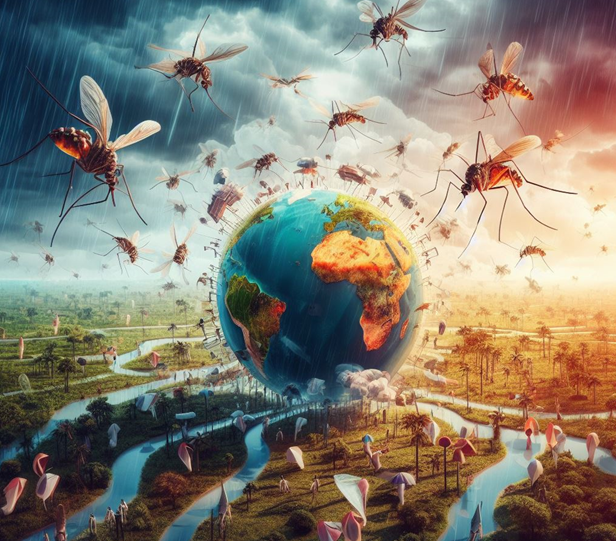
PCR vs. ELISA: Which One Should We Use To Identify Mosquitoes involved in Malaria Transmission?
~
In this study, researchers compared two methods for detecting malaria parasites in mosquitoes. They used a PCR-based method (targeting mt COX-I gene) and an ELISA method (targeting the circumsporozoite protein). They tested mosquitoes at different time points after feeding them on blood from patients infected with Plasmodium vivax malaria. They found that PCR was clearly more sensitive than ELISA in detecting parasite DNA in both the abdomen and head/thorax segments of the mosquitoes. However, it was not able to distinguish between different life stages of the parasite. Bisecting the mosquitoes (separating the abdomen from head and thorax) prior to PCR did not improve the results. On the other hand, ELISA only detected parasites in the Head and Thorax [and only once, detected the parasites in the abdomen after 6 days]
~
Their conclusion: "PCR is a robust method for detecting Plasmodium DNA within a mosquito, but its limited Plasmodium life-stage specificity makes it a poor candidate for detecting infectious mosquitoes. The “gold-standard” CSP ELISA should not be replaced by PCR-based methods for detecting infectious Plasmodium but can be used in conjunction with CSP ELISA for the confirmation of positive infectious mosquitoes and detection of low-density infections within a mosquito". Thanks to @Kecwdo for explaining this so well to me.
~
Hendershot et al| parasitesandvectors.biomedce… @SethIrish4 @FitsumGTad80503


Kevin Ochwedo retweeted
As the planet warms due to climate change, diseases like dengue and malaria could spread to places where people might never have been exposed to them before 🧵 [1/5]

ALT A person wearing a protective suit sprays insecticide in a garden with the sea in the background. Beside this image, Felipe Colón, Technology Lead at Wellcome, says: "Warmer temperatures create more opportunities for diseases to thrive."
Kevin Ochwedo retweeted

Habitat Diversity, Stability, and Productivity of Malaria Vectors in Irrigated and Nonirrigated Ecosystems in Western Kenya ift.tt/RbFMz0x
Kevin Ochwedo retweeted

Malaria-carrying mosquitoes kill hundreds of thousands of people every year. Scientists have found a way to get rid of them by spreading a gene to wipe out mosquito populations. But is it a good idea?
#GeneDrive
youtu.be/xAPjCSN0tRs
Kevin Ochwedo retweeted

Eradicating #malaria will be even harder following the COVID-19 pandemic. Thankfully, there are exciting innovations to eliminate malaria for good: gatesnot.es/3wdJZwl