

CEO of TradeSmith, a leading fintech and quantitative investment research firm. Investors trust over $30 billion to be monitored and analyzed on our platform.
Joined October 2022
- Tweets2.6K
- Following215
- Followers5.4K
- Likes1.1K


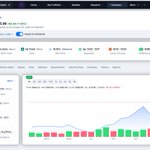
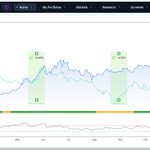

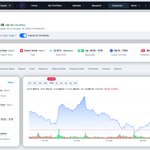


$BBY is up 27.6% over the past year and just hit a new one-year high on Friday.
That says more than most of the headlines you will read about the American consumer.
Best Buy is the largest specialty electronics retailer in the country, with more than 1,000 North American stores, a large e-commerce business and Geek Squad services.
It sells TVs, laptops and phones from Apple, Samsung, Sony and Microsoft. Those are wants, not needs.
When household budgets get stretched, the new laptop is the first purchase to get postponed. That makes $BBY one of the cleanest real-time reads on consumer health.
Its latest quarter showed comparable-store sales up 4.1%, and the near-term outlook pleased Wall Street.
$BBY is not alone. Visa $V, Mastercard $MA, Williams-Sonoma $WSM and Marriott $MAR have all been sending the same message.
Consumer-sensitive stocks do not hit new highs in a weak economy.
Government data on jobs and inflation is debated endlessly. Stock prices reflect the collective judgment of industry insiders, money managers and bankers with real money on the line.
The U.S. economy has imbalances and real risks. But right now, the market is pricing in more positives than negatives.
TradeSmith's Technical Score on $BBY sits at 93.4 out of 100, a strong read on the momentum behind this move.
Which signal do you trust more, the headlines or the price action?

Iren $IREN traded near $27 Tuesday afternoon, up more than 7%. Three analysts have targets that would nearly quadruple it.
Bernstein is at $100. Northland and Cantor Fitzgerald are both at $99.
That is a big gap for a stock that was down about 33% this year as of Monday's close. Here is what those three analysts are paying for.
Start with the customer. Iren carries a $9.7 billion Microsoft AI cloud contract. Then the build. The company is guiding to $25 billion to $30 billion of capital spending in fiscal 2027.
That second number is the risk and the opportunity in one line. Spend it well against signed demand, and the targets look reasonable. Struggle to fund it, and the stock stays stuck where it is.
Tuesday's bounce says buyers are willing to bet on the first outcome again. The next proof point comes from the funding side, not the demand side.
Is $100 a target or a fantasy?

18 oil and gas stocks hit new one-year highs last week, led by $XOM and $CVX, pushing $XLE to a new all-time high.
Shell $SHEL, ConocoPhillips $COP, EOG Resources $EOG and Canadian Natural $CNQ were all on the list.
This is a quiet bull market. Few people are talking about it, but shareholders are getting paid.
We went long the emerging uptrend in oil and gas back in September of last year. The thesis was simple: global growth keeps demand solid, and U.S. shale output growth looks like it is peaking.
When shale flatlines, the market loses a source of supply growth it relied on for more than a decade. Oil also looked cheap relative to gold and other assets.
The Iran War was a bonus that was never part of the original call. Oil is up 14% in just the past three weeks.
Good news on the war could spark a short-term pullback. The longer-term setup still looks strong for three reasons.
First, damaged Middle Eastern infrastructure could take over a year to return to pre-war flows, which supports oil above $80 a barrel.
Second, buffer stockpiles of crude and refined products were drawn down over the past six months and now need to be refilled.
Third, this trade is not crowded. Adjusted for a decade of dollar debasement, key oil and gas ETFs are down significantly.
TradeSmith's short-term Health indicator reads Bullish on both $XOM and $CVX.
Is energy a core holding for you yet, or still just a trade?
Gross margin tells you how much is left after making the thing you sold.
Take sales, subtract the direct cost of producing the product, and divide by sales. A software company might keep 80 cents of every dollar at this stage. A grocer might keep 25.
It is the first and purest signal of a business's economics, before rent, marketing, or executives take their share.
Three new highs and one new one-year low on today's tape.
Rubrik $RBRK hit a new one-year high. The data security company keeps showing that the cybersecurity bull market is still running. TradeSmith's Technical Score on $RBRK sits at 82.4, a strong momentum read.
S&P Global $SPGI hit a new six-month high. The credit ratings and index giant works like a toll booth on global capital markets, collecting fees as debt gets rated and money tracks its benchmarks.
Royalty Pharma $RPRX hit a new high. It owns royalty streams on blockbuster drugs, which puts it squarely in the healthcare strength that has dominated the new highs list.
Booking Holdings $BKNG went the other way and hit a new one-year low. That stands out given the strength we have seen in hotel operators like Marriott, so it is one worth watching for a turn.
The bigger picture from today's list:
Cybersecurity is still leading.
Healthcare, from devices to royalties, keeps showing up.
Financial infrastructure names are firming.
Travel is mixed, with hotels strong and online booking lagging.
Trends that persist tend to keep paying. Today's highs list says several of the big ones are still intact.
Bookmark this for your watchlist.
AMD $AMD is lined up to supply up to 2 gigawatts of Instinct MI450 chips to Anthropic $ANT, with deployment starting in the first half of 2027.
Under the July agreement, AMD also committed to invest up to $5 billion in Anthropic.
That is the same pattern showing up everywhere this week: the supplier helps finance the customer, and the customer buys the supplier's chips.
Anthropic's S-1 also points to more than $20 billion of AMD Helios capacity beyond its main commitments table. And AMD is one of three chipmakers that indicated non-binding interest in buying into Meta's stock offering.
$AMD closed Monday at $531.28, up 3%, as the chip group rallied. TradeSmith's Quantum Score has it at 92.3, with technical and fundamental scores both above 90.
Nvidia owns the headlines. AMD is quietly assembling a second order book.
How big can the MI450 ramp get in 2027?
Broadcom $AVGO sits at the center of a $63 billion financing package built to put its chips into Anthropic's $ANT data centers.
Here is how it works. A newly formed vehicle buys Broadcom XPU accelerators and networking gear, then leases them to Anthropic.
Bank of America, Citi and Morgan Stanley are arranging the first lien. Blackstone is the sole provider of the committed second lien. Deliveries start in 2027.
The detail investors should notice: Broadcom gives the vehicle residual value support equal to the first-lien portion. In plain English, Broadcom stands behind what the chips are worth later.
That is how a chip sale becomes a financing product.
The stock closed Monday at $329.17, up 2%. The rate, the term and the split between the liens were not disclosed.
Bulls see locked-in demand into 2027 and beyond. Bears see a supplier taking on part of its customer's risk.
Which reading wins for $AVGO?
Atlassian $TEAM is up 278% since software stocks bottomed in April.
Just months earlier, many software stocks fell 30% to 60% in under four months. It was one of the fastest large declines in market history.
The fear was simple. AI lets a few people build software that once took teams of expensive programmers, squeezing revenue, margins and valuations.
Then the market changed its mind, at least for now.
Since the April low: Snowflake $SNOW is up 137%, Paycom $PAYC is up 138%, Veeva $VEEV is up 105% and ServiceNow $NOW is up 74%.
My call back in March to get long cybersecurity has been a big winner. CrowdStrike $CRWD and Palo Alto Networks $PANW are both up more than 120%.
TradeSmith's Quantum Score confirms the strength, with a Technical Score of 85 on both names.
And the SPDR S&P Software & Services ETF $XSW hit a new all-time high this week.
The bigger lesson: stocks move faster than ever. Rapid tech change, light-speed information and AI-powered trading compress years of moves into months.
Memory names $MU and $WDC rose 384% and 489% from early 2025 to early 2026. $ASTS gained 4,191% over a recent two-year stretch.
That speed works in both directions. Being on the right side of the trend matters more than ever.
Was the software selloff overdone, or is the AI threat still ahead?
Big Week in Earnings - Week of October 26:
$MSFT $GOOGL $AMZN $LLY $XOM $V $MA $ABBV $INTC $CVX $KO $MRK $CAT $HSBC $SHEL $NVS $AZN $LIN $GEV $TTE
$MSFT - Wednesday, AMC | EPS est: $4.71 | Rev est: $90.69B
$GOOGL - Wednesday, AMC | EPS est: $2.99 | Rev est: $124.59B
$AMZN - Thursday, AMC | EPS est: $1.97 | Rev est: $202.18B
$LLY - Thursday, BMO | EPS est: $6.41 | Rev est: $22.51B
$XOM - Friday, BMO | EPS est: $4.02 | Rev est: $105.42B
$V - Tuesday, AMC | EPS est: $3.44 | Rev est: $12.09B
$MA - Thursday, BMO | EPS est: $5.16 | Rev est: $9.65B
$ABBV - Friday, BMO | EPS est: $3.78 | Rev est: $17.35B
$INTC - Thursday, AMC | EPS est: $0.37 | Rev est: $16.47B
$CVX - Friday, BMO | EPS est: $4.82 | Rev est: $61.41B
$KO - Tuesday, BMO | EPS est: $0.88 | Rev est: $12.93B
$MRK - Thursday, BMO | EPS est: $2.10 | Rev est: $17.32B
$CAT - Thursday, BMO | EPS est: $7.05 | Rev est: $20.67B
$HSBC - Tuesday, BMO | EPS est: $2.22 | Rev est: $19.09B
$SHEL - Thursday, BMO | EPS est: $3.61 | Rev est: $99.72B
$NVS - Tuesday, BMO | EPS est: $2.24 | Rev est: $14.58B
$AZN - Friday, BMO | EPS est: ~13% core growth | Rev est: $16.02B
$LIN - Thursday, BMO | EPS est: $4.52 | Rev est: $9.17B
$GEV - Wednesday, BMO | EPS est: $4.02 | Rev est: $12.02B
$TTE - Thursday, BMO | EPS est: $3.68 | Rev est: $65.09B
Bookmark this for your watchlist.
$GOOGL plans $195 billion to $205 billion of capex this year. $AMZN plans about $220 billion.
Add Meta's freshly raised $135 billion to $145 billion, and three companies alone are on track for roughly $550 billion of spending in 2026.
This week shows whether it is paying. Alphabet and Microsoft report Wednesday after the close, a few hours after the Fed decision. Amazon follows Thursday.
The numbers to watch: Microsoft guided Azure to about 45% growth in constant currency. Expectations for AWS sit at 30% to 35% growth, after 37% in Q2. Alphabet goes in more than 20% below its May peak.
Meta raised its spending and fell 7% the next day. That is the test the market is running on all of them: growth has to outrun the bill.
TradeSmith's Quantum Score on $MSFT: 86, the highest of the three reporting this week.
Which of the three earns its spending best?
Free cash flow is the money left after the business pays to keep itself running.
Take cash from operations, then subtract capital spending, the factories, equipment, and systems the company must buy to stay in business. What remains is free. It can go to dividends, buybacks, debt, or growth.
A company that earns a profit but spends it all just to keep up is not free. Look for the cash that is actually left over.
$MU: Nvidia's Jensen Huang says memory supply is unlikely to outstrip demand by 2029.
That one line is the Micron thesis.
Micron backs it up. Its entire 2026 HBM supply, including HBM4, is sold out, and CEO Sanjay Mehrotra expects supply to stay tighter than demand through 2027 and 2028.
Pricing is following the shortage. J.P. Morgan just raised its fourth-quarter DRAM contract price forecast to a 10% to 15% increase, up from 3% to 8%. NAND: 15% to 20%, up from flat to 5%.
When customers sign long-term supply deals, they are telling you what they expect. Nobody locks in supply that far out ahead of a glut.
The stock is still trading like the cycle could turn tomorrow. Micron's own outlook says otherwise, at least through 2028.
TradeSmith's Quantum Score fundamental read on Micron: 94 out of 100.
Is the 2029 call too bullish, or not bullish enough?
12 oil and gas stocks hit new one-year highs on Friday, led by Exxon Mobil $XOM and Chevron $CVX.
The full list at one-year highs: $XOM, $CVX, $EOG, $COP, $APA, $SU, $CNQ, $PBR, $BP, $SHEL, $E and $EQNR.
That's U.S. majors and producers, Canadian producers, Brazil's Petrobras and the big European integrateds, all moving together.
When an entire group breaks out at once, the trend is broad. This is not a one-stock story.
Also at a one-year high: American Tower $AMT, the wireless infrastructure and data center REIT. It's another reminder that the data center buildout reaches well beyond the chipmakers.
On the other side of the ledger, four names hit new one-year lows.
Chipotle $CMG, the fast food giant.
Stellantis $STLA, maker of Jeep, Ram and Chrysler.
Kratos Defense $KTOS, the military drone and communications leader. A notable reversal for a stock that rose 532% over a recent two-year run.
Energy Fuels $UUUU, the uranium mining and rare earth name.
The split is clear. Strength in energy and infrastructure, weakness in restaurants, autos and a couple of recent high-flyers.
Bookmark this for your watchlist.
The $269 Billion Bill Behind Anthropic's Perfect S-1... Here's the Bull and Bear of it.
$269.4 billion. That is how much Anthropic $ANT has promised to pay Google $GOOG, Amazon $AMZN, and Microsoft $MSFT for compute, "regardless of actual usage."
Those are the filing's words, not mine.
Everyone will lead with the revenue today. They should. It is the best growth chart ever filed with the SEC.
$41 million in 2023. $386 million in 2024. $4.6 billion in 2025. Then $16.3 billion in just the first half of 2026, up 1,300% from a year earlier.
Net Revenue Retention is roughly 900%. That means a typical group of customers is spending about nine times what it spent a year ago.
Read that again.
Gross margin was negative in 2024. In the first half of 2026 it was about 85%. Operating cash flow went from negative $1.5 billion to positive $3.9 billion. The company is sitting on $112.4 billion of cash.
Even the scary headline number is mostly noise. The $80.7 billion net loss includes $72.4 billion of non-cash charges from marking up its convertible notes and similar instruments. The better Anthropic does, the bigger that "loss" gets. The operating loss was only $693 million.
So where is the risk?
Here is the setup.
80% of Anthropic's revenue is consumption-based. Customers pay for what they use, when they use it. If usage slows, revenue slows the same month.
The costs do not work that way.
Google: at least $114.5 billion through July 2033.
Amazon: at least $110 billion through April 2036.
Microsoft: at least $44.9 billion through May 2033.
If Anthropic uses less than it committed to, it pays the difference anyway. The filing calls that a "true-up."
Add one more line. Once all capacity is delivered, which Anthropic expects in December, its SpaceXAI compute deal runs about $3.1 billion a month. That is roughly $37 billion a year from one supplier. Anthropic's first-half revenue, doubled, is $32.6 billion.
Sit with that number.
Revenue can change month to month. The bills are locked in for up to ten years.
Anthropic says so plainly. It may "enter into these obligations based on revenue expectations that may not be realized."
That reframes the whole document. This is not really a software IPO. It is a giant bet on how fast enterprise AI keeps growing, wrapped around one of the most profitable growth engines ever built.
The bull case is simple. Compute is the scarcest input in AI, and Anthropic locked up a decade of it early. Revenue grew 1,368% last quarter while compute costs grew 300%. If that gap holds, these contracts become the best trade of the decade.
The bear case is also simple. Usage only has to flatten for a few quarters. Customers can turn the meter down. Google and Amazon still get paid.
Both are true at the same time. That is the trade.
One more detail. The public gets one vote per share. A single Class F share, held by the seven co-founders, carries 50.1% of the voting power. You get the upside and the risk. They keep control.
When the amended filing lands, I am watching three numbers. Q3 revenue, which this version leaves blank. The total compute commitment, also blank. And how much of it is due in the next twelve months.
Those three numbers will tell you whether $269.4 billion is a moat or an anchor.
2.37 million people just viewed Chamath calling neoclouds "disorganized and poorly capitalized."
$CRWV $NBIS $IREN $CIFR $WULF $HUT $CORZ $APLD $GLXY $ORCL $MSFT
Then Elon Musk said debt markets have "almost entirely shut off" for companies without substantial revenue outside AI data centers. His prediction: "guppy-level death" among 200+ neoclouds.
Overnight, $NBIS and $CRWV fell 4%. $IREN and $CIFR fell 3%.
The bear case is about funding, not demand. These companies borrow against GPUs that lose value every chip cycle, and the Nebius CEO says the bond market just closed to GPU asset-backed debt.
The bull case runs through Microsoft $MSFT. It made up 62% of CoreWeave's 2024 revenue, signed a $17.4 billion deal with Nebius and a $9.7 billion deal with IREN. Those contracts are the collateral lenders care about.
Oracle $ORCL is the warning label. It is the one big cloud funding its AI buildout mostly with debt, over $100 billion so far, and loans tied to one of its data centers recently traded at 89 to 91 cents on the dollar.
So both sides can be right. Neoclouds with long hyperscaler contracts and energized power can still raise money. The ones without are the guppies.
And you have to wonder, are they just acquisition targets fueling the online negative chatter? Driving their value way down to acquire them - we see that all the time.
What happens next is consolidation, not collapse. Big Tech plans more than $7 trillion of data center and AI spending through 2030, and someone still has to deliver that power. Neoclouds are needed, 100%.
The question this week is which balance sheets survive the shakeout.
What is your view on Neoclouds?
$XBI is up 68% and $IBB is up 51% since I shared my bullish sentiment on biotech in August of last year.
Over the past 10 days, Amgen $AMGN, Biogen $BIIB and Gilead Sciences $GILD all hit new one-year highs.
Those leaders have pushed the iShares Nasdaq Biotechnology ETF $IBB to a 36% return over the past year.
Yet almost nobody is talking about it.
CNBC isn't running long biotech segments. Biotech CEOs aren't on the podcast circuit the way Jensen Huang is.
Bring up biotech at an investment conference and you get blank stares. That indifference is the bullish part.
A strong industry uptrend plus public indifference is one of the most reliable setups in markets. Trends tend to persist, and ignored markets rarely get bid up to expensive levels.
That leaves plenty of valuation room to run, and plenty of sidelined money that could still pile in.
TradeSmith's Quantum Score backs up the momentum. $AMGN and $BIIB both carry a Technical Score of 91.
The bigger story is AI meeting biology. Researchers running millions of digital simulations can find drug candidates and predict how treatments behave far faster than before.
Breakthroughs that once took decades could arrive in years. The last biotech bull market ran 300% over four years.
Biotech tends to get a bad rap, how do you feel about it?
Profit is an opinion. Cash is a fact.
The income statement can show earnings the company has not collected yet, or smooth costs across years. The cash flow statement tracks the actual dollars that came in and went out. It is much harder to dress up.
When profits look great but cash keeps draining, believe the cash. It is the statement that catches the stories the other two can tell.
$IREN closed Friday at $24.91, 67.6% below its 52-week high of $76.87.
The contract book is not the problem. The company holds a roughly $9.7 billion, five-year Microsoft deal for 200 MW at Childress, Texas, backed by a $3.65 billion debt package rated A. Last week it secured a license for a roughly 300 MW AI campus in Badajoz, Spain, targeted for 2028.
The debate is the balance sheet. At June 30 it held $5.9 billion of cash against $7.59 billion of debt, with a $25 billion to $30 billion capex plan for fiscal 2027.
That is the whole neocloud trade in one stock: contracted demand on one side, funding risk on the other. Right now the stock is pricing the second.
Wall Street's median target sits near $80. Earnings land Nov 5, one week after the hyperscalers tell us how much they plan to keep spending.
Is $IREN a deep-value setup or a balance sheet you avoid?
$SPCX and $TSLA together would be worth about $3.5 trillion. Both boards now have special committees of independent directors studying a combination.
Musk's own words: "Do I think it would be a good idea? Yes." He also said calling it a certainty "would be overstating it."
The hurdle is real. A deal needs a majority of all outstanding Tesla shares, not just the votes cast. Musk called that "quite a high hurdle." Barclays thinks an announcement could come before Tesla's Dec 3 annual meeting.
Meanwhile, supply keeps arriving. Up to 328.4 million more SpaceX shares become tradable Monday. The track record on unlock days is mixed: down 4% in August, flat in September, up 1% on Oct 9, and down nearly 9% on Thursday's 1.3 billion share unlock.
The business underneath keeps delivering. Q3 revenue came in at $14.58 billion against a $12.54 billion estimate.
SpaceX closed Friday at $147.49, up 1.9%.
Would you rather own the rocket company alone or the combined giant?
Apple $AAPL climbed 1.2% to a new all-time high Thursday, while $META fell 7% and $SMH dropped 6%.
Memory leader Micron $MU dropped 6%. The Nasdaq Composite had its worst day since June.
The market is sending a message. Apple may be one of the biggest winners of the coming AI applications boom.
Think back to the internet. Amazon, YouTube, Facebook and Netflix didn't build the fiber, routers and servers.
They built great businesses on top of that infrastructure. AI is heading into the same phase.
Palantir $PLTR is a working example. The business is booming, and the stock is up more than 1,000% since early 2024.
Apple's edge is distribution. For more than 145 million Americans and over 1 billion people globally, Apple devices are the main gateway to the internet, and increasingly to AI.
As AI agents get more capable, people will spend on agentic apps that handle complex tasks and manage daily life.
iPhones, iPads and Macs become the interface for all of it. Apple doesn't need the smartest AI model to win.
It already owns one of the most valuable distribution networks ever built.
TradeSmith's Quantum Score shows a Technical Score of 82 on $AAPL, in line with the breakout.
Does $AAPL win the AI applications race without building the best model?