

Allways open to new ideas and projects 📩 We are all Freaks
Germany
Joined April 2021
- Tweets15K
- Following6.4K
- Followers838
- Likes27.7K








Andre Krypto retweeted

this harness paper is f*cking gold
Anthropic engineers broke down what actually makes Claude Code work so well. spoiler: it's not the model.
the secret: the harness. that's the whole gap.
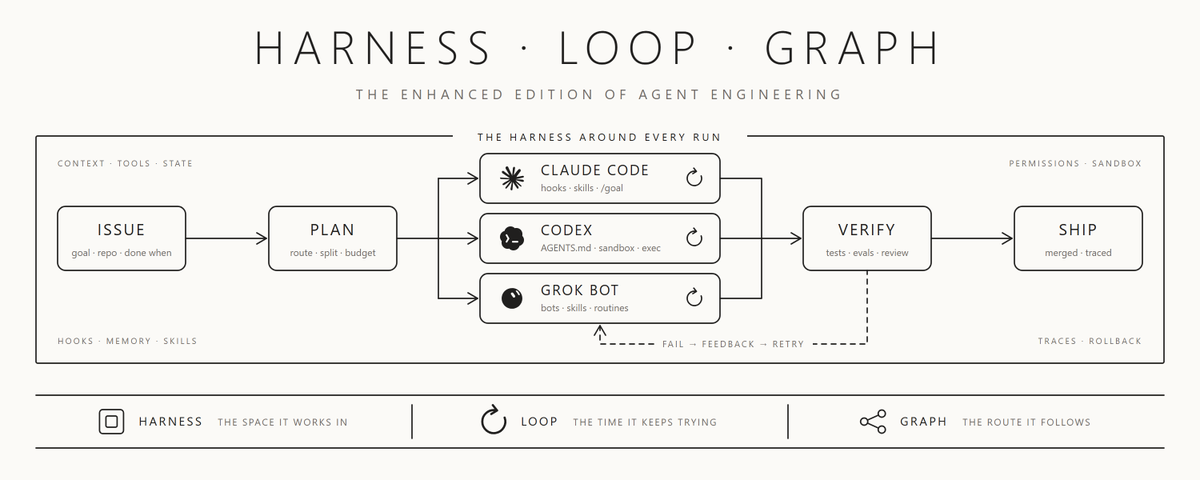
prompt engineering → context engineering → harness engineering.
the 6 layers of the harness:
layer 1 → tools
fewer tools, one job each.
every error tells the agent what to try next.
layer 2 → context
short CLAUDE.md → files on demand → compaction when it fills up.
layer 3 → permissions
reads + tests → auto.
deploys + deletes → ask a human.
everything → sandbox.
layer 4 → hooks
before a tool runs → block secrets and protected files.
after every edit → format, lint, typecheck. no exceptions.
layer 5 → verification
fresh reviewer reads the diff, not the summary → runs the tests → fail? fix → rerun.
layer 6 → evals
every harness change scored → success, tokens, turns → keep what wins.
the model is the engine. the harness is the whole car.
they even folded all 6 layers into one prompt. paste it into Claude Code and it engineers the harness for you.
6 layers. 1 prompt. 0 infinite loops.
save this before your next agent build
then read the article below ↓


Andre Krypto retweeted

This Anthropic context paper is f*cking gold
A long-running agent at Anthropic now burns 84% fewer tokens and scores 39% higher. Nobody touched the weights. The model wasn't the upgrade.
The upgrade: the agent stops hoarding tool results and starts writing what matters to files.
results → clear → memory → sessions → answer
The 6 parts of context management:
Part 1 → the context fills up
Every file read, search and test output stays in the window.
At turn 100 the workflow dies halfway.
Part 2 → context editing
Near the limit, stale tool results get cleared automatically.
The conversation stays. 84% fewer tokens.
Part 3 → memory as files
The agent creates, reads, updates and deletes files in a memory folder.
Stored on your side, not in the context window.
Part 4 → survives every session
Decisions, findings and project state carry into the next chat.
New session, same knowledge.
Part 5 → context awareness
The model tracks how many tokens it has left.
It saves and clears before the room runs out.
Part 6 → stack both
Context editing alone: 29% better.
With memory on top: 39% better.
An agent that keeps every tool result runs out of room at turn 100. An agent that clears and remembers finishes the job.
I packed all 6 parts into one prompt. Drop it into Claude Code and it sets context management up for you.
6 parts. 1 prompt. 84% fewer tokens.
Then read the article below ↓

Andre Krypto retweeted

This is f*cking insane. Anthropic engineer:
"You're not supposed to prompt Opus 5.5
You're supposed to build a system that prompts itself. At Anthropic, 90% of our engineers have already built these systems"
In 30 minutes, she walks through exactly how Anthropic builds agents that remember, fix their own mistakes and get sharper with every run.
Better than any $1000-$2000 agent course I've seen.
Watch it, then read the article below ↓
Andre Krypto retweeted

This is f*cking insane. Anthropic engineer Lydia Hallie just showed how the people who build Claude actually run it:
"Most people run one model in one chat and hope it works
I use Fable 5.2 to plan and review while Opus 5.5 builds everything. Inside Anthropic, engineers keep dozens of agent sessions running 24/7 in parallel"
In a 17-minute workshop, she shows how to get the full value out of Claude Code without burning your token budget
Fable 5.2 Plans → Opus 5.5 Builds → Dozens Of Parallel Sessions → Agents Running 24/7
One model thinks and judges, the other does the heavy lifting, so neither wastes tokens on the other's job
Parallel sessions keep the work moving even when one agent gets stuck
Most people pay top price for one model to do everything and get slower results for it
Worth more than 100+ YouTube tutorials combined
Bookmark it and watch it today
Then read how to wrap this setup in a harness, loops and graphs in the guide below ↓


Andre Krypto retweeted

THIS ANTHROPIC MCP PAPER IS F*CKING GOLDMINE
anthropic's engineers compressed 150,000 tokens of tool context into 2,000. same tools, same task, same model
the upgrade lives in the architecture: the agent swaps direct tool calls for code that makes those calls
tools → files → code → filter → answer
the 6 steps of code mode:
(1/6) → Tools become files
every MCP tool turns into a .ts file in ./servers. the agent lists the folder and opens the files it needs for the task
(2/6) → Load on demand
tool definitions load per task. 150,000 tokens become 2,000. time and cost fall by 98.7%
(3/6) → Filter in code
a 10,000-row sheet gets filtered inside the sandbox. the model receives the 5 rows that matter
(4/6) → Loops in code
polling Slack for deployment complete runs as a while loop. the loop returns the final result to the model in a single call
(5/6) → Private by default
emails and phones turn into [EMAIL_1] and [PHONE_1] before the model sees them. the real data lands in Salesforce intact
(6/6) → Skills
working code gets saved to ./skills with a SKILL.md. the agent builds its own toolbox with every session
the takeaway:
load every tool and the context burns out with the first question.
write code and the agent opens 2 files
i packed all 6 parts into one prompt. drop it into Claude Code and code mode sets itself up
1 prompt = 98.7% of tokens saved
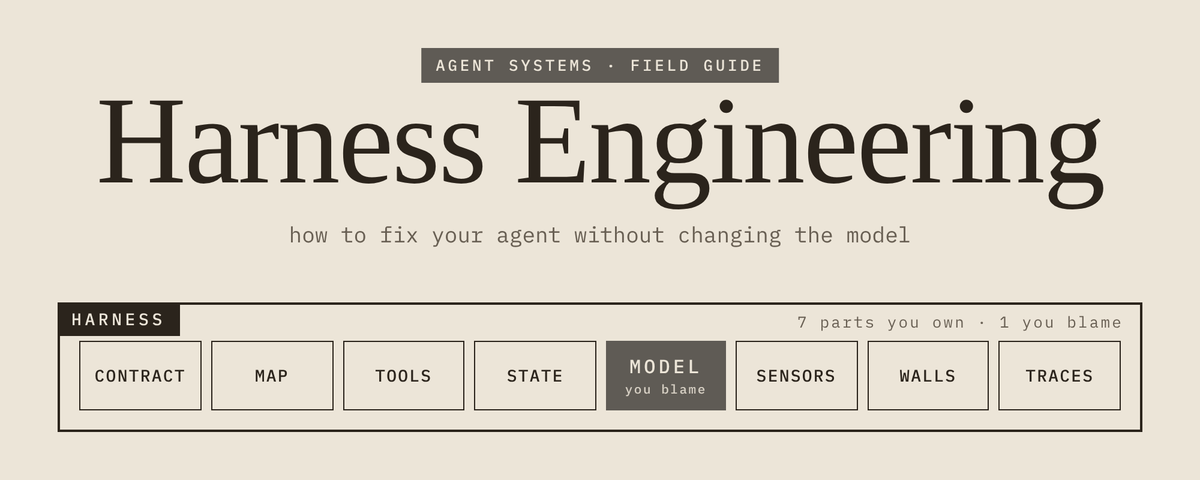
save this, then read the full "Context, Harness, Loops, Prompts" guide ↓


Andre Krypto retweeted
Dario Amodei (Anthropic CEO) just released a prompt that turns Fable 5.2 into an entire company that checks its own work while you sleep
It's f*cking unreal...
Send it to Fable 5.2, and thank me later. Then read the article below ↓


Andre Krypto retweeted

WHOEVER LEAKED THIS SECOND BRAIN JUST MADE YOUR WHOLE CHATGPT HISTORY USELESS
I thought my AI knew me after 2,000 ChatGPT chats, and every new tab still asks what I do, what stack I use and how I like my answers.
Apparently not.
This brain's setup is much more interesting:
→ 01 ME.MD + STACK.MD get written from your exported chat history before anything else (what you build, the tools you use, which answers you kept vs regenerated, 7 preferences each backed by a real chat), no "paste the same about-me paragraph into every new tab"
→ NIGHT DIGEST runs at 23:00 in the cloud with the laptop closed, raw/ stays read-only, 2,000 chats get boiled down to decisions, fixes and dead ends in 5 nights, anything that fits nowhere gets flagged for you instead of filed
→ CONTEXT PACK loads before every question: the 6 pages that matter for this one, each cited to the chat it came from, so the model starts where you left off, no "explaining your codebase from zero for the 40th time"
→ RULES.MD takes one line from you ("never suggest a library I already ripped out") and every bot rereads it before the next run, no "watching it recommend the same dead fix you rejected in march"
→ SUNDAY LINT at 18:00 is report only, merges 9 chats that solved the same bug, flags 3 answers you later found were wrong, flags 1 decision you reversed and never wrote down
so you get:
Chats digested. Context packed. Rules kept. Mistakes flagged.
the interesting part isn't a model with a longer memory.
it's one folder every bot reads first, so chat 2,001 already knows what the first 2,000 figured out.
Instead of 2,000 chats you'll never scroll back through, you let the brain compile 164 pages and 1,320 links from your own history in 4 weeks, load the right 6 before every question, and keep every rule you gave it.
Digest the history. Pack the context. Keep the rule.

Andre Krypto retweeted

SI agents / influencers will be the meta of this cycle, even though a lot of people I respect in this space are looking the other way.
Their thesis is simple: the next X can’t be the old X.
Meaning:
Truth Terminal, Zerebro; that chapter has already been written. The next runner can’t just be another version of what came before.
I think people are missing the bigger picture.
These projects ONLY sold the idea.
They captured attention while no one knew what's going on. There were little expectations on what the final output should look like, and that output compared to SI's standards today, is very weak.
To date, none of the SI Agent / crypto projects have fully realized / demonstrated the underlying concept in its truest form.
The next meta won’t be a copy of what worked before.
It'll be reformed evolution of an idea that the market already validated years ago, and will continue to find relevant for years to come.
still just the first innings for AI agents / companions / influencers.
-$CLAUDIA
Andre Krypto retweeted

this is pure f*cking treasure
how to build your first ai agent (full walkthrough)
if this had landed in front of me a year ago, my first agent would've shipped in an afternoon instead of eating two weeks of my life
in the right hands it resets what one person can ship alone:


Andre Krypto retweeted

I am begging you to paste this into Claude Code right now...
it coordinates Opus 5.5, Sonnet 5.5, and Fable 5.2 into an autonomous engineering team that takes task completion from 18% to 95%
Steal this before everyone starts using it, then read the full "The Harness Is the Machine" guide below ↓


Andre Krypto retweeted

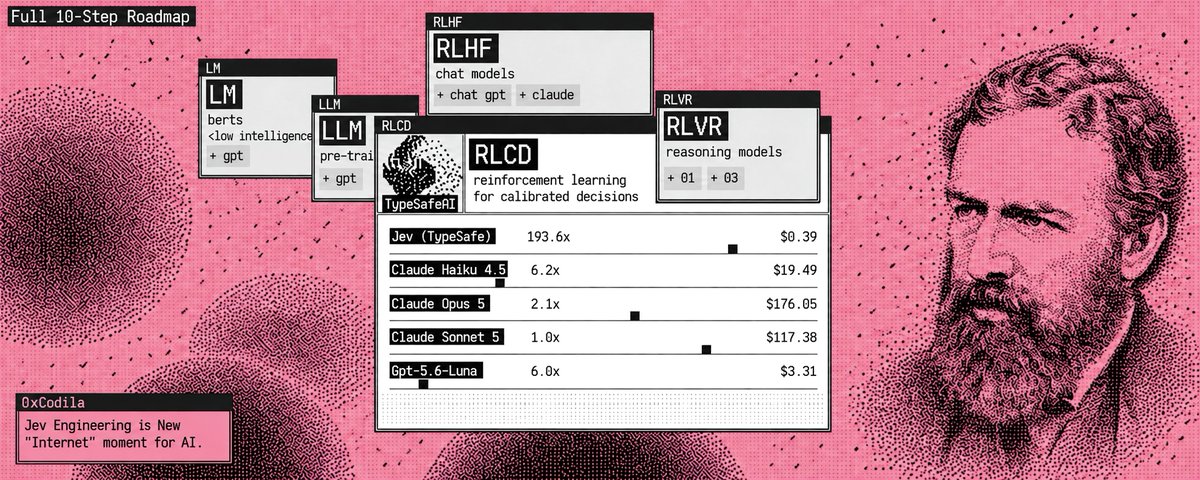
this prompt runs on Andrej Karpathy's autoresearch ideas (ex-OpenAI, ex-Tesla) and turns Opus 5.5 into a graph that actually finishes any job
it's f*cking wild...
paste it into Opus 5.5 and thank me later
then read the article below ↓

Andre Krypto retweeted
one year at Stanford costs more than $60,000
the CEO of Obsidian put his second brain setup on GitHub for $0
Steph Ango shared his vault, his theme and his agent skills: 7 repos, 77,106 stars. the vault template alone is a f*cking masterclass
• layer 1: the vault
> kepano-obsidian - his personal vault template, organized bottom-up
↳ github.com/kepano/kepano-obs…
> 40-questions - what he asks himself at the end of every year and every decade
↳ github.com/kepano/40-questio…
• layer 2: getting the web in
> defuddle - any web page as clean Markdown, built for the Obsidian Web Clipper
↳ github.com/kepano/defuddle
> clipper-templates - ready Web Clipper templates for popular sites
↳ github.com/kepano/clipper-te…
• layer 3: handing it to an agent
> obsidian-skills - teaches Claude Code and Codex the Obsidian CLI and its open formats
↳ github.com/kepano/obsidian-s…
• layer 4: making it yours
> obsidian-minimal - the distraction-free theme, tunable to the last detail
↳ github.com/kepano/obsidian-m…
> flexoki - an inky color scheme for prose and code
↳ github.com/kepano/flexoki
copy layer 1 before layer 3. an agent is only as useful as the vault you point it at
Karpathy's take on the same idea, Claude skills + Obsidian, is in the article below ↓


Andre Krypto retweeted

no f*cking way... OpenAI just dropped the one thing that makes Codex scary. 110 plugins and skills, all free, built by NVIDIA, Adobe, Stripe, Shopify and Figma themselves. even Microsoft is in there
a designer, a developer, an analyst and an assistant cost $46,200 a month. this costs $0
Sam Altman (CEO of OpenAI) says the first one-person billion-dollar company will run on exactly this. find your job below:
→ you run a store: Shopify + Stripe. "build my checkout, subscriptions and refunds"
→ you design: Figma, Canva and Adobe. "turn this Figma file into a working site"
→ you code: AWS, GitHub, CodeRabbit and Codex Security. "deploy this repo and review every PR before I do"
→ you run numbers: PostHog, Mixpanel and Datadog. "tell me why sales dropped last week"
→ you invest: public equity investing. "read NVIDIA's earnings and write me the memo"
→ you make videos: Remotion + Higgsfield. "cut a 30-second ad from this footage"
→ you live in meetings: Gmail, Slack, Zoom, Notion, Teams and Outlook. "prep me for every call today"
2 minutes to start: open Codex and type "install the Shopify plugin", swap in yours. sign in when it asks, then paste the task from your line. start with the job you pay the most for
plugins: github.com/openai/plugins
skills: github.com/openai/skills
what would you pick: a $46,200 team or one sentence in Codex?
the full stack running live below ↓


Andre Krypto retweeted
This Anthropic MCP paper is f*cking gold
Anthropic's engineers cut an agent's tool context from 150,000 tokens to 2,000. Same tools, same task. And the model wasn't the upgrade.
The upgrade: the agent stops calling tools and starts writing code that calls them.
tools → files → code → filter → answer
The 6 parts of code mode:
Part 1 → tools as files
Every MCP tool becomes a .ts file in ./servers.
The agent lists the folder and opens only what it needs.
Part 2 → load on demand
150,000 tokens of tool definitions down to 2,000.
A 98.7% saving in time and cost.
Part 3 → filter in code
A 10,000-row sheet gets filtered in the sandbox.
The model sees 5 rows.
Part 4 → loops in code
Polling Slack for "deployment complete" runs as a while loop.
No round trip through the model on every check.
Part 5 → private by default
Emails and phones turn into [EMAIL_1] and [PHONE_1] before the model sees them.
The real data still lands in Salesforce.
Part 6 → skills
Working code gets saved to ./skills with a SKILL.md.
The agent builds its own toolbox.
An agent that loads every tool burns its context before you ask anything. An agent that writes code opens 2 files.
I packed all 6 parts into one prompt. Drop it into Claude Code and it sets code mode up for you.
6 parts. 1 prompt. 98.7% fewer tokens.
Then read the enhanced edition of agent engineering below ↓
Andre Krypto retweeted

holy sh*t...
SpaceXAI engineer Lauren Tan released an update for her GitHub repo
paste this into your agent to catch recurring mistakes with automated checks
Prompt:
policy recurring_failure_guard {
bind {
repo := [REPO]
task := [TASK]
accept := [OBSERVABLE_RESULT]
scope := [ALLOWED_PATHS_AND_ACTIONS]
access := [AUTHORIZED_TOOLS_AND_PERMISSIONS]
}
preserve {
unrelated_edits
reproducible_inputs
existing_authorizations
rollback_path
}
baseline.capture -> {
revision := tested commit
worktree := staged + unstaged changes
environment := runtime + dependencies + build config
read repository rules and relevant reports
inspect existing verification commands
reproduce the reported failure before editing
case := {
fixture: exact input or saved request
initial_state: required application state
execute: command or ordered user actions
expected: observable completion criterion
observed: actual output or state change
evidence: logs + errors + artifact paths
}
}
baseline.result |> match {
REPRODUCED => trace the faulty execution path
NOT_REPRODUCED => inspect inputs and revision differences
BLOCKED => return missing prerequisite + next action
}
cause.resolve -> {
trace input -> calls -> state changes -> output
compare observations with the suspected cause
inspect related failures for a shared mechanism
require evidence before declaring a root cause
retain uncertainty where competing explanations remain
avoid speculative changes outside the failing path
}
safeguard.select |> match cause {
forbidden_dependency => {
enforce import or module boundaries
report the forbidden edge and supported dependency
}
invalid_state => {
constrain construction with types or validated APIs
reject invalid inputs at the relevant boundary
}
unsupported_usage => {
provide a supported operation
migrate obsolete examples and affected callers
add lint or compiler diagnostics where appropriate
}
behavioral_regression => {
preserve the failing input or user scenario
add an assertion on the incorrect observable result
}
repeated_mechanical_work => {
reuse or extend a tested script, CLI or codemod
expose a reproducible invocation
}
}
check.define -> {
name := [CHECK_NAME]
location := [EXISTING_SUITE_OR_POLICY]
command := [EXACT_INVOCATION]
rejects := [ORIGINAL_VIOLATION]
permits := [VALID_NEIGHBORING_CASES]
diagnostic := [REQUIREMENT_AND_SUPPORTED_CORRECTION]
}
check.validate -> {
faulty := original implementation + proposed check
fixed := corrected implementation + same check
controls := permitted inputs and neighboring behavior
assert faulty detects the original violation
assert fixed satisfies the requirement
assert controls preserve supported behavior
inspect assertion failures, outputs and exit codes
distinguish a detected defect from broken setup
isolate historical comparisons from the active worktree
record unavailable comparisons as NOT_RUN
}
candidate.exercise -> {
behavior => replay the affected UI, CLI or API scenario
performance => compare equivalent measured runs if relevant
quality => run types, lint and relevant regression checks
inspect the actual result of each operation
bind every artifact to its revision and configuration
invalidate affected results after relevant code changes
}
check.status |> match {
PASS => retain evidence for the stated requirement
FAIL => correct the cause and rerun affected checks
NOT_RUN => retain the missing prerequisite and next action
}
repository.update -> {
integrate the safeguard into the existing check path
document the supported command or API
replace examples that reproduce the obsolete pattern
preserve reusable launch, control and capture tools
verify the combined candidate after integrating changes
}
return {
revision: [TESTED_COMMIT]
worktree: [TESTED_CONTENT_STATE]
change: [DIFF_OR_PR]
cause: [CONFIRMED_MECHANISM_AND_EVIDENCE]
safeguard: [BOUNDARY_TYPE_RULE_OR_REGRESSION_CHECK]
commands: [INVOCATIONS_AND_EXIT_CODES]
proof: [FAULTY_FIXED_AND_CONTROL_RESULTS]
artifacts: [EVIDENCE_PATHS]
checks: [PASS_FAIL_OR_NOT_RUN_PER_CHECK]
limits: [UNCOVERED_CASES_AND_BLOCKERS]
next: [OWNER_AND_ACTION]
}
complete only when required checks support acceptance
follow repository review and merge requirements
keep permissions and stop conditions explicit
}


Andre Krypto retweeted

Elon Musk reposted my second brain setup last week. It runs on Claude Code and an Obsidian vault.
A thread, an article, a PDF, a podcast transcript. Drop one into a folder, say "ingest this", and Claude writes a summary page, walks the vault, finds every related note and links them.
The whole setup, start to finish:
→ install Obsidian, make a vault
→ open the vault in Claude Code
→ ask it to build you a personal wiki with a CLAUDE.md in the root
→ drop a source into /raw and say "ingest this"
→ Claude writes the summary, updates every related note, adds the backlinks
→ once a week say "lint the wiki", it fixes dead links, outdated facts and orphan pages
Every question I ask it now points at my own pages.
Bookmark this and set it up the next time you lose a tab you meant to read.
Full CLAUDE.md template is in the article below ↓


Andre Krypto retweeted

Anthropic Engineering: "At Anthropic, we don't write prompts anymore. we build loops"
in 42 minutes, she shows how the Claude team creates loops that prompt themselves
if this cost $400, people would call it the best agents course of the year
it's free
watch it, and Bookmark.
Andre Krypto retweeted

KARPATHY WROTE THIS DOCUMENT TO COMPLETELY AUTOMATE OBSIDIAN WITH CLAUDE
I was ready to abandon my second brain
manual cross-referencing was destroying my workflow, but finding this exact document opened my eyes to a completely different approach
it is incredibly convenient -> Karpathy's method turns the AI into a full-time maintainer for your Zettelkasten:
> the LLM reads every new source and integrates it into a structured wiki
> Obsidian becomes your visual IDE while Claude operates as the backend
> the agent runs automated checks to find contradictions across your notes
> your entire vault compounds automatically without you typing a single link
the friction is completely gone. I just feed it raw documents and the agent organizes my entire life
here is the official document from Karpathy explaining the architecture 👇

Andre Krypto retweeted

This is f*cking insane. OpenAI co-founder Andrej Karpathy opened his screen and showed exactly how he uses AI every day
70 minutes. No slides. Just the way the top 1% actually work with LLMs
Prompts → Context → Tools → Workflows → How The Top 1% Work
Most people are overcomplicating it. He picks the right model, feeds it the right context and lets the tools do the rest
Anyone can open ChatGPT and type. Almost nobody uses it the way the man who co-founded OpenAI does
Worth more than any $2,000 AI course
Bookmark and watch it today
Then read how to turn that into agents that run on their own with harness, loops and graphs in the guide below ↓