
Robot learning @berkeley_ai @physical_int
Berkeley, CA
Joined August 2018
- Tweets112
- Following322
- Followers1.1K
- Likes269

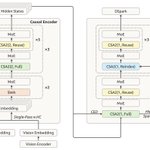




tbh, I think we kind of undersold pi07 when it first came out - it's a _huge_ step up compared to previous models in terms of generalization and finetuning performance
and there's a lot more where that came from ;)

True physical intelligence will run on many different form factors, to do many different tasks. Our partners have used the Pi API to build robust deployments in a huge breadth of domains, from logistics to agriculture. Excited to see what people will build next :)


Kyle Stachowicz retweeted

π is looking to opportunistically hire for a very special role : )
we're growing our contributions to the robotics ecosystem and hiring a scrappy generalist with a deep understanding of robotics & hardware to own this push. it'll be an open mandate to roll up your sleeves to do fun projects and build an incredible community (e.g. sponsoring grants, giving away HW, hackathon ecosystems).
please dm / tag exceptional people who have worked in public!
Kyle Stachowicz retweeted

Action chunking is a critical component in virtually all modern approaches to imitation learning for robotics.
But why is it so critical, and do we really need action chunking? Check out our latest work to find out! (1/n)
action-chunking.github.io


I love this @Ultraroboticsco OP1 design, super pragmatic choices. Tbh, the robot-on-a-robot setup maps better to humans' dynamic range and usable workspace size better than a lot of full humanoids.
Robots will have many shapes.

OP1 has all the moves. It was designed to be safe, productive, and easy to deploy.
Many companies we've spoken with are concerned about legged and wheeled robots being tipped over; OP1's not getting knocked down.
Many battery-powered robots need downtime to recharge or swap batteries; OP1 plugs directly into a standard power outlet and runs continuously, never needing to recharge.
Many robots require difficult integrations, such as being bolted down to the floor; OP1 is on locking wheels and can be moved around easily when you need to move it.
At Ultra, we're on a mission to make the world's most useful and deployable robot. OP1 is a big step (or in our case, extension) in that direction.
Really great thread from @lucy_x_shi about the origins of π0.7. We went into the project originally thinking that a hierarchical "world model"-style policy would be a great way to make model better at generalization, but as we've scaled our data that gap largely disappeared.

Excited to share the latest model we've been training: π0.7: a highly steerable model that can be prompted to do almost any task, out of the box!
This robot has never seen this air fryer - in fact, it's never seen *any* air fryer - but with some prompting it can use it perfectly!
It's not only a capable generalist policy, but it can also perform highly dexterous tasks right after pretraining! Here's some videos of the model cutting and peeling vegetables
For details on how we trained π0.7 (and some more videos of robots doing cool things - we're especially excited about the cross-embodiment transfer results), take a look at our tech report and blog post pi.website/blog/pi07

Partial observability means that a robot policy - even with infinitely many demonstrations - will still be worse than the demonstrator. With MEM, we built a recipe to close this gap.
Fantastic work led by @KarlPertsch @marceltornev @DannyDriess.
Kyle Stachowicz retweeted

Long-tail scenarios remain a major challenge for autonomous driving. Unusual events—like accidents or construction zones—are underrepresented in driving data, yet require semantic and commonsense reasoning grounded in control.
We propose SteerVLA, a framework that uses VLM reasoning to steer a driving policy via grounded, fine-grained language instructions.
Paper: arxiv.org/abs/2602.08440
Website: steervla.github.io/
Kyle Stachowicz retweeted

It's interesting (and good) to sed tje Macdonalds worker as the "hard mode" of robot intelligence. Lots of people dont, i think, have a good picture of what work will be hard for robots and what won't.
High mix, chaotic work like this is the dream but its hard to pull off


Spend an hour reading this weekend and I think you’ll know more about robotics than 99% of people, including some people who invest in robotics.
notboring.co/p/robot-steps

You can do a shocking amount of dexterous tasks with really simple hardware, with a great pretrained foundation model and high-quality data collection strategies :)
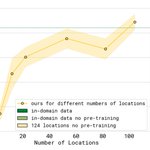
I got *soooo* excited when @simar_kareer showed me this figure for the first time a few months back. Better pretraining directly unlocks better transfer, and not just between robots - humans are just another embodiment. And there's lots more in the pipeline at π!
Kyle Stachowicz retweeted

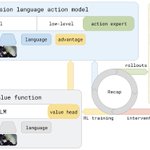
Our model can now learn from its own experience with RL! Our new π*0.6 model can more than double throughput over a base model trained without RL, and can perform real-world tasks: making espresso drinks, folding diverse laundry, and assembling boxes.
More in the thread below.