

Media| Documentary| Videography| Humanity| Communication and Advocacy|. Everyone can make a change...
Nigeria
Joined September 2012
- Tweets26.3K
- Following2.6K
- Followers1.4K
- Likes45.7K





Chinonso Okeke retweeted

It has also been confirmed that World Education Services (WES) has delisted FUTO, IMSU, ESUT and UNIBEN.
The implication is that both past and present graduates of these universities could face serious difficulties getting their certificates recognised internationally.
Other universities, like Nasarawa State University, may soon follow suit.
I warned, and I am still warning, about fraud in our education system. It is everyone’s fight because both the innocent and the culprits will bear the brunt.
Academic fraud destroys our country’s reputation faster than almost anything else.
ABSU, you are lucky. Continue to fight corruption fiercely.


It’s hilarious how they made advertising spaces expensive for opposition just to spend their rallies talking about Peter Obi. Talk about free PR, Obi is truly living rent-free in their heads.

“Peter Obi has visited 17 states in southern Nigeria: He’s visited the entire states of the South East; he’s visited the entire South South with the exception of Rivers State; and has visited only Lagos State in the South West”
“My Father, Atiku Abubakar, has campaigned in 6 states and all in Northern Nigeria because he’s an ethnic jingoist”
– VP Kashim Shettima speaking at the #RenewedHopeInEnugu Presidential rally
21


Chinonso Okeke retweeted

If you are organising an event or know of any exciting event happening in any of these states in 2027
📍 Enugu
📍 Abia
📍 Imo
📍 Ebonyi
📍 Anambra
Please drop the event details in my DM or the comment section.
We are interested in festivals, concerts, conferences, exhibitions, cultural events, lifestyle experiences, entertainment shows, business summits, community events and other exciting platforms with a great footfall
This is an opportunity to get your events on the radar for possible brand sponsorship and partnership.
Please share, tag an event organiser, or recommend an event you know.
Let’s put the Southeast on the map!
Honestly, Nigerians who organise corporate events still have a long way to go.
The event was slated to start at 9 a.m. At 10:14, they were still setting up the halls. Been here for over an hour.
You should respect time.
22
Chinonso Okeke retweeted
A government campaigning on what it will do if re-elected is like watching your landlord promise to fix your leaking roof if you renew your rent.
They have the keys. They own the building. Fix it.
Governance in Nigeria is perhaps the only profession where people can spend four years explaining what they intend to do with a job they already have.
Alex Otti is showing that you don’t need eight years to demonstrate competence.
Chinonso Okeke retweeted

NIGERIANS, GO AND VERIFY (7)
LIFTING THE VULNERABLE : ANAMBRA’S BLUEPRINT FOR POVERTY ALLEVIATION AND SUSTAINABLE EMPOWERMENT (2006–2014)
Economic growth that does not translate into improved living conditions for ordinary citizens is incomplete. This is one of our fundamental concerns with President Bola Ahmed Tinubu's government. Development must ultimately be measured by its impact on human lives, particularly those of the poor and vulnerable. This was underpinned by the Anambra Integrated Development Strategy (ANIDS). We believed that infrastructure, education, healthcare, agriculture, and social protection must reinforce one another. Poverty was not merely a shortage of money; it was also a lack of access to opportunities, productive resources, and the basic conditions necessary for a decent life.
Our poverty alleviation strategy, therefore, went beyond temporary handouts. It focused on restoring dignity, creating economic opportunities, and equipping vulnerable citizens with the means to become self-reliant.
Our approach attracted recognition beyond Anambra. In May 2010, Magnus Kpakol, then National Coordinator of the National Poverty Eradication Programme (NAPEP), commended our commitment to poverty reduction, declaring: “We are prepared to support you in the excellent work you are doing in Anambra State.”
1. POVERTY MAPPING: KNOWING WHERE POVERTY LIVES
We recognised that poverty could not be effectively addressed without knowing where it was concentrated and what caused it. We, therefore, undertook a poverty-mapping exercise to identify the most deprived local government areas and communities.
The exercise revealed that some of our poorest communities were also important food-producing areas. Their challenges included poor access to markets, agricultural inputs, electricity, water, and other economic opportunities.
Areas including Anambra West, Orumba South, Awka North, and Ogbaru required particular attention. The findings informed our development priorities, enabling us to direct roads, agricultural support, and social interventions toward neglected communities.
2. EMPOWERING WOMEN, WIDOWS, AND COOPERATIVES
We recognised that rural women, widows, and indigent households bore a disproportionate burden of poverty. Across the 21 local government areas, we provided financial assistance and productive support to thousands of beneficiaries.
Our administration provided financial assistance to support the establishment and expansion of small businesses and farming activities. We also introduced revolving loan schemes to promote enterprise development, economic self-reliance, and improved livelihoods.
We distributed productive equipment, including sewing machines, generators, ovens, cookers, hair dryers, shoe-making machines, and welding equipment. The objective was to help beneficiaries establish sustainable livelihoods rather than remain dependent on government assistance.
We also promoted access to microcredit and cooperative financing to enable small entrepreneurs to expand their businesses, improve their incomes, and create employment.
Our philosophy was simple: rather than merely giving people money to survive today, the government should help them acquire the means to earn a living tomorrow.
3. AGRICULTURE AND FADAMA: MAKING RURAL COMMUNITIES PRODUCTIVE
Agriculture was central to our poverty-reduction strategy because many rural households depended on farming.
Through partnerships with the Federal Government, the World Bank, and other development partners, particularly under the FADAMA programme, we supported farmers with finance and productive assets.
In November 2009, our administration disbursed millions to FADAMA Community Associations across the state. By October 2010, the National FADAMA office was commending Anambra’s commitment. Its National Project Coordinator, Buka Tijjani, represented by Charles Ugwuona, described Anambra as the leading state in the programme.
Chinonso Okeke retweeted

Who is Sen James Lankford?
Get to know the man Peter Obi met.
Sen James Lankford is a United States Senator representing Oklahoma.
Born: March 4, 1968
In office since: January 3, 2015
James Lankford is an American politician, Baptist minister and Republican senator. He is an influential conservative voice in the United States Senate, particularly on religious liberty, immigration, national security and government spending.
He was elected to the US House of Representatives in 2010 and subsequently elected to the Senate in 2014.
2. His political positions
Lankford is generally considered a conservative Republican.
Positions He Currently Occupies:
1) Chairman, Senate Ethics Committee: Oversees ethical standards among senators
2) Member, Senate Finance Committee Taxation, federal revenue and economic policy
3) Member, Intelligence Committee Intelligence and national security oversight
4) Chairman, Energy Subcommittee Energy and infrastructure matters.
So, una see say no be small man Peter Obi meet.
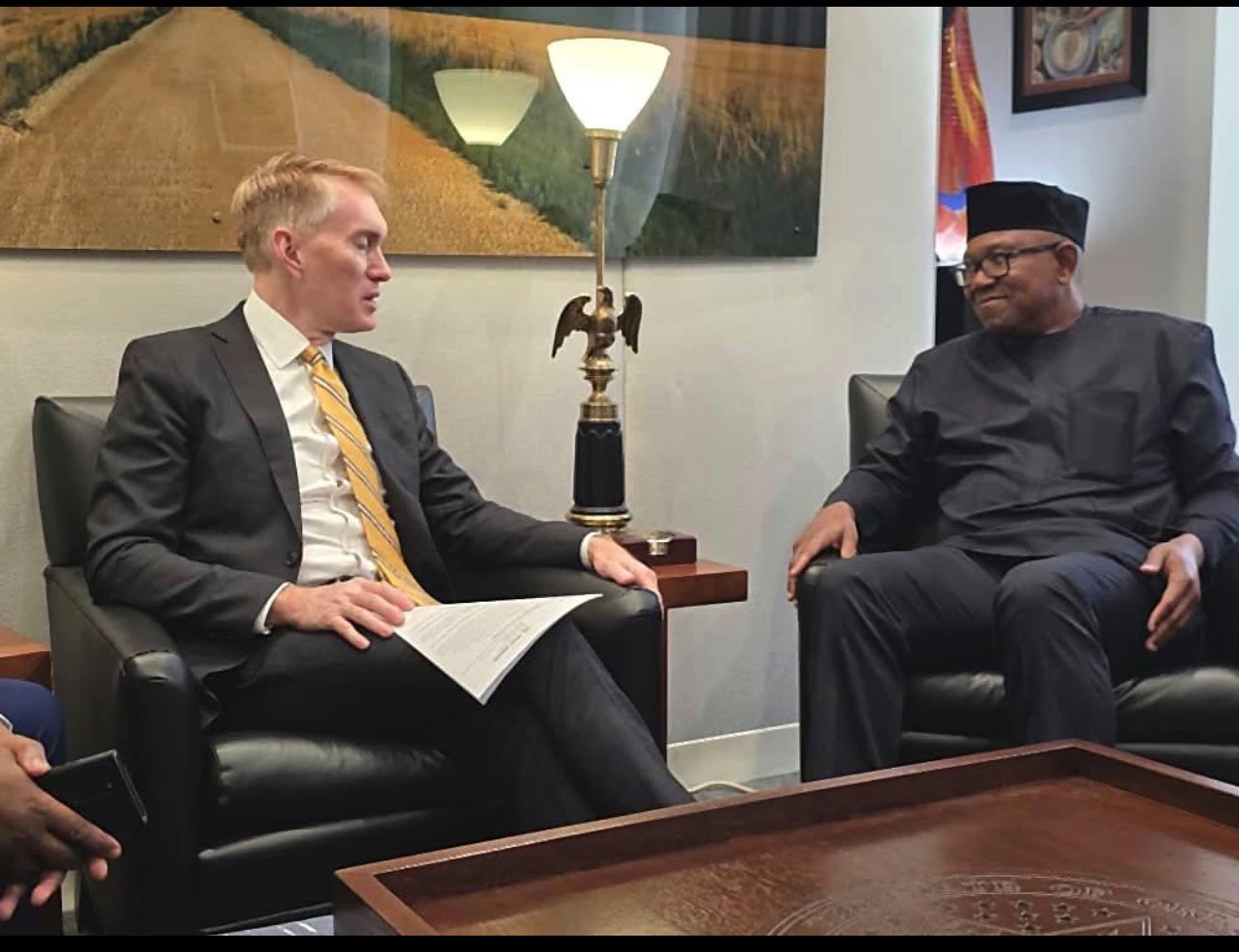

International Engagements to Strengthen Nigeria’s Democracy Continue.
Yesterday, November 17, the second day of our engagements on Capitol Hill in Washington, D.C., we visited the United States Senate and met with some senators, including Senator James Lankford, who kindly invited me over to his office.
I am deeply grateful to Senator Lankford for his warm reception, generous time, and meaningful exchange of views on strengthening democratic institutions, fostering peace, and promoting our shared values.
Our conversations underscored the importance of international collaboration, effective governance, credible democratic processes, and the security and well-being of all Nigerians.
These engagements offer a further opportunity to deepen relationships and advance our shared vision of a peaceful, united, and prosperous Nigeria.
Our commitment to building a nation that serves every Nigerian remains steadfast.
A New Nigeria Is POssible! -PO


Chinonso Okeke retweeted

“Men help another man” Challenge 🫱🏿🫲🏾
Men only; It’s International Men’s Day, and too many men, especially family men, rarely get their flowers.
Quote/Comment one thing that would bring you joy today. Another man here might be able to help.
Happy International Men’s Day.
S.O 🖤
Then the President has failed and should not be re-elected.

Power generation drops to 3,180MW as DisCos ration electricity supply
Nigeria’s electricity generation has fallen to 3,180 megawatts (MW), with distribution companies (DisCos) receiving a combined allocation of 2,885MW, raising concerns over worsening power supply nationwide.

19
Chinonso Okeke retweeted
NIGERIANS, GO AND VERIFY (4)
Building a Healthy Nation: Our Health Sector Record in Anambra
Peter Obi
In the previous instalment of this series, I discussed our investments in education and explained why we considered human capital development central to the progress of Anambra State. Another sector that received considerable attention under our administration was healthcare. We understood that education gives people the tools to build their future, while good healthcare enables them to live healthy and productive lives.
When we assumed office in 2006, the healthcare system in Anambra faced serious challenges. Our health institutions required rehabilitation, medical equipment was inadequate, many communities lacked accessible primary healthcare facilities, and several medical training institutions had not secured accreditation. We therefore decided to approach healthcare as a comprehensive development priority, rather than concentrate resources on a few prominent hospitals.
Under our Anambra Integrated Development Strategy (ANIDS), we invested simultaneously in primary, secondary, and tertiary healthcare, medical training, maternal and child health, medical equipment, and partnerships with religious and private institutions.
Our approach was simple: healthcare should be accessible to people wherever they live, and the quality of treatment they receive should not depend on their status or whether they live in a city or a rural community.
Building a Teaching Hospital and College of Medicine
One of our most significant achievements was the establishment of the Chukwuemeka Odumegwu Ojukwu University Teaching Hospital at Awka.
We initiated, constructed, equipped, and secured accreditation for the institution, building it virtually from scratch. When I discovered that the state university was admitting medical students without having a teaching hospital through which they could complete their training, possibly with the intention of assigning them elsewhere, I considered the situation unacceptable. We therefore embarked on the construction of a modern teaching hospital to address this deficiency.
We constructed more than 25 buildings and provided facilities for the College of Medicine, laboratories, pathology, accident and emergency services, pediatrics, male and female wards, special wards, consultant clinics, and other essential departments.
We also provided vehicles, including ambulances and staff buses, to support the hospital and the College of Medicine as part of the accreditation requirements.
The objective was not merely to build another hospital but to establish an institution capable of providing specialist healthcare while training the next generation of Nigerian medical doctors.
Rehabilitating General Hospitals
We also recognized that a teaching hospital alone could not meet the healthcare needs of the population. General hospitals had to function effectively because they provide the essential link between primary healthcare and specialist treatment.
We rehabilitated and resuscitated 15 general hospitals across the three senatorial zones of Anambra State. We undertook substantial improvements in their buildings, wards, equipment, and general facilities.
In 2013, we provided ₦400 million for the ongoing renovation of 11 selected general hospitals, alongside other healthcare interventions.
Our intention was to ensure that people did not have to travel unnecessarily long distances to obtain basic secondary medical care.
Taking Primary Healthcare to the Communities
We believed that the best healthcare system is one that prevents illnesses and treats people early, rather than one that waits until minor health problems become emergencies.
That informed our extensive investment in primary healthcare. We built over 120 primary healthcare centers across communities in the 177 autonomous communities of Anambra State and rehabilitated existing facilities.
Chinonso Okeke retweeted

Yesterday, @inecnigeria said ward collation results can’t go on IReV because the feature hasn’t been built or tested, and that it would take a while.
We disagree.
It’s not rocket science, so we built it. In one evening. On IReV’s own data.
Left: IReV today.
Right: IReV with Form EC8B. 🧵👇


Chinonso Okeke retweeted

Bola Tinubu Family Paralyzes Lagos Economic Activity | Sahara Reporters http://t.co/gJubHtmGJt


Chinonso Okeke retweeted

NDC-NCC PRESS STATEMENT FOR IMMEDIATE RELEASE
November 18, 2026
DELE ALAKE’S ALLEGATIONS A COVER UP. APC EXPORTING PRESIDENT TINUBU’S LAGOS PATTERN OF POLITICAL VIOLENCE/AGBERO STYLE TO THE ENTIRE COUNTRY
The Nigeria Democratic Congress (NDC) National Campaign Council rejects the false press statement by the All Progressives Congress (APC) Presidential Campaign Council Spokesperson, Mr. Dele Alake, accusing the NDC and other opposition parties of recruiting thugs ahead of the 2027 elections. Rather, the APC supporters are the ones perpetrating a yearlong campaign of terror against the NDC across Nigeria. And Nigerians are not surprised, as this ongoing violence is simply a chapter from President Bola Tinubu’s Lagos State pattern of political violence and agbero style of governance, introduced since 1999 and now being exported across the entire country.
Alake’s baseless accusation is a textbook case of the perpetrator crying victim. For the past year, the NDC and our peaceful supporters have endured relentless intimidation and targeted attacks orchestrated by thugs loyal to the ruling party. To set the record straight, the NDC states as follows a documented trail of violence against the party because Mr. Alake’s claims insult Nigerians.
Where were Mr Alake and the APC on 18 July 2025, when Edo State Governor Monday Okpebholo publicly threatened and warned our presidential candidate, Mr Peter Obi, not to enter Edo State without prior clearance during a political rally in Uromi?
Senator Francis Adenigba Fadahunsi, representing Osun East Senatorial District, was caught on a viral video in Ilesa instructing APC supporters in Yoruba to "seek out and kill" members of the rival Accord Party before the election. To date, he has faced no real accountability, proving that violence is tolerated and rewarded within the APC.
On October 10, 2026, armed thugs invaded NDC Enugu campaign office, fatally shooting our member, Ifeanyi Christopher Nwolie. On November 12, 2026, hoodlums attacked a peaceful NDC town hall in Oregun, Lagos, injuring supporters.
It was an APC governor, Governor Hyacinth Alia of Benue State, who deployed thugs to violently block, harass, and disrupt Mr Peter Obi when he sought to pay a solemn condolence visit to Yelewata for the tragic massacre of 273 innocent souls in Benue
Across Calabar, Delta, and Edo States, Mr Peter Obi and his campaign entourage have been repeatedly targeted and attacked by thugs linked to the ruling party. NDC running mate, Alhaji Rabiu Musa Kwankwaso’s team was also attacked in Kano while on campaign
Mr Alake should direct his lectures on peaceful conduct to his principal, President Bola Tinubu, who famously declared that power is not served à la carte and instructed his followers to "grab it, snatch it, and run away with it." The President is also on public record stating his desire to win by any means necessary and boasting that he enjoys seeing the opposition in disarray.
The truth is undeniable: the surging popularity of the NDC, and the Peter Obi–Rabiu Kwankwaso ticket is entirely organic. It has grown by leaps and bounds because the APC administration has failed Nigerians woefully, inflicting untold hardship through harsh, ill-conceived, and unworkable economic policies.
NDC does not need to instigate citizens who are already pushed to the wall by daily hunger, multidimensional poverty, and rampant insecurity. What the APC is witnessing at its rallies is not sponsored disruption—it is the genuine, spontaneous rejection of a failed government by a traumatised populace. NDC must not be dragged into the self-inflicted chaos of a ruling party facing the wrath of the electorate.
Unlike the APC, whose playbook relies on voter suppression and exploiting vulnerable youths, the NDC’s movement is built on ideas and competence. We view youths as nation-builders deserving jobs and education, not foot soldiers for violence.
(Continued in the comments)
