

Researcher studying native bee behaviour, ecology and evolution 🐝
Tokyo, Japan
Joined October 2016
- Tweets14
- Following207
- Followers94
- Likes265

Lucas Hearn retweeted

Weird world of Aussie bees: How one species creates gender balance in the nest @flinders @RSocPublishing doi.org/grvjv8 phys.org/news/2023-03-weird-…

Lucas Hearn retweeted

We're buzzing with excitement! SAM researchers @LRHearn @ParslowBen @michael_s_y_lee & Mark Stevens have co-authored 2 new papers showing why some Aussie bees prefer to stay single & why some are fussy about flowers. tinyurl.com/3dcszc44 @ConversationEDU
📸 @JamesBeeDorey
Lucas Hearn retweeted

WE BEE-LONG TOGETHER: @ParticleWA's @AlexDook learns about @Flinders PhD student @LRHearn's research into the social evolution of a native Aussie bee.
@uwanews @ScienceUWA 🐝🐝🐝
particle.scitech.org.au/eart…
Lucas Hearn retweeted

Dawn of sociality—investigating solitary to social nesting behaviour in an Australian native #bee ow.ly/bAWf50JCs2p #ProcB @LRHearn @UnlivingDave @FlindersCSE

Lucas Hearn retweeted

New work with J. Henske+@santiaguetz.We conduct an experiment examining totipotency in the orchid bee Euglossa dilemma, aiming to better understand the lack of nonreproductive workers in orchid bees, which have evolved in all other corbiculate bee tribes doi.org/10.1111/evo.14513

Lucas Hearn retweeted

Biodiversity losses tend to be under-reported, especially for invertebrates. 📉 🐝 With the help of ALA data, @JamesDoreyPhoto and colleagues are changing that. Their study of 553 Aussie bee species post-fire found 11 are now eligible for the @IUCNRedList.
https://nitter.gq/t.co/LXARVwIPqb
Lucas Hearn retweeted

After nearly two years of collaborative effort we have finally published our #bushfires and #bees paper. In the paper we develop a new method to examine poorly-known taxa and recommend 11 spp. for #IUCN listing.
doi.org/10.1111/gcb.15879 @GlobalChangeBio

Lucas Hearn retweeted

A wicked talk by @LRHearn about his genetic work on sociality in an Australian #bee species. #ANBC2019 #hymenoptera #Genomics

Lucas Hearn retweeted
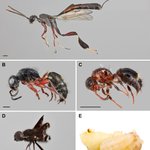
New species alert! @LRHearn et al. discovered + described the new species Ephutomorpha tyla parasitising nests of Amphylaeus morosus. The first record of a Hylaeinae host for #mutilidae!
The article at @Aust_Ent_Soc - Austral Entomology doi.org/10.1111/aen.12414 #wasplove
