

PhD in #yogurt , now post-doc in #biobased plastics| Creator of @YummyPhysics | Tweets in 🇫🇷 🇬🇧
Strasbourg, France
Joined March 2017
- Tweets347
- Following431
- Followers189
- Likes543




Another paper from my PhD is (finally) out:
authors.elsevier.com/a/1bPBy…
We study what makes set yogurt bouncy or squishy. In physics jargon, we call it the rheology of emulsion gels.
👩🔬🥛🛠️⚗️🔬
What did we do? [a thread]
⬇️
In France, we have quite a few municipal credit banks (in large cities mostly). They generally focus on the social side, rather than the environmental one.
thebanks.eu/bank-categories/…
2
Marion Roullet retweeted

L'outil libre et gratuit GES1 point5, permettant d'évaluer l'empreinte carbone des laboratoires de recherche, est disponible dès aujourd'hui : labos1point5.org/ges-1point5
Voir notre communiqué ci-dessous⬇️


Marion Roullet retweeted

New video! Let's dive into the pixels of our screens to explore the physics of liquid crystals: fluids that are colourful, beautiful, and ordered! 📱
youtube.com/watch?v=fEPefMCv…
Marion Roullet retweeted
New video! How to use microdroplets and ultrasounds to synthesize drugs directly in the body? 💧🔬💊
For the answer, tune in to our first microfluidic interview, with Marine Bézagu!
youtube.com/watch?v=QdjLBycL…

Marion Roullet retweeted

Une poussée d'Archimède... inversée !
les résultats étonnants de chercheurs @PMMH_lab @InstLangevin dans @nature montrent qu'il est possible de faire flotter un objet... sous un liquide en lévitation !
espci.psl.eu/fr/actualites/2…
doi.org/10.1038/s41586-020-2…

Marion Roullet retweeted

Hello again, YouTube!
La saison 2 du Projet Lutétium commence maintenant 🥳
Voici le programme, à partager largement ! youtube.com/watch?v=dUsZRMjd…
Marion Roullet retweeted
Breaking news: the Lutetium Project is back! We'll release new videos from our Season 2 starting next Tuesday, September 1st. We can't wait to share them with you!
And here is the preprint: arxiv.org/abs/2007.11843!
The figure you want to see is Fig 5, p 17.
We are currently modifying the data analysis for part 3.2, but it won't modify significantly the results.

Even nicer if you make mixtures: then you get a linear transition between one exponent and the other one.
I can put the draft of the 2nd paper of the series on ArXiv and send you the link when it's online, in case you have any input on this result.
1
Both the research and the videos were funded by @MSCActions, to which I am very grateful.
The research was carried at Unilever and @PhysAstroEd
1
The clips used to illustrate some concepts are from my #scicomm project @YummyPhysics, check the full episodes on Youtube: youtube.com/channel/UCTzDRqE…

If you are interested, please check our paper (free for 40 days):
📰authors.elsevier.com/a/1bPBy…
Or the preprint (free forever but less pretty):
🗒️ arxiv.org/abs/2007.04679
1
1
I was working in an ice cream R&D department when I did this research, but why?
Ice cream has a complicated structure, part of which is a milk-like emulsion that forms a yogurt-like network.
If you want to make vegan or fat-reduced ice cream, you need to understand how they work
The next step is to use these results to study the mixtures. These results are not published yet, but if you can't wait to find them out, you can check the Chapter 7 of my PhD thesis, available here: era.ed.ac.uk/handle/1842/357…
1
1
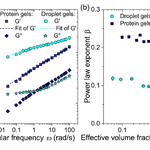
We went on showing that choosing to put big bouncy fat droplets or tiny fluffy proteins in gels does have an influence on some results. But not that much, really!

1
1
We could determine this space, that we call volume fraction, using our previous study on the viscosity of milk-like emulsions. The paper is here (free!): sor.scitation.org/doi/10.112…
and I have presented the results here: nitter.gq/LabSquishyStuff/status…

Have you ever wondered why #cream is thicker (more viscous) than #milk?
Cream contains more fat droplets, so it's difficult to move them all to pour it.
But what about the role of milk proteins in these #emulsions?
A summary of our new paper (arxiv.org/abs/1810.03905): 1/n

1
1
More precisely, what matters is the way you measure the quantity of what you put is important. ⚖️
Traditionally, the weight of the ingredients is used (because it is convenient).
But we showed that the space occupied by the stuff, protein or fat droplets, is more important.
1
1
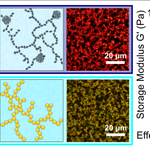
This new paper is the first part of the study, with separated ingredients. The main result is that the bounciness (in jargon, the storage modulus G’) depends much more on HOW MUCH stuff you put in your gels than WHAT you put in them.

1
1
Our strategy was to separate these two elements.
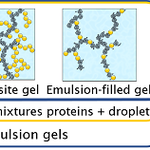
1⃣First we studied the gels made of only proteins (similar to fat-free yogurt), and those with only fat droplets (similar to the French “crème fraiche”).
2⃣Then we put everything back together.

1
1
