

Math prof. Author of long-form textbooks on proofs (https://xitter.cf/t.co/YqXnxDmOe0), real analysis (https://xitter.cf/t.co/3IGQ6BIx5Z) & math history (https://xitter.cf/t.co/KkXMGTxCDK).
Sacramento, CA
Joined July 2019
- Tweets7K
- Following610
- Followers53.3K
- Likes30K





Math 1 was crazy

Andrew Wiles worked on Fermat's Last Theorem alone in his attic for 7 years and told nobody except his wife.
The problem was 358 years old. Fermat scribbled in a margin in 1637 that he had a proof and no room to write it, and every mathematician since had failed.
Wiles saw the statement in a library book at 10 years old. He never let it go.
He was a Princeton professor when he started in 1986. He stopped publishing new work and released old results in pieces to hide the silence.
He announced it in Cambridge in June 1993, over 3 lectures, revealing the target only at the end. Newspapers ran it worldwide.
Then a referee found a gap. One step in the proof did not hold, and the error was fundamental.
He spent 14 months trying to close it in public view, with the whole field watching. He was ready to quit.
The fix arrived in September 1994. He has said he stared at it in disbelief for 20 minutes.
The BBC filmed him describing that moment. He gets a few words out, then turns away from the camera in tears.
He kept the greatest result of the century secret so nobody could take it.


Maybe some day! But not soon. Got other things in the list first :-)
Btw I clicked your profile and saw that you taught high school math in Tucson. That’s great, I have family there. My cousin’s daughter graduated from Tanque Verde High School.
Chill, it’s only been 3 hours. He’s 5 years old so it takes time.
Anyways, we started with bijections and cardinality, moved on to countable versus uncountable infinities, Cantor’s diagonal argument, Hilbert’s Hotel, ordinal arithmetic and transfinite induction. I’m trying to get to the aleph hierarchy before bedtime, but he’s really struggling with the axiom of choice and Zorn’s lemma.
I think I’ll wait until the morning to cover the continuum hypothesis—don’t want to give him bad dreams, ya know.
“The reports of my death have been greatly exaggerated”
—human math researchers

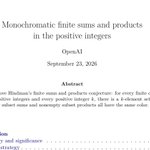
Some fascinating developments following OpenAI's shock breakthrough proof of the Quasi-Riemann Hypothesis, which was released publicly on October 6:
1. Building on OpenAI's proof, a recent Hexagon preprint (released on October 12) by Cureton and Thorner establishes that ALL finite-order Hecke L-functions are zero-free to the right of 1 - 1/6000.
2. And now, today, an arXiv preprint by Frei, Somos and Widmer uses this result to prove unconditionally the 2007 Ellenberg–Venkatesh bounds on ℓ-torsion in class groups of number fields.
I was amused to see the AI declaration in the second paper: "No artificial intelligence tools were used in this work."


Jay Cummings retweeted

We want to support the mathematics community in turning progress in AI into deeper human understanding and new discoveries. To support that goal, we are contributing $5 million to a new Simons Foundation initiative to help mathematicians examine, understand, and build on results produced by AI, including the results we recently published.
The funding, managed and awarded by the @SimonsFdn will support workshops, conferences, and special programs. We will also provide access to our models and computing resources to Simons Foundation-supported researchers.

How can the math community forge the best path forward in the AI age? We're committing $15M to workshops and initiatives — plus free AI computing resources for foundation-supported researchers — through new partnerships with @AnthropicAI and @OpenAI: bit.ly/4zpfIbW
#math #science #AI


I think AI can help guide a student’s vague questions toward interesting pastures. But I agree it will be imperfect.
It’s mostly silly stories IIRC, but I also think that’s the book that comes closest to what you’re after. (Please let me know if you find a better one!)
Jay Cummings retweeted

you could be living in sacramento
you could be sacramentomaxxing
we have the the kings, old sac, the waterfront
you will build your life in sacramento, california

America’s most livable cities, at local median salary and local tax rate.
New York: this is probably the reason why Mamdani won

Readers added context they thought people might want to know
The chart's "most livable cities" rankings and quality-of-life data rely on Numbeo, a crowdsourced site where anyone can submit or alter entries; it carries explicit disclaimers on accuracy and has been widely criticized by experts and media as unreliable.
numbeo.com/common/terms_o…
en.wikipedia.org/wiki/Numbeo
tf1info.fr/international/…
Jay Cummings retweeted

Just getting started on @LongFormMath’s Proofs, already much more lively than how proofs were taught in high school. Looking forward to the rest of it!

Jay Cummings retweeted

10 remarks on AI and math that can be true all at once:
1. The recent progress is stunning and exciting.
2. The Quasi-Riemann Hypothesis is arguably Fields-medal level.
3. Mathematics is being transformed and there is no way back.
4. OpenAI doesn't give a fuck about the future of mathematics.
5. Half-baked unreadable preprints claiming major results can effectively stall mathematical progress.
6. Some mathematicians are responding with naive, overly defensive comments.
7. The social-media wankers framing this as "OpenAI tramples gatekeeping" have no experience of mathematical research.
8. The product of mathematics is clarity and understanding. Not theorems, by themselves.
9. Mathematics is a critical infrastructure of human cognition. The human need for understanding isn't obsolete and it can't be offloaded to machines.
10. We haven't "solved" mathematics and we won't get there before the Sun burns out.
For examples of how AI might do this:
A younger me would have been very interested in learning about advanced topics in math, but nobody around me knew those topics or had time to share them with me. If I had AI to chat with, I very likely would have asked it to teach me things.
Similarly, for many people in the world, even buying math books and other resources is challenging.
Also, people who love to teach math now have new resources to do a better job at it.
Lastly, AI will be discovering new and beautiful things. Which both increases the quantity of fun, fascinating things to study, and also produces a lot of new things which in some ways is more exciting than studying very old math
During K-12 school, I didn’t particularly like math. It was only when I took college-level math courses that I fell in love with the subject.
Now that AI is making the fun and fascinating parts of math much more accessible, I hope far more people will also come to love math.
Btw it seems like this one is not completely verified yet with Lean. And many others also seem to not be verified with Lean.
Seems strange that they would release so many where a lean check is doable but not done.

