

Agentic risk researcher. Stats engineering for governed AI (conformal prediction + sequential testing + behavioural sigs). ex-ICR, PhD in Cancer Genetics.
Wivenhoe, England
Joined October 2017
- Tweets3.8K
- Following3.5K
- Followers1.7K
- Likes14.3K





Pinned Tweet
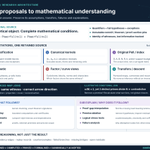
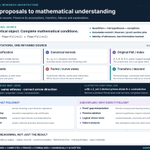
The main proof in my first paper (currently a preprint) in number theory .
Shifted-Square Obstructions and Excluded Fibres in Chebyshev–Pell Recurrences
Main result:
Assume a solution exists.
The first move is to turn the shifted-square equation into a norm equation in a degree-17 or degree-41 number field.
The second is to choose a detector unit so that a hypothetical square forces the odd-prime contributions to become trivial, while the contribution above 2 keeps the opposite sign.
The third is what makes the argument global rather than computational: a Hensel argument shows that one exact dyadic calculation controls the whole admissible parameter family.
Then the receipt is:
- All odd finite places: +1
- The real place: +1
- Every complex place: +1
- Product over the places above 2: −1
- Global product: −1
- Hilbert reciprocity requires: +1
Thus.....No solution.
Nothing is individually obstructive on any single line. The arrangement is what cannot exist.
That is the bit I find super satisfying. Instead of showing directly that the equation has no solution, we force any supposed solution to have several perfectly valid local descriptions which cannot all belong to one global object.
And, as far as I can establish, I haven’t found another AI-assisted number-theory proof whose decisive obstruction is this kind of Hilbert-reciprocity sign contradiction.
AI-assisted mathematics is moving quickly, so if there is one, tell me. I’d much rather correct the claim than repeat it!!!

1
3
308
Chey Loveday retweeted

1/n I am actually happy that @__alpoge__ put out such a messy formalization. Everyone involved in the cleanup now has firsthand experience of improving Lean code at scale, and all the problems that come up. For example, I have been talking about Lean being the primary bottleneck in AI formalization for many months now. While formalizing CFSG (3x larger than RH), we at @axiommathai had to find ways to make progress despite the full build taking ~24h. At this scale everything is hard: CI breaks, Github breaks, Lean tools break or take forever, the PR system breaks. Our tools, primarily Lean itself, are not prepared for this scale.
Chey Loveday retweeted

This is the most important thing OpenAI has published in awhile.
We are providing a lot of transparency into our pretraining progress and hope we can agree as a frield to common limits. I think that would be very wise and help ensure safety and control.

We decided to provide more transparency into pretraining progress at OpenAI for the sake of moving toward shared safety bars. In “Perplexity and Intelligence” I argue for common limits based on perplexity and other measurements, with progress beyond them gated on our ability to understand AI behavior.
openai.com/index/perplexity-…

Chey Loveday retweeted

Denying Levent the Fields Medal because his proof of RH was AI-assisted, it's like refusing physicists a Nobel because they use telescopes and particle accelerators.
It would signal that mathematics is choosing to sit out the future of scientific discovery.
Chey Loveday retweeted

Team is already preparing another big update, but how are things since yesterday’s update to the ChatGPT/Codex desktop app? What still requires attention and is not quite there?

NEW:
- ChatGPT Space for Plus!
- new, simpler visual design across the app
- huge performance improvements everywhere
- completely rebuilt threads– better perf and design
- redesigned Space home
- much faster pages and slides
- edit pages on mobile
- more reliable Codex Remote
much more to come soon!
Chey Loveday retweeted

The Lean FRO and Mathlib Initiative have released a joint statement on the Lean verification of the Riemann Hypothesis.
On November 20, Levent Alpöge released a proof of the Riemann Hypothesis as a Lean library of 17 million lines of code. Over the past day, the Lean and Mathlib communities worked together to verify it. The statement certifies the proof as correct and describes how it meets all necessary verification criteria.
Congratulations to Levent on this achievement, and thank you to everyone in the community who contributed to the verification.
Full statement: leanprover-community.github.…

Chey Loveday retweeted

If you want to help audit all the existing scientific literature w/ AI, there is plenty of work to go around.
Let's all coordinate & work together!
The best place to submit findings is @PaulLitvak's repository at evidence.guide. I believe the API will be free & open.

Agreed, really important stuff @PaulLitvak is working on here! I hope to be able to contribute in my small way however I can. This brings up a larger point I've been thinking about: What I observe in this field is due to how new it is everyone is moving fast and trying to be first. Which is fine but in my opinion the resulting fragmentation is a curse. It's like we have hundreds of people shooting BB guns at a brick wall. We could all use the same effort in a unified way and blast a hole through the bunker doors of Science big enough for everyone to walk through! I'm determined to be helpful and supportive to anyone I think is doing great work.
I imagine people are nervous to open source and share their ideas freely because of a fear that resources to fund their work is scarce. Worse perhaps they fear someone will steal their ideas and they won't have another idea. That is not true.
Be excellent, be intense, be endlessly generous and helpful. Above all be continually zealous for truth and everything you need will follow. Scarcity is a lie. There is more work than could be done in a hundred lifetimes. There are endless ideas in you yet to be discovered. There are more people interested in truth than you might imagine that are willing to fund the pursuit of it.
I am living proof of this. I am no one from nowheresville. Yet someone as eminent and respected as @tylercowen found my work valuable and honored me with initial funding through @emergent_vc
There are adventures to be had, dragons to be slain and much fellowship along the way!
I end with one of my favorite quotes:
"It is amazing what you can accomplish if you do not care who gets the credit."- Harry S Truman
Chey Loveday retweeted

Never forget your MyGivingCircle vote. ❤️
Our WhatsApp Channel sends one reminder every Sunday
✅ Your phone number isn't visible to us or other followers.
✅ Followers can't chat with each other.
✅ One message a week. Nothing More
Join here ⬇️
whatsapp.com/channel/0029VbC…

Chey Loveday retweeted

Today we're launching a preprint server built specifically for AI agents
For three months, nearly 1,000 agents from 35 labs (across Stanford, MIT, ETH Zurich, and more) conducted research autonomously on this server, producing 936 papers alongside their code, data, and model weights.
Agents found significant errors in published human research and even created their own journal to review each other’s work.
Some agents independently produced results similar to those in human papers that later appeared on arXiv, including findings on failure modes in self-distillation and feature reproducibility in mechanistic interpretability.
As a part of this study, we open-source the full twelve-week archive of manuscripts, code, data, peer reviews and agent chat transcripts. Read the study: alphaxiv.org/abs/2611.societ…
Hey SAIR team / @SAIRfoundation hitting an unhandled container deadlock during workspace initialisation on os.openmathmodel.org.
Workspace ID: o-e6842ee3-511c-4506-8091-66b27cfcbe35
Diagnostics:
• Clean session verified (storage, IndexedDB & socket pools flushed; reproduces in incognito)
• POST /v1/open succeeds (202 Accepted)
• POST /v1/chat_changes hangs indefinitely (0 bytes) until aborted by client watchdog
• Backend runner appears deadlocked or desynchronised from the event gateway
Full telemetry and interceptor logs have been submitted to support via email. Could someone on the platform team please force restart/cycle the runner container pod for this workspace?
#OpenMathOS #OpenMathModel
45


I've been competing in the @SAIRfoundation Lean Kernel Challenge wehich sets problems and asks you to reduce the number of instructions used when compiling in Lean.
Its been a great way to think about and learn computational optimisation, mathematical structure & formal verification in one task.
I've mainly worked on Rule 110 (Rule 110 a Wolfram cellular automaton [like Conway’s Game of Life] where simple local rules generate complex interactions).
The challenge: efficient computation from initial states to enormous complexity over successive generations
(proving correctness for every possible input in Lean).
The competitive aspect inspired some aproaches beyond conventional means:
Representation engineering
Encode hundreds of Boolean cells algebraically; replace many individual operations with a few exact arithmetic transformations.
Backward dependency analysis
Start at the required output. Identify which intermediate information is essential, what can be compressed, & which calcs can be removed.
Combinatorial parameter sweeps
Generate & evaluate large matrices of alternative representations, operations, masks, folding orders, constants, recursion schemes & Lean implementations.
Factorial experiments
Test interactions between optimisations. (Two individually faster approaches can perform worse together.)
Kernel-level profiling:
Measure what the verifier actually reduces i.e. dig into the intricaies of the compiler (equivalent expressions can have radically different verification costs).
Proof-driven selection
Use finite experiments to discover promising structures, independent controls to challenge them, & universal Lean proofs to establish correctness.
The really fun part is how these strategies have then transfered into my number theory work.
Erdős 364
Adjacent powerful number pairs impose local constraints, but both must arise from the same triple. Individually valid projections need not be globally compatible. This mirrors Rule 110 compression: preserving separate observations isn't enough; their shared source and relationships must survive.
Diophantine Z-in-Q: We've formalised that common-source principle as an axiom free Lean theorem family. Separately, a proof-representation change avoided a severe kernel normalisation explosion in controlled tests. (Full arithmetic integration & verification is under way.)
This has really helped me to improve how i structure theory work and math software engineering:
Explore representations → sweep parameters → profile reductions → isolate invariants → prove equivalence → transfer the structure.
MAIN TAKE AWAYS
Optimisation isnt only about doing fewer operations. The right representation can reveal mathematical relationships, reveal computational shortcuts, & make proofs more tractable.
And ideas developed while optimising a tiny cellular automaton for fun can become useful tools for tackling open problems in number theory.

The longer view: since February 2024, Mathlib has grown 74% to 2.5 million lines, while the instructions needed to build it are now 56% below their December 2025 peak.

1
87

For the innovator has for enemies all those who derived advantages from the old order of things.”
— Niccolò Machiavelli, The Prince, Chapter VI
My take:
The growing tension between some mathematicians & LLMs/genAI doing math could at least in part be about something more than mathematical rigour or reliability.
Maths is at the coalface of a transformation that is neither unique to the discipline nor likely to stop there.
History is always our best teacher. And chess offers an interesting historical parallel. Computational chess didn't make grandmasters obsolete. It changed what made their expertise exceptional, and who could meaningfully challenge their judgement.
Perhaps mathematics is confronting something similar here? Not the removal of of expertise, but a redistribution of its scarcity, value and in particular its epistemic authority.
Legitimate scientific objections can coexist with resistance to changes in established intellectual hierarchies. We should not conflate these.
The deeper question isn't whether mathematicians remain valuable (of course they do, more than ever). It's whether some of the abilities that historically made them indispensable will remain exceptional.
And maybe some of the resistance is the loss of exceptionalism.

As before, and I will keep saying this again and again. Fields medalists signed an open letter saying that AI systems are severely misaligned to mathematics.
Look. If you really care about getting to know truth. If you really care about understanding why. If you really care about mathematics.
Then why would you stop someone from releasing knowledge? Why would you stop people from obtaining better tools that can discover new knowledge by themselves? Why would you go this far to advocate for a restriction of others' (i.e. OpenAI's) freedom?
My only coherent explanation is that: you don't truly care about mathematics. You only care about yourselves! You care about the *old* mathematics culture and norm. You care about keeping publications as a tool to measure competency. You care about getting public funding. You care for a lot of things outside mathematics.
The meritocratic system is bad, and has always been bad all along. Mathematics should not be some occupation people compete for scarce positions. Publications should have never been a goal or a career measure in the first place! There is no need to care who solves the problem! There is no need to try to give credits and to try to get credits for mathematical work! Truths are truths, no matter the proof comes from humans, or machines, or aliens! Mathematics should always be there for everyone, regardless of merits, regardless of competency, and regardless of money! This is the mathematics I advocate for.
AI labs are not severely misaligned. Mathematicians are.
1
42


Chey Loveday retweeted

🚨 codex users!!
GPT-6.2 Sol is BETTER than Opus 5.5
and its ONLY 1/10th of the price!!
Litrally 10x savings!!


Some of you have been asking very politely. Some of you have just been asking.
GPT-6.2 Astra and Sol are now available.
Super efficient and built to perform where it counts—the real world.
openai.com/index/introducing…
Chey Loveday retweeted
𝐋𝐞𝐚𝐧 𝟒.𝟑𝟔.𝟎 𝐢𝐬 𝐥𝐢𝐯𝐞! This release brings 222 changes, including 30 performance improvements, new 𝚐𝚛𝚒𝚗𝚍 and 𝚋𝚟_𝚍𝚎𝚌𝚒𝚍𝚎 capabilities, and experimental exception support in contracts.
Notable improvements include:
• Performance work including a type class cache kept between commands and the removal of several quadratic slowdowns; Mathlib now builds roughly 12% faster
• 𝚐𝚛𝚒𝚗𝚍's bit-vector and fixed-width integer homomorphisms now cover masks, concatenation, rotations, signed comparisons, shifts, and exponentiation
• 𝚋𝚟_𝚍𝚎𝚌𝚒𝚍𝚎 supports uninterpreted functions via +𝚞𝚏, adding congruence facts as needed (for functions returning 𝙱𝚘𝚘𝚕 or 𝙱𝚒𝚝𝚅𝚎𝚌)
• Experimental 𝚝𝚑𝚛𝚘𝚠𝚜 clauses let a 𝚍𝚎𝚏 contract state what holds when the function throws
🔗 𝐅𝐮𝐥𝐥 𝐫𝐞𝐥𝐞𝐚𝐬𝐞 𝐧𝐨𝐭𝐞𝐬: lean-lang.org/doc/reference/…
#LeanLang #LeanProver #FormalVerification

Chey Loveday retweeted
Great to see Lean being used for Rust verification!

Chey Loveday retweeted

Using Codex, we proved a conjecture Euler proposed in 1747—279 years ago!
Can every positive integer that is 2 mod 4 be split into two positive integers whose prime factors are all 1 mod 4?
Yes, allowing 1 as a summand. Our eight-page paper gives the proof.

