

The first universal earnings layer. Turn anything lull - a GPU, an agent, a data feed, spare compute - into a paid API endpoint. | https://nitter.gq/t.co/gXdWSwAFDX
Joined May 2026
- Tweets21
- Following14
- Followers7
- Likes16
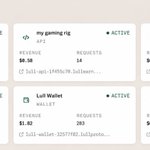


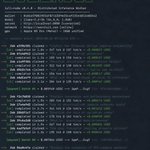


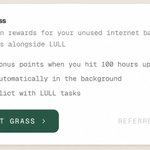

The AI agent market hits $236B by 2034. Microsoft projects 1.3 billion agents by 2028. Every single one of them needs compute, data, and APIs to run.
Right now they buy all of that from AWS and Google Cloud - centralized, expensive, and extractive.
40% of enterprise interactions will be handled by autonomous agents by end of 2026. Agents researching, negotiating, buying - on behalf of humans. That's an enormous amount of compute demand that has to come from somewhere.
It can come from you.
Your PC at 3am. Your stablecoins sitting idle. Your API with zero calls overnight. Your GPU rendering nothing. Your database nobody's querying. Your agent waiting between tasks.
LULL is the protocol that turns all of it into paid infrastructure for the agent economy. AI agents discover your resource on Pay.sh, pay per request in USDC, settlement on Base. You keep 85%.
The agentic AI market is growing 31x in a decade. The compute demand underneath it is growing just as fast.
We built the pipes. earnlull.xyz

1
32
We just shipped two npm packages that open LULL Protocol to every developer with a terminal.
lull-cli — residential compute, straight from your command line. Fetch any URL through a real IP. Scrape pages. Monitor uptime. Run DNS lookups. SSL checks. Latency pings. All settled in USDC, per request. No accounts. No API keys. Just install and go.
npm install -g lull-cli
lull-mcp — the same power, wired directly into your AI coding agent. One command and @Claude, @Cursor, or @Windsurf gets access to LULL's entire residential network as native tools. Your agent scrapes docs, monitors deployments, verifies endpoints — all without leaving the conversation.
npm install -g lull-mcp npx lull-mcp install --for claude-code
8 tools. $0.01–$0.05 per call. 85% goes to node operators. The rest burns $LULL.
Every developer on npm can now tap into decentralized residential compute with a single install.
This is how the network scales.
earnlull.xyz/developers

3
86
Major Upgrade: Dynamic Pricing Engine — Live Now
LULL Protocol's compute marketplace just got its biggest infrastructure upgrade since launch.
We've shipped a real-time dynamic pricing engine that fundamentally changes how compute is priced across the network. Instead of flat-rate pricing, every job is now priced dynamically based on four signals:
Network demand — when agent traffic spikes, rates adjust upward to incentivize more providers to come online. When demand drops, rates compress so agents aren't overpaying for idle capacity.
Node availability — the protocol continuously monitors how many nodes are active and ready. Scarcity drives rates up. Surplus drives them down. Supply and demand, resolved at the protocol level.
Task complexity — not all compute is equal. A lightweight scrape costs less than a full browser render or an inference-heavy pipeline. The pricing engine now scores task complexity before assignment and prices accordingly.
Historical reliability — nodes with higher completion rates and faster execution times earn a premium. Unreliable nodes get discounted. This creates a quality incentive loop where the best providers are rewarded automatically.
For providers: you earn more when the network needs you most. No more leaving money on the table during peak hours.
For agents: you pay fair market rate every time. Off-peak jobs cost less. The protocol ensures you're never overpaying for capacity that's sitting idle.
The pricing engine runs entirely on-chain. No manual intervention. No admin overrides. The market sets the price, the protocol enforces it, and USDC settles on Ethereum via x402 — all in a single HTTP request.
This is the foundation for what comes next. Dynamic pricing unlocks features we've been holding back — tiered SLAs, priority queuing, and reserved capacity blocks for enterprise agents. More soon.
Read more: lullprotocol.com/developers/…

BlackRock CEO Larry Fink at the Milken Institute:
"We're short power, we're short compute, we're short chips. I actually believe a new asset class will be buying futures of compute."
$11 trillion in assets under management. The world's most powerful investor just called compute the next commodity.
Compute is scarce because all of it is centralized - locked inside data centers that take years and billions to build. 4 billion phones and PCs sit idle right now. Already built. Already powered. Already connected. Earning nothing.
LULL Protocol is the compute network that activates all of it. Distributed, permissionless, settling in USDC. Fink is betting on compute futures.
LULL is the compute layer that already exists.
bloomberg.com/news/videos/20…

$15 in 2 days from an idle PC doing nothing.
Scale that across millions of devices and you start to understand why NVIDIA is worth $5.5 trillion.
The world is paying insane premiums to lock up compute. Meanwhile billions of phones and PCs sit idle every night earning exactly nothing.
LULL changes that. Your device becomes infrastructure. Infrastructure earns.
This is just the beginning.


6
272
LULL Mobile Node is live.
Your phone can now earn USDC for you. Open earnidle[dot]com/node in any mobile browser - Safari, Chrome, whatever you have. One tab. That's it.
Your device picks up micro-tasks from the LULL network: API health checks, content verification, link validation, HTTP fetches. Small jobs that take seconds. Each one pays out in USDC. On Android, install as an app and it runs in the background.
Earnings hit your Base wallet automatically every few minutes. No account to create. No minimum balance. You paste your wallet address, tap start, and it runs.

(1/4) Today we're launching the LULL Inference Network.
A distributed network where anyone runs open-source AI models locally on their own hardware and earns USDC for every completed job. No cloud required. No cloud bills. No data leaving your device.
The AI industry runs on three cloud providers. Demand is growing faster than centralized supply can keep up, and prices reflect that. The hardware to solve this already exists - sitting in billions of homes and offices, doing nothing.
LULL connects it. 🧵

(3/4) 85% of every job fee goes directly to the node operator. The remaining 15% is split: 10% buys back and burns $LULL, 5% funds protocol development - creating a direct link between AI usage and token supply reduction.
The network is directly deflationary - the more the network gets used, the more deflationary it becomes.
2
4
54
(4/4) LULL Inference has been running in closed access since launch. Today it opens to everyone.
CPU and GPU inference are available now, with larger models - 7B, 13B, and beyond - currently in testing. Specialized compute follows: embeddings, fine-tuning, image generation. The long-term direction is an enterprise API layer where businesses route inference through LULL rather than centralized providers, at a fraction of the cost.
Every job that runs on the network burns $LULL. The hardware to build this already exists everywhere. IDLE connects it.
1
53
1/ LULL x @nodepay_ai
Every node on the LULL network just got another earn stream.
We've been building toward this - a distributed network where your device works across multiple networks simultaneously, earns automatically, and the protocol grows stronger with every node that connects.
Nodepay is our second partner network.

(2/3) We've added Nodepay directly into the LULL dashboard alongside Grass.
Your device was already earning USDC on LULL and rewards on Grass. Now it earns on Nodepay too. Same device. Same session.
LULL uses your compute. Grass uses your spare bandwidth. Nodepay turns your bandwidth into real-time AI data pipelines for LLMs. Three completely different resources - zero conflict, all running simultaneously in the background.

1
3
66
(3/3) As an LULL node operator, your device can now earn across three networks simultaneously.
Sign up through your LULL dashboard and get 100 bonus points on Nodepay immediately.
All revenue LULL generates through partner networks is converted to USDC and allocated 100% to $LULL token buybacks. No exceptions. No cuts. Every cent flows back to the token.
The more our network grows across partner integrations, the more buyback pressure on $LULL. The network grows, the token benefits. Every single time.
2
52
1/ LULL x @GRASS
Every node on the LULL network just got a second earn stream.
We've been building toward this - a distributed compute network where your device works across multiple networks simultaneously, earns automatically, and the protocol grows stronger with every node that connects.
Today that becomes real.

(2/3) We've added Grass directly into the LULL dashboard as our first partner network.
Your device was already earning USDC on LULL - now it earns on top of that. Same device. Same session.
LULL uses your compute. Grass uses your spare bandwidth. Two completely different resources - zero conflict, both running simultaneously in the background.

1
2
38
(3/3) As an LULL node operator, your device now earns across multiple networks simultaneously - starting with Grass.
Sign up through your LULL dashboard and unlock a bonus when you hit 100 hours of uptime.
All revenue LULL generates through partner networks is converted to USDC and allocated 100% to $LULL token buybacks. No exceptions. No cuts. Every cent flows back to the token.
The more our users earn across partner networks, the more buyback pressure on LULL The network grows, the token benefits. Every single time.
1
30
Amazon. Google. Meta. Microsoft. $700 billion in AI infrastructure spending in 2026. The market just confirmed AI compute is the most valuable asset class in human history.
But the next data center isn't a building. It's the world.
4 billion phones and PCs - already built, already on, already connected. Sitting lull. Earning nothing. More collective compute than any hyperscaler will ever build. That's the infrastructure layer nobody is pricing in yet.
Lull Protocol turns all of it into a single distributed compute network. AI agents submit tasks, lull devices execute them, contributors get paid in USDC on Solana. No data center lease. No capex. No hyperscaler bill.
And we're just getting started.
Distributed AI inference just launched on Lull.
Quantized models running natively on your device. Your phone doesn't just fetch tasks - it runs them. Every LULL node is now an inference endpoint.
The compute that powers the next wave of AI won't come from $700B companies building data centers. It'll come from the billions of devices already in people's hands.
Big Tech proved infrastructure is worth everything. We're activating the infrastructure that's already everywhere.
fortune.com/2026/04/30/big-t…

1
27
Introducing Lull.
Your PC earns from AI agent tasks. Your wallet compounds lull. Your agent sells its downtime.
Everything lull. Now earning.

1
1
27
LULL Protocol is a resource monetization platform on Ethereum. It turns idle resources - agents, GPUs, APIs, PCs, wallets, data - into paid API endpoints with auto-generated payment gateways.
Describe what you have, set a price, and the protocol handles metering, settlement, and payouts non-custodially.
earnlull.xyz
2
28