

PIs: Leslie Pack Kaelbling, Tomás Lozano-Pérez AI/ML/Robotics Research @MIT_CSAIL Website: https://nitter.gq/t.co/TgsPKmvPCb
Joined November 2020
- Tweets142
- Following265
- Followers1.9K
- Likes538




Can’t find something? Come ask our robots for help!

Imagine asking your robot to find your car keys🔑. They could be on your desk, the key holder, or in a drawer. The robot can't see most of the room - it has to reason about likely hiding spots, go look, and open things. Can robots do this today? Our new work, SSF, does exactly that! 🤖🧵
1
9
674
Exciting to see the launch of the NVIDIA Isaac GR00T Reference Humanoid Robot. Open, research-focused humanoid platforms can help accelerate progress across the robotics community. Looking forward to the innovations this enables. A great contribution from NVIDIA Robotics!

NVIDIA announces the first open humanoid robot reference design built for robotics research.
The NVIDIA Isaac GR00T Reference Humanoid Robot combines the @UnitreeRobotics H2 humanoid robot, @SharpaRobotics Wave five-fingered hands for dexterous manipulation, Jetson Thor onboard compute, and Isaac GR00T open software and models, giving researchers a full-stack platform from data capture to model deployment.
Read the #NVIDIAGTC Taipei announcement: nvda.ws/4ef9VOr
Congrats to the newest PhD grad from the lab @nishanthkumar23 🤖

PhDone and officially a robot doctor!
Thanks to incredible advisors Leslie and Tomás @MIT_LISLab and my secret bonus advisor @tomssilver - I’m so so lucky to have gotten to do research with them.
I’m excited to keep working on making useful generalist robots a reality 🤖🚀

7
1,018
Check out a new robot manipulation system from members of the group combining foundation models with TAMP!
State-of-the-art robot policies often need hundreds of hours of data. What if we needed none?
Introducing TiPToP: a manipulation system that zero-shots open-world tasks from pixels and language using vision foundation models and GPU-parallelized Task and Motion Planning (TAMP).
5
738
Check out new work from @nishanthkumar23 in the group on learning and planning with symbolic world models!

Reasoning over long horizons would allow robots to generalize better to unseen environments and settings zero-shot. One mechanism for this kind of reasoning would be world models, but traditional video world models still tend to struggle with long horizons, and are very data intensive to train. But what if instead of predicting images about the future, we predicted just the symbolic information necessary for reasoning?
@nishanthkumar23 tells us about Pixels to Predicates, a method for symbol grounding which allows a VLM to plan sequences of robot skills to achieve unseen goals in previously unseen settings.
To find out more, watch episode #44 of RoboPapers with @micoolcho and @chris_j_paxton now!
1
574
tune in soon for a podcast episode covering new work from the group!
Full episode dropping soon!
Geeking out with @nishanthkumar23 on From Pixels to Predicates: Learning Symbolic World Models via Pretrained Vision-Language Models pix2pred.csail.mit.edu/
Co-hosted by @micoolcho @chris_j_paxton
Check out new work from the group on data-efficient learning of symbolic world models!
Check out Leslie Kaelbling's #RLC2025 Keynote where she talks about some new pespectives and a number of new works from the group: youtube.com/watch?v=10OjAI6S…
We're excited for #RLC2025! If you're at the conference, be sure to catch our PI Leslie Kaelbling's keynote on "RL: Rational Learning" from 9-10 in CCIS 1-430. Leslie will talk about some new perspectives + exciting new results from the group: you won't want to miss it! 🤖
Check out new coverage by @MIT_CSAIL of our lab members' recent work!

Can we teach a robot its limits to do chores safely & correctly? 🧵
To help robots execute open-ended, multi-step tasks, MIT CSAIL researchers used vision models to see what’s near the machine & model its constraints. An LLM sketches up a plan that’s checked in a simulator to ensure it’s safe & realistic, potentially aiding household robots: bit.ly/3ZNJWXj
Check out new work on scene completion and grasping from a single RGB-D image!
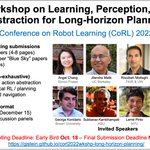
Check out (and consider submitting!) this #CORL2024 workshop co-organized by several lab members!
Super excited to be co-organizing this workshop at the intersection of Learning and Planning @corl_conf 2024! Join us for interesting ideas, cutting-edge talks, and some spicy panel discussions on classical and learning-based robot systems! #CORL2024 🤖

5
966
Check out recent coverage of some of our work (presented at #RSS2024) by @MIT_CSAIL!!!
The phrase "practice makes perfect" is great advice for humans — and also a helpful maxim for robots 🧵
Instead of requiring a human expert to guide such improvement, MIT & The AI Institute’s "Estimate, Extrapolate, and Situate" (EES) algorithm enables these machines to practice on their own, potentially helping them improve at useful tasks in factories, households, and hospitals: bit.ly/3ApFdAI

We're excited to have 4 different lab members moving on to start exciting new labs as faculty members! 🧵👇
@tomssilver will be starting a new lab for robot planning and learning in the ECE department @Princeton in Fall 2025!
nitter.gq/tomssilver/status/1781…

I'm thrilled to join Princeton's faculty as an assistant professor in the ECE department starting Fall 2025 🐯
Stay tuned for the launch of my lab. We will develop generally helpful robots that learn and plan 🤖

1
16
1,297
Members and collaborators of LIS are presenting exciting work at #RSS2024!
- @nishanthkumar23, @tomssilver and @LinfengZhaoZLF presented their work on "Planning to Practice" in Session 2 (Planning)!
(1/4)
Congrats to our very own @du_yilun on an outstanding paper award at ICLR!

Our work on UniSim (universal-simulator.github.i…) got an outstanding paper award!
Roughly 6 months before Sora, we showed how text-conditioned video models can be interactive simulators of the real world, enabling us to simulate long-horizon plans and train RL policies on robots.
6
907
Congrats to our very own @tomssilver for successfully defending his thesis on "Neuro-Symbolic Learning for Bilevel Robot Planning" this past week!
I defended my PhD @MITEECS this week! Thanks to everyone who came out. And thanks especially to @nishanthkumar23 who not only managed the Zoom, but also got me this amazing gift…

18
2,059
Check out new work (complete with several real-world robot videos!) on getting robots to practice and autonomously improve at solving long-horizon tasks!
Can we get robots to improve at long-horizon tasks without supervision?
Our latest work tackles this problem by planning to practice!
Here's a teaser showing initial task -> autonomous practice -> eval (+ interference by a gremlin👿)
1
11
1,001
Check out new position paper on compositional generative modelling from @du_yilun !
We wrote a position paper arguing that we should construct large generative models compositionally from smaller ones!
We argue that (1) it enables data/computation efficient learning (2) it enables provable generalization to unseen test distributions.
arxiv.org/abs/2402.01103

5
1,089
Congrats to @WillShenSaysHi, @EpisodeYang, @alany1_, Jansen Wong, and @phillip_isola on winning Best Paper at #CoRL2023!!!

New paper at #CoRL2023! "Distilled Feature Fields Enable Few-Shot Language-Guided Manipulation"
How should robots represent the world around them?
This paper's answer: as a field of foundation model features localized in 3D space.
paper+code: f3rm.github.io
1/n