

Canada's leading independent, nationally focused think tank based in Ottawa. We exist to make poor public policy unacceptable in the nation's capital.
Ottawa, Ontario
Joined February 2010
- Tweets31.2K
- Following4.6K
- Followers23.2K
- Likes6K


“The beaver reminds us to build strong homes and communities, knowing that what we build can benefit others, too. A strong Canada doesn’t require us to think alike or ignore our differences. It needs us to recognize what we owe one another and accept responsibility for the country we share,” writes Karen Restoule (@karenrestoule), director of Indigenous Affairs at MLI for Inside Policy.
Read here⬇️
macdonaldlaurier.ca/staying-…

What will it take for Canada to become an “energy superpower?”
On @erinotoole’s podcast “Blue Skies,” guest @ExnerPirot, director of energy and Senior Fellow at MLI explores what it will take for Canada to live up to its potential as a modern energy superpower. From oil and gas to nuclear energy, hydroelectricity to critical minerals, they examine Canada’s resource potential and the opportunities to strengthen our economy while leveraging energy security as part of Canada’s new “variable geometry” on the world stage.
Macdonald-Laurier Institute retweeted

“Give the beaver 🦫 trees and rivers, and it gets to work: moving branches, carving channels, building dams, and making a lodge. In Ojibwe tradition, the beaver is one of our greatest teachers. By building a home for its family, it shapes the flow of water, creates wetlands and habitats, and gives other animals and creatures a place to thrive.
“In a sense, one could call it “a shared home.”
My essay in today’s Macdonald-Laurier Institute’s Inside Policy builds on remarks delivered at the Beyond Admiring the Problem: Solutions for a Stronger Canada, an event co-hosted by Jeff Collins at the Palmer Institute for Canadian Leadership and Martha Hall Findlay at the University of Calgary on October 7, 2026.
macdonaldlaurier.ca/staying-…

“Popular suspicion that the political branches cannot be trusted with rights is widespread (Goodyear-Grant et al. 2013). Yet, provincial legislatures are increasingly invoking the notwithstanding clause to reassert their conception of rights. Is the provincial willingness to invoke the clause feeding this popular suspicion or have post-2018 invocations been principled?” writes Charlie Buck (@Charlie_R_Buck) in his latest piece “Responsibly invoking the notwithstanding clause” for MLI Inside Policy.
Read here⬇️
macdonaldlaurier.ca/responsi…
MLI is working through releasing eight essays reflecting on Rainer Knopff and Ted Morton’s The Charter Revolution and the Court Party, 25 years after its publication.
Read the essays as they’re released and hear reflections from Knopff and Morton⬇️
macdonaldlaurier.ca/issues/c…

“There’s not going to be a peace deal with Russia. A peace deal would suggest that Ukrainians can live in freedom and security. There might be a ceasefire with Russia and that ceasefire is always going to require very significant security guarantees from allies, and that's ultimately the best that we can hope for,” says MLI Senior Fellow Christian Leuprecht to @davidcommon on @CBCNews.
“I won’t go through every possible reform. But one that is often proposed is removing resource revenues from the formula. Alberta would see no change. Most current recipients would see modest cuts, while Saskatchewan and Newfoundland and Labrador would receive roughly $1.3 billion each more. It would also end any debate over whether Hydro-Québec’s electricity prices are set appropriately.
Ottawa has plenty of reasons to consider changes like these. The referendum just gave it one more,” writes MLI Senior Fellow Trevor Tombe (@trevortombe).
Read here⬇️
macdonaldlaurier.ca/albertas…

“The intent to destroy Hamas, or to end the enduring security threat posed by Hamas, is not genocide,” said MLI senior fellow @BrianCox_RLTW earlier this month.
Cox was in Australia to debate Chris Sidoti, a commissioner of the UN inquiry established to investigate Israel, on that inquiries finding that Israel committed genocide in Gaza.
Read the @UNWatch write-up of the debate here⬇️
unwatch.org/un-commission-of…
“The decision to honour Navi Pillay is evidence that the Nobel Committee has lost its moral bearings. A Peace Prize that cannot apply its principles consistently is not defending universal values. It is discrediting them,” writes MLI Senior Fellow Alan Kessel.
Read here⬇️
macdonaldlaurier.ca/the-nobe…

Macdonald-Laurier Institute retweeted

“Jamie Tronnes, executive director of the Washington, D.C.-based Center for North American Prosperity and Security, described any allegation that Canada is interfering in the U.S. midterms as ‘laughable.’
‘It’s laughable to think that Canada can even influence the American election,’ she said, noting that there are only two think tanks south of the border that focus on the Canada-U.S. relationship.
‘There just aren’t enough lobby groups or activist groups—or anything like that—that they can even point to who would be engaged in some long term project to throw the election,’ Tronnes said.
She said it’s ‘wishful thinking’ that Canada is behind American companies speaking out about the effect of tariffs.”
—CNAPS Executive Director Jamie Tronnes in The Hill Times
hilltimes.com/2026/10/21/can…

Our government verifies almost everything about prospective Canadians except the one thing that matters most: whether applicants understand and are prepared to uphold the institutions and responsibilities of Canadian citizenship.
In “A covenant, not a grant: Canada’s citizenship process asks too little in return,” Mark Musselman decries Canada’s misguided approach to naturalization, and calls on Ottawa to treat citizenship as a mutual commitment rather than simply a status to be conferred.
“The issue is not immigration itself, but whether the process by which immigrants become citizens asks enough of them, and of us, in return,” explains Musselman.
“What Canada is offering immigrants is not a grant. It is a covenant and treating it as anything less … empties it of the very meaning that makes it worth having.”
Read full paper here⬇️
macdonaldlaurier.ca/a-covena…

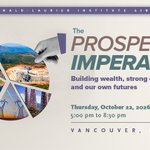
This Thursday MLI is hosting a panel discussion in Vancouver “The Prosperity Imperative: Building wealth, strong communities, and our own futures”
The event will bring together leading Indigenous and international voices to explore the proposition that lasting social outcomes are built on strong economic foundations. Drawing on experiences from Indigenous communities in Canada and around the world, speakers will examine how ownership, entrepreneurship, investment, and wealth creation can grow healthy and thriving communities.
Joining the panel is MLI’s Director of Indigenous Affairs Karen Restoule (@karenrestoule), Magatte Wade (@magattew), Champion, Prosperity, Not Poverty, Kody Penner (@KodyPenner), Chief Development Officer, Nations Royalty and Sharon Singh, Partner, Environment & Indigenous, McMillan LLP.
📍The Vancouver Club - Vancouver, BC
Thu, Oct 22 • 5PM-8:30PM
Register here⬇️
eventbrite.ca/e/the-prosperi…

Christopher Coates, MLI’s Director of Foreign Policy, National Defence and National Security, and a former Royal Canadian Air Force officer goes on @CTV to discuss developments regarding the training fire at CFB Wainwright.
“Benchmark Canada makes relevant data available to stakeholders, offering comparative statistics across five economic pillars and evaluating Canada’s ability to finance, build, govern, secure, and elevate its citizens’ living standards. The platform offers benchmarked data and insights on 44 distinct metrics, including mortgage delinquencies, which contributed to this commentary,” write Murtaza Haider (@regionomics) and Stephen Moranis in the National Post (@nationalpost).
macdonaldlaurier.ca/canadas-…
Check out MLI’s latest project @Benchmark_Cda by @KevinVuongxMP⬇️
benchmarkcanada.org/

“We cannot beat great powers and hegemons at state capitalism. Our competitive advantage is having clear rules and fair returns for private capital. Alberta must be protected as a level playing field where businesses compete with each other, not with the government,” writes Heather Exner-Pirot (@ExnerPirot), director of energy, natural resources and environment at MLI.
Read here⬇️
macdonaldlaurier.ca/is-alber…

“While Albertans are understandably focused on the referendum question on separation, many are less sure about the ballot’s constitutional questions six to nine. This is a shame: these are important constitutional issues that deserve the spotlight,” writes Geoffrey Sigalet (@GeoffSigalet) in @TheHubCanada.
With Alberta’s referendum vote today, read Sigalet’s thoughts on the other questions…⬇️
macdonaldlaurier.ca/what-abo…

“Stopping MAID for mental illness is necessary. But if it is achieved via a bill that must pass by March 2027, with advance requests attached, Parliament will have learned nothing from the last five years. A death cannot be appealed. Debate has to come first,” writes MLI Senior Fellow Ramona Coelho (@rljcoelho).
Read here⬇️
macdonaldlaurier.ca/ottawa-k…

Christopher Coates, MLI’s Director of Foreign Policy, National Defence and National Security, and a former Royal Canadian Air Force officer, comments on the training fire at CFB Wainwright.
“Recent changes to Canada’s gun laws, which have included banning thousands of models of commonly owned firearms and freezing handgun ownership, are deeply unpopular among gun owners and many rural, northern, and western Canadians. Critics argue that the laws have been motivated more by politics than sound policy. Adopting an evidence-based approach to hearing protection could serve as an olive branch between the government and these communities and demonstrate that the Carney government is taking a more serious approach to this issue than its predecessor,” writes Noah S. Schwartz (@NoahSchwartzy) for MLI Inside Policy.
Read here⬇️
macdonaldlaurier.ca/separati…

Canada’s bureaucracy is very good at “self-diagnosis of its problems” but “what it's very bad at is treating those symptoms,” says a retired veteran public servant who spent years working at the centre of government.
Jean-Guy Forgeron, who served as chief of staff to the clerk of the privacy council, and held key roles in other ministries like Fisheries and Oceans, says this means that when it comes to reforming the public service, the initiative must come from “the top.”
“And when I mean the top, I mean the prime minister of Canada,” says Forgeron.
Public service reform is a critical issue at a time when the federal bureaucracy has ballooned, and Ottawa is also being called on to play a key role in initiatives like getting major national infrastructure projects across the finish line.
The federal public service went from about 257,000 employees in 2015 to a peak of almost 368,000 in 2024. It has subsequently fallen. Treasury Board put the number at roughly 345,000 in March 2026, and Ottawa says it aims to drop it to around 330,000 by 2029.
To discuss where the public service is headed, and if it’s well positioned to deliver on the key national projects presently on its radar, Forgeron joins Inside Policy Talks.
On the podcast, he tells Peter Copeland (@CopelanPeter), acting director of domestic policy at MLI, that these staffing numbers are “a symptom of a disease that we should be worried about.”
He said the best way to address this challenge is with a program review like the one carried out in the 1990s by the government of then-prime minister Jean Chrétien. Instead of levelling across-the-board cuts, such a review would focus on determining what government should and should not be doing, says Forgeron. Reductions could then be made accordingly.
Watch the full episode: youtube.com/watch?v=B-W5TAME…