

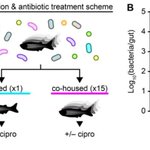
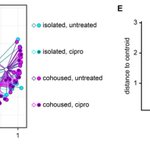

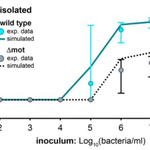
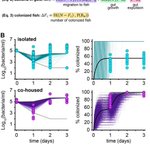



In this preprint, we collaborated with @bunsen_B to understand microbiome transmission using zebrafish. We found that dispersal dynamics can readily move gut colonization and assembly from a stochastic to fairly predictable biorxiv.org/content/10.64898…
And allowed for the recovery of bacterial density after antibiotics in complex self-assembled communities

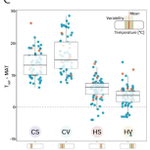
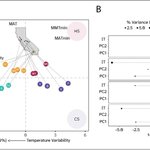
I am a little behind in sharing the newest pre-prints from the lab. First, Ariel Favier (an incredible graduate student) sampled bacteria (Gammaproteobacteria) all over California to evaluate if there was signs of local adaptation to temperature: biorxiv.org/content/10.64898…
In general Enterobacteriales (much better at eating glucose) follow more a hotter is better hypothesis, whereas Pseudomonas vary in their thermal breath more than each thermal limit separated.


María Rebolleda retweeted

How the genes plasmids carry affect their hosts has been well studied, but this smaller scale of evolution has proven much tougher despite decades of theory. Plasmids are small and replication is fast and hard to measure. 2/
science.org/doi/10.1126/scie…

María Rebolleda retweeted

Rhizosphere bacterial communities defy expectations: domestication doesn’t always lower diversity
Hernández-Terán et al. @ipomeaP @anaelena2777 @mrebolleda
📖 nph.onlinelibrary.wiley.com/…

ALT Impact of domestication on host influence of the rhizosphere bacterial communities.
In the literature of domestication and microbiomes there seems to be the expectation that domestication should lead to the loss of microbiome diversity and host-control. Alejandra and I were skeptical of both, so we decided to see what we know so far (1/8) nph.onlinelibrary.wiley.com/…

Alejandra Hernandez-Teran (who is currently in the job market) lead this work. She got me interested and she conducted the literature search and analyses. A collaborator from Mexico (@anaelena2777) provided valuable advice. (8/8)