

Married NOW RETIRED. Hobbies = hunt, fish, travel. Politically and fiscally conservative. Served 3yrs 10mos in 101st Airborne. NO DMs PLEASE!
High in the Montana Rockies.
Joined March 2016
- Tweets158K
- Following7.1K
- Followers6.7K
- Likes329K

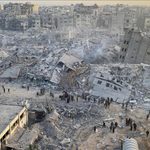






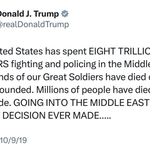


Think about other U.S. wars of aggression these past few decades. Take Vietnam, Afghanistan, Libya, Iraq, Serbia, etc. (the list is unfortunately very long). The pattern was roughly always the same with an immense power differential between aggressor and victim.

I don't think people realize just how extraordinary what we're witnessing with Iran is.
I was arguing with a dear journalist friend of mine yesterday who was telling me that Iran was winning, yes, but only on the strategic level, not tactically.
The type of thing a skinny kid getting stuffed in lockers in highschool tells himself to make himself feel better: "These people will BEG to work for me in ten years. Everyone knows jocks peak in highschool. They'll literally beg." 😏
I think that's precisely wrong, and that's what makes the Iran war different. As of now, Iran is in fact holding its own tactically too.
Think about other U.S. wars of aggression these past few decades. Take Vietnam, Afghanistan, Libya, Iraq, Serbia, etc. (the list is unfortunately very long). The pattern was roughly always the same with an immense power differential between aggressor and victim. These wars were, by and large, imperial: the empire attempting to crush a much weaker people whose only realistic recourse was guerrilla resistance. And that is when they actually had the will to resist: some - like Libya - barely even bothered, just resigning themselves to their fate (despite being, at the time, the richest country in Africa).
As spectators of these wars, if you had any moral sense, the dominant emotion was a kind of helpless disgust: you were watching a giant stomp through someone else's house.
Sure, the U.S. actually lost many - if not most - of these wars, famously replacing the Taliban with the Taliban or being expelled with their tail between their legs from Vietnam, but the power differential was no less real for it.
It's just that power doesn't always guarantee victory: sometimes the giant can't kill everyone, and eventually tires of trying. But the “victories” won this way were always pyrrhic at best: the people endured, yes, but what they were left with was a country in ashes that takes decades to rebuild. Meanwhile, in the grand scheme of things, the giant walked away with little more than a bruised ego.
Iran is - remarkably - proving to be an entirely different beast: when others were merely surviving a giant, Iran appears to be able to compete with one.
What just happened over the past 48 hours is the best illustration of this. You had the President of the United States issue a formal ultimatum: reopen the Strait of Hormuz within 48 hours or we "obliterate" your power grid.
Iran's response was essentially: we dare you, if you do this we'll make all your Gulf allies uninhabitable within a week.
And, as we saw, Trump backed down: pretexting non-existent "VERY GOOD AND PRODUCTIVE CONVERSATIONS" with Iran, he said his ultimatum no-longer applied (or, rather, became 5 days). Adding he now envisaged the Strait of Hormuz being “jointly controlled by me and the Ayatollah.” To the amusement of Iran’s diplomacy (nitter.gq/IraninSA/status/203613…).
That, folks, is a textbook tactical victory. It is, remarkably, Iran demonstrating in this instance that it had escalation dominance over the United States of America. That is, the ability to credibly threaten consequences so severe that the US - for perhaps the first time since the Cold War - found it preferable to stand down.
That's no skinny kid being locked in a locker dreaming of revenge fantasies. That's the kid grabbing the bully's wrist mid-shove and watching his face change.
And it's not the only tactical victory in this war so far. Take the episode over the Israeli attack on Iran's South Pars gas facility. Iran had warned that if that happened U.S. allies in the region - including Israel - would face a symmetrical response.
And they delivered: famously devastating Qatar's Ras Laffan facility - which produced roughly 20% of global LNG supply - and leading, according to Qatar themselves, to a $20 billion loss of annual revenue for the next 5 years (oilprice.com/Latest-Energy-N…).
Not only that but they also managed to hit Israel's Haifa refinery (aljazeera.com/news/2026/3/19…), one of the country's most strategic and protected sites.
The result was Trump distancing himself from the South Pars attack, saying that Israel had "violently lashed out" unilaterally and that "NO MORE ATTACKS WILL BE MADE BY ISRAEL pertaining to this extremely important and valuable South Pars Field." Israel then said it wouldn't strike Iran energy sites anymore (bloomberg.com/news/articles/…).
From where I stand, that's another tactical victory. It is, at least, Iran demonstrating that is can fight back **symmetrically** against the U.S. and its allies. Not through asymmetric resistance with IEDs hidden in the roadside or traps hidden in the jungle, but eye for eye, and against some of the most heavily protected sites on the U.S.'s side.
That's qualitatively different from any other adversaries the U.S. has directly fought in recent wars.
There's plenty more, such as the pretty relevant fact that Iran has gained control of the single most strategic energy chokepoint on earth and the U.S. is finding it impossible to break that control.
To the point where Trump has been reduced to publicly begging China - of all countries - for help, which given Trump's ego mustn't have been easy to do. Only to be told no. By China. And by everyone else he asked.
This is the topic of my latest article: how this is, in fact, the first genuine "multipolar war."
First, in the narrow sense: because Iran is revealing itself to be a genuine pole of power - not a superpower, but an actor that cannot be submitted, which is all multipolarity is.
And second, because the war itself is accelerating multipolarity everywhere else: the U.S. has never been more isolated, never looked weaker and its security guarantees have never been more hollow.
In my article I lay out the full scoreboard - military, economic, political - and explain why this war has already changed the world, regardless of how it ends.
Enjoy the read here: open.substack.com/pub/arnaud…

96
Women are super duty humans. I don't know how they do all that they do.
This post is from an account that no longer exists. Learn more
44
Trump Admin Looking To Restore Coal Plants As America’s Grid Buckles wattsupwiththat.com/2025/11/… via @wattsupwiththat

23
Surprise! Study says Late Jurassic CO2 was 1,200 ppm, dipped to 750 ppm in the Cretaceous wattsupwiththat.com/2025/08/… via @wattsupwiththat

14
WTF!!!!!

The U.S. government just handed over nearly a hundred million dollars to the Taliban for a staged ISKP operation—another deception in a long line of lies. If you are unaware of the previous fake ISKP operations, see the report in my link in bio: ISKP: Know Thy Enemy.
They're being played for fools and don’t even want to hear it. Instead, they keep throwing your taxpayer dollars at terrorists.
That money isn’t just wasted—it’s being diverted into a massive plot against the U.S. homeland. It’s time for the good people inside government to step up and stop the bleed—before it costs more American lives. Our own government is enabling this. You are NOT the good guys!
12
This is a must read especially for Russia haters like Lindsey Graham.

🇷🇺🪖👉“The Russian army has everything”⁉️ from the mouth of the Western military elite...
This is the incredibly honest opinion of the Chief of the General Staff of the French Armed Forces, General Thierry Burkhardt, who just said: "Russia is a strong military and nuclear power, which is constantly investing in it as much as we can hardly imagine.
Russia has a full-fledged model army, down to the tips of its nails. I don't see anything that the modern Russian army lacks." And how do other representatives of the enemy camp assess the state of our army?
Waldemar Skrzypczak, former commander of the Polish Ground Forces:
"Russia has weapons that cannot be neutralized from the outside. They are based on artificial intelligence. There are no effective systems to combat them today."
Anthony Cotton, head of US Strategic Command (STRATCOM):
"Russia has the largest and most diverse arsenal of nuclear weapons of any country in the world. In addition to modernizing the 'nuclear triad', Russia is working to create hypersonic systems and continues to create new nuclear guided missile submarines."
Bundeswehr General Harald Kujat:
"No weapons supplied to Ukraine by the West, including Germany's Taurus missiles, will be able to prevent Russia from achieving its goals."
General John Murray, commander of the US Army Futures Command:
"The latest Russian weapons are superior to most similar American systems. In one case, our specialists were impressed by the combination of artillery and drones used to aim and correct fire. In another case, by the range of new missiles that can easily destroy support aircraft behind the front line and effectively limit access to the skies of Ukraine."

11
New Study: The Arctic Was 9°C Warmer Than Today During the Holocene Thermal Maximum wattsupwiththat.com/2025/07/… via @wattsupwiththat
12
Global Greening From Higher CO2 Hits “Striking” New Heights – but the Mainstream Media Won’t Tell You About It wattsupwiththat.com/2025/06/… via @wattsupwiththat
12
Trump’s Attack on Harvard Could be a Turning Point in the Battle Against the Climate Cult wattsupwiththat.com/2025/06/… via @wattsupwiththat
1
15


The Associated Press Is Wrong, Coffee Prices Are Not Rising Due to Climate Change wattsupwiththat.com/2025/05/… via @wattsupwiththat

15
Antarctica’s Ice Sheet Stages a Remarkable Comeback wattsupwiththat.com/2025/05/… via @wattsupwiththat
8