

Wisdom of Mark Douglas. Learn to trade without the slightest bit of fear.
- Tweets3.6K
- Following1
- Followers3.4K
- Likes1.2K





ALT Without the presence of an external structure forcing the typical trader to think otherwise, he is susceptible to any number of justifications, rationalizations, and the kind of distorted logic that will allow him to get into a trade believing that it can’t lose, which makes determining the risk in advance irrelevant.

ALT You have two choices: You can try to eliminate risk by learning about as many market variables as possible. (I call this the black hole of analysis, because it is the path of ultimate frustration.) Or you can learn how to redefine your trading activities in such a way that you truly accept the risk, and you’re no longer afraid.

ALT If you really believe in an uncertain outcome, then you also have to expect that virtually anything can happen. Otherwise, the moment you let your mind hold onto the notion that you know, you stop taking all of the unknown variables into consideration. Your mind won’t let you have it both ways. If you believe you know something, the moment is no longer unique. If the moment isn’t unique, then everything is known or knowable; that is, there’s nothing not to know. However, the moment you stop factoring in what you don’t or can’t know about the situation instead of being available to perceive what the market is offering, you make yourself susceptible to all of the typical trading errors.

ALT To think in probabilities, you have to create a mental framework or mind-set that is consistent with the underlying principles of a probabilistic environment. A probabilistic mind-set pertaining to trading consists of five fundamental truths. 1. Anything can happen. 2. You don’t need to know what is going to happen next in order to make money. 3. There is a random distribution between wins and losses for any given set of variables that define an edge. 4. An edge is nothing more than an indication of a higher probability of one thing happening over another. 5. Every moment in the market is unique.

ALT The possibilities of the type of movement the markets can display are almost endless because of the diverse number of forces affecting it. All of us have this tendency to mentally lock ourselves into only a very limited number of those ways. And when the market doesn't conform to our preconceived mental image, we make up the difference with distortions and illusions and suffer the consequences later.

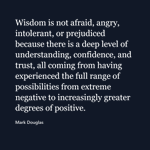
ALT Wisdom is not afraid, angry, intolerant, or prejudiced because there is a deep level of understanding, confidence, and trust, all coming from having experienced the full range of possibilities from extreme negative to increasingly greater degrees of positive.

ALT If we have experienced only the negative side of a certain type of experience, we feel fear. If we have experienced only the positive (never having had a painful experience in certain area), we won't have that particular fear, but we do develop an intolerance or even a disdain for anyone who has had a negative experience.

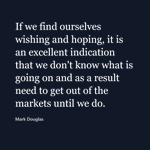
ALT If we find ourselves wishing and hoping, it is an excellent indication that we don't know what is going on and as a result need to get out of the markets until we do.


