

The fastest AI dev news engine on X — model releases, tools, and what they actually mean
What is trending in AI?
Joined April 2016
- Tweets14.1K
- Following1.2K
- Followers12K
- Likes7.6K



▲ Mirendil just released Fern 0.1, its first model, and it can hold 10M tokens of code in one context window.
The key idea is that context is a second way to spend compute. Fern was pretrained from scratch with architecture, training and serving built for 10M tokens. That is about 23 MB of code, roughly half a million lines.
On Mirendil's own repos, loss keeps falling as the window grows: 0.246 bits per byte at 32K bytes down to 0.155 at 23M bytes. RULER single-needle retrieval stays at 100% from 32K to 10M tokens. It is a trade-off though: multi-hop HotpotQA drops to 45% at 10M, and Fern 0.1 scores 6.1% on Terminal Bench 4.0 versus 66.4% for Claude Opus 5.5.
Fern sits on Mirendil-Base, a 0.1 to 0.5T model that 1 researcher built with agents in 3.5 months for under $10M. Access is early access only for now......
Full analysis: marktechpost.com/2026/10/27/…
Announcement: mirendil.com/news/introducin…
Pretraining post: mirendil.com/news/pretrainin…
Early access: mirendil.com/early-access
@mirendil @bneyshabur @tararezaeikh

▲ vLLM Semantic Router just open-sourced d3-ultra, a 27B decision model that answers questions with probabilities instead of text.
The key idea is "state once." The model reads your input a single time, then answers every question on it. Those questions can be choices, yes/no, scores, boxes in an image, or a track across a video.
On the team's own SR-Text test, d3-ultra scores 87.2, ahead of Fastino's GLiDE V1.2 at 85.1 and Liquid AI's d1-ultra at 83.4. On 1 AMD Instinct MI325X, 255 questions about 1 photo take 2.16 s. It is a trade-off though: on Box grounding it trails its sibling d3-turbo, 58.2% vs 60.0%, and both test sets are private.
Weights are on Hugging Face under Apache-2.0: 26.09B parameters, 131,072 tokens per question, text, JSON, images and video in......
Full analysis: marktechpost.com/2026/10/26/…
Model: huggingface.co/vllm-sr/d3-ul…
Repo: github.com/vllm-project/sema…
Free API: decision.vllm-sr.ai
@XunzhuoLiu

▲ Baidu just open-sourced Unlimited OCR 2, a 3B OCR model that parses books and reports of hundreds of pages in a single request.
The key innovation is SR-SWA (Sparse Reference Sliding Window Attention). Instead of scanning an ever-growing KV cache, the decoder attends to a fixed set of working references, 512 tokens in Baidu's example. Per-step decoding latency and memory stay nearly constant as the document grows.
On MarathonDocBench (hundreds of pages) it scores 77.1 overall, against 33.7 for Kimi-K3 and 22.9 for Qwen3.8-Max. On MPDocBench (dozens of pages) it leads Qwen3.8-Max 84.6 to 78.3. It is a trade-off though: heading hierarchy is its weakest metric at 48.2 on long documents, the reference pool is lossy, and every score is self-reported.
3.34B parameters, MIT license, about 6.7 GB of BF16 weights. Runs on Transformers, with a customized SGLang build for serving......
Full analysis: marktechpost.com/2026/10/26/…
Model: huggingface.co/baidu/Unlimit…
Repo: github.com/baidu/Unlimited-O…
Report: huggingface.co/baidu/Unlimit…
@Baidu_Inc

▲ OpenAI just released GPT-6.1 Terra, a fast model that does Astra-level computer use at a fraction of the cost.
The key idea is cost per task, not peak score. Terra looks at screens, drawings and photos, reasons at a dial-able effort level, then clicks and types through the computer-use tool. OpenAI tuned it for high-volume work like forms, invoices and technical drawings.
On Agents' Last Exam v1 at medium effort, Terra scores 57.6% at $0.29 per task. GPT-6 Astra scores the same 57.6% at $4.82 per task. It also hits 85.5% on MMMU-Pro, close to Astra's 86.7%. It is a trade-off though: on Terminal-Bench 4.0 it solves 50.3%, behind GPT-6.1 Sol (55.9%) and Claude Sonnet 5.5 (70.6%).
Available now in the API as gpt-6.1-terra, plus ChatGPT Work and Codex. 1.05M context, closed weights, $1 / $5 per million tokens, half of Sol......
Full analysis: marktechpost.com/2026/10/26/…
Announcement: openai.com/index/introducing…
Docs: developers.openai.com/api/do…
System card: deploymentsafety.openai.com/…
@OpenAI @OpenAIDevs

▲ Marktechpost AI retweeted
▲ Nace AI just released Drex for Search, which brings its Drex decision models to document search, so AI agents get cited pages instead of top-k chunks.
The key idea is that search is a series of decisions. Drex first classifies the question as a quick lookup or a deeper agent search. It then narrows the workspace from folder to file, section and page, down to table and column inside a sheet. Only the kept pages reach the LLM, and the answer cites the file and page.
The numbers, per Nace: 92.05% on BrowseComp-Plus with GPT-5, at 12.61 search calls per question, 16.6x fewer than the only entry ahead. 77.5% R@1 on VisDocAgentBench, 10 points above Claude Opus 5. 94.7% on MADQA with Gemini 3.5 Flash. On OfficeQA Pro, all 9 agent setups Nace tested needed fewer turns, with Claude Code on Opus 5.5 going from 18.5 to 9.1 turns.
Claude Code, Codex, Cursor and OpenCode can call it through the nace-mcp server or the CLI. There are also Python and TypeScript SDKs and a REST API......
Full analysis: marktechpost.com/2026/10/26/…
Product: aicampaign.live/NC-A1-1
Console: aicampaign.live/nc-a1-2
Docs: console.nace.ai/docs
@NaceAI
▲ Marktechpost AI retweeted
▲ Tsinghua University researchers just open-sourced AKV, a serving system that lets LLM agents manage their own KV cache instead of summarizing old history.
The key idea is "cache engineering". Agents drop selected KV entries from attention but keep the text history unchanged. Retained KV is reused as-is, so nothing gets re-prefilled. A Repos step re-rotates RoPE keys to compact positions.
Across 3 models and 4 agent benchmarks, average cost falls 27.7% and average score rises 1.7 points versus threshold summarization. On SWE-bench Verified, GPT-OSS-120B's cost per task drops from 20.0 to 9.7 cents while its score rises from 40.0 to 43.2. It is a trade-off though: MiniMax-M2.7 on BrowseComp-Plus scores 58.9, below Text Engineering's 62.3.
AKV extends SGLang with an OpenAI-compatible API and ships under Apache-2.0. Drop and Repos currently support Qwen, GPT-OSS and MiniMax-M2 text models......
Full analysis: marktechpost.com/2026/10/26/…
Paper: arxiv.org/abs/2610.28577
Repo: github.com/thu-nics/AKV
Project page: fuvty.github.io/thinking_yar…
▲ Marktechpost AI retweeted
▲ Nanbeige just open-sourced Nanbeige4.3-33B, a 33B dense model built to run agent harnesses and then teach smaller models.
The key idea is "teacher first." Nanbeige trains a strong 33B agent, then plans to distill its agentic skills into Nanbeige4.3-3B. The model is a plain Llama-style dense stack with a 524,288-token context window, thinking on by default, and preserved reasoning across tool-use turns.
In Nanbeige's own tests it scores 80.9 on Terminal-Bench 2.1 vs 73.0 for Qwen3.8-27B, and 65.5 on DeepSWE vs 42.5. It leads 17 of 20 rows in its table. It is a trade-off though: it is text-only, it trails Qwen3.8-27B on SWE-Bench Pro (60.3 vs 61.7), and some competitor rows conflict with those labs' own model cards.
Weights and a Base checkpoint are on Hugging Face under Apache 2.0. BF16 weights are about 66 GB, and the card's serving recipe uses 4-way tensor parallelism......
Full analysis: marktechpost.com/2026/10/25/…
Model: huggingface.co/Nanbeige/Nanb…
Base: huggingface.co/Nanbeige/Nanb…
@nanbeige

▲ Marktechpost AI retweeted
▲ Hugging Face just released Carbon-X, an open 14.8B model that reads raw DNA inside a chat and answers in English.
The key idea is 1 decoder for both DNA and text. A hybrid tokenizer keeps Qwen3's text vocabulary and turns DNA into 6-base tokens. There is no separate DNA encoder: it starts from Qwen3-14B, then gets 302B tokens of DNA + text mid-training, SFT and RL.
Across 5 DNA benchmarks it averages 66.7% with thinking off, vs 67.5% for GPT-6.1 Sol at max effort. It leads every model tested on BioReason Coding (74.9%) and NextBase (39.4%). It is a trade-off though: splice-site questions score only 29.8%, and it is not clinically validated.
Weights are Apache 2.0 and fit on 1 x 80 GB GPU. Hugging Face estimates about $300 to score 2.4M ClinVar variants, vs $32K to $4M on frontier models......
Full analysis: marktechpost.com/2026/10/25/…
Model: huggingface.co/HuggingFaceBi…
Blog: huggingface.co/spaces/Huggin…
Repo: github.com/huggingface/carbo…
GGUF: huggingface.co/HuggingFaceBi…
@huggingface @_lewtun @LoubnaBenAllal1 @ClementDelangue

▲ Marktechpost AI retweeted
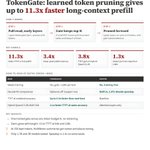
▲ Stanford and UC Berkeley researchers just released TokenGate, a drop-in module that lets LLMs skim long context instead of reading every token.
The key idea is a small learned gate at an early layer. It scores every document token and keeps only the top-K. Layers above it process just those K tokens and store no KV cache for the rest. Top-K is not differentiable, so they add each kept token's score as a bias on attention logits, like an MoE router.
On Qwen3-1.7B, TokenGate cuts time-to-first-token 1.4x to 11.3x and peak prefill memory 1.5x to 3.4x with no accuracy loss. Against the next-best pruning baseline, it is up to 6.4x faster. It is a trade-off though: you train a gate plus LoRA per task, and at 256 kept tokens MultiNews summaries got names and places wrong.
Code and checkpoints are open under Apache-2.0, for Qwen3-1.7B and hybrid Qwen3.5-2B (3.8x faster TTFT at matched accuracy)......
Full analysis: marktechpost.com/2026/10/25/…
Paper: arxiv.org/abs/2610.26754
Repo: github.com/token-gate-llms/T…
Model: huggingface.co/liana313/toke…
@lianapatel_ @Stanford @berkeley_ai

▲ Marktechpost AI retweeted
▲ Anthropic just launched OSS Scanner, giving critical open-source projects free, periodic security audits from its strongest models, including Claude Mythos.
The key idea is skipping the human review queue. Anthropic's models surfaced over 29,000 candidate vulnerabilities in 6 months, but humans could triage only about 6,000. OSS Scanner sends raw model reports straight to maintainers who opt in, each with a reproducer, an explanation and a candidate patch.
The numbers: in Anthropic's audit of 97 critical and high findings across 48 projects, 85 (88%) met its disclosure bar and only 1 was a false positive. In the first 11 days, it reported 77 critical and 803 high model-rated findings, and curl shipped a fix for a High-severity use-after-free (CVE-2026-92392). It is a trade-off though: nothing is human-reviewed first, 11 of the 97 audited findings were duplicates, and maintainers say severity can be inflated.
Enrollment is a pull request with a project.yaml and a Dockerfile; scans run offline in an isolated VM. Free, with Anthropic covering the full cost. 114 projects accepted from about 650 applications so far......
Full analysis: marktechpost.com/2026/10/25/…
Docs: red.anthropic.com/oss-scanne…
Repo: github.com/anthropics/oss-sc…
Launch post: anthropic.com/research/launc…
@AnthropicAI @ClaudeDevs

▲ Nanbeige just open-sourced Nanbeige4.3-33B, a 33B dense model built to run agent harnesses and then teach smaller models.
The key idea is "teacher first." Nanbeige trains a strong 33B agent, then plans to distill its agentic skills into Nanbeige4.3-3B. The model is a plain Llama-style dense stack with a 524,288-token context window, thinking on by default, and preserved reasoning across tool-use turns.
In Nanbeige's own tests it scores 80.9 on Terminal-Bench 2.1 vs 73.0 for Qwen3.8-27B, and 65.5 on DeepSWE vs 42.5. It leads 17 of 20 rows in its table. It is a trade-off though: it is text-only, it trails Qwen3.8-27B on SWE-Bench Pro (60.3 vs 61.7), and some competitor rows conflict with those labs' own model cards.
Weights and a Base checkpoint are on Hugging Face under Apache 2.0. BF16 weights are about 66 GB, and the card's serving recipe uses 4-way tensor parallelism......
Full analysis: marktechpost.com/2026/10/25/…
Model: huggingface.co/Nanbeige/Nanb…
Base: huggingface.co/Nanbeige/Nanb…
@nanbeige
▲ Hugging Face just released Carbon-X, an open 14.8B model that reads raw DNA inside a chat and answers in English.
The key idea is 1 decoder for both DNA and text. A hybrid tokenizer keeps Qwen3's text vocabulary and turns DNA into 6-base tokens. There is no separate DNA encoder: it starts from Qwen3-14B, then gets 302B tokens of DNA + text mid-training, SFT and RL.
Across 5 DNA benchmarks it averages 66.7% with thinking off, vs 67.5% for GPT-6.1 Sol at max effort. It leads every model tested on BioReason Coding (74.9%) and NextBase (39.4%). It is a trade-off though: splice-site questions score only 29.8%, and it is not clinically validated.
Weights are Apache 2.0 and fit on 1 x 80 GB GPU. Hugging Face estimates about $300 to score 2.4M ClinVar variants, vs $32K to $4M on frontier models......
Full analysis: marktechpost.com/2026/10/25/…
Model: huggingface.co/HuggingFaceBi…
Blog: huggingface.co/spaces/Huggin…
Repo: github.com/huggingface/carbo…
GGUF: huggingface.co/HuggingFaceBi…
@huggingface @_lewtun @LoubnaBenAllal1 @ClementDelangue
▲ Marktechpost AI retweeted
▲ Microsoft just open-sourced Agensh, a multi-agent harness that runs up to 1,024 coding agents with no lead agent in charge.
The key idea is self-organization. Every worker runs the same loop: gather context, claim a sub-task, build, verify, merge. They coordinate through a shared Gitea repo, a Mattermost channel and a shared findings board, instead of an orchestrator.
On the 5 hardest ProgramBench tasks (GPT-5.6-sol, 6 hours, offline), the mean test-pass rate rose from 19.31% with 1 agent to 28.78% with 128 agents. On pandoc, 1,024 agents hit 55.06%, up from 33.89%. With GPT-6.1-sol, 32 agents reached 79.59%. It is a trade-off though: going from 1 to 8 agents added only 1.37 points on the 5-task mean, and token cost is not disclosed.
The full harness, launch scripts and reproduction guide are on GitHub under the MIT license. It runs on Linux with Docker Compose......
Full analysis: marktechpost.com/2026/10/24/…
Repo: github.com/microsoft/Agensh
Paper: arxiv.org/abs/2609.26781
Project: aka.ms/Agensh
@MSFTResearch @msdev @msdev

▲ Marktechpost AI retweeted
▲ Cognition just open-sourced the Devin Vulnerability Fixes plugin, agent skills that patch this week's critical PHP, Node.js and GitLab RCEs across your repos.
The key idea is a fixed, auditable workflow. The agent runs a read-only inventory of Dockerfiles, base images, distro packages, CI, Helm and Terraform. Nothing changes until you approve. Every target version, digest and checksum is verified before editing.
It covers PHP2Shell (CVSS v4.0 9.2), the Node.js October 21 release (10 CVEs, 4 High) and GitLab CVE-2026-110264 (CVSS 10.0). Tests run before and after inside the new production image, then it opens 1 PR per repo with a risk label and rollback plan. It is a trade-off though: there is no published fix-rate benchmark, and validation is only as good as your test suite.
3 skills, MIT license, free. Runs in Devin, Claude Code, Codex, Cursor, Factory Droid, GitHub Copilot, Gemini CLI, OpenCode and Windsurf......
Full analysis: marktechpost.com/2026/10/24/…
Repo: github.com/CognitionAI/devin…
Blog: devin.ai/blog/vulnerability-…
Plugin: devin.ai/security/vulnerabil…
@cognition

▲ Stanford and UC Berkeley researchers just released TokenGate, a drop-in module that lets LLMs skim long context instead of reading every token.
The key idea is a small learned gate at an early layer. It scores every document token and keeps only the top-K. Layers above it process just those K tokens and store no KV cache for the rest. Top-K is not differentiable, so they add each kept token's score as a bias on attention logits, like an MoE router.
On Qwen3-1.7B, TokenGate cuts time-to-first-token 1.4x to 11.3x and peak prefill memory 1.5x to 3.4x with no accuracy loss. Against the next-best pruning baseline, it is up to 6.4x faster. It is a trade-off though: you train a gate plus LoRA per task, and at 256 kept tokens MultiNews summaries got names and places wrong.
Code and checkpoints are open under Apache-2.0, for Qwen3-1.7B and hybrid Qwen3.5-2B (3.8x faster TTFT at matched accuracy)......
Full analysis: marktechpost.com/2026/10/25/…
Paper: arxiv.org/abs/2610.26754
Repo: github.com/token-gate-llms/T…
Model: huggingface.co/liana313/toke…
@lianapatel_ @Stanford @berkeley_ai
▲ Anthropic just launched OSS Scanner, giving critical open-source projects free, periodic security audits from its strongest models, including Claude Mythos.
The key idea is skipping the human review queue. Anthropic's models surfaced over 29,000 candidate vulnerabilities in 6 months, but humans could triage only about 6,000. OSS Scanner sends raw model reports straight to maintainers who opt in, each with a reproducer, an explanation and a candidate patch.
The numbers: in Anthropic's audit of 97 critical and high findings across 48 projects, 85 (88%) met its disclosure bar and only 1 was a false positive. In the first 11 days, it reported 77 critical and 803 high model-rated findings, and curl shipped a fix for a High-severity use-after-free (CVE-2026-92392). It is a trade-off though: nothing is human-reviewed first, 11 of the 97 audited findings were duplicates, and maintainers say severity can be inflated.
Enrollment is a pull request with a project.yaml and a Dockerfile; scans run offline in an isolated VM. Free, with Anthropic covering the full cost. 114 projects accepted from about 650 applications so far......
Full analysis: marktechpost.com/2026/10/25/…
Docs: red.anthropic.com/oss-scanne…
Repo: github.com/anthropics/oss-sc…
Launch post: anthropic.com/research/launc…
@AnthropicAI @ClaudeDevs
▲ Microsoft just open-sourced Agensh, a multi-agent harness that runs up to 1,024 coding agents with no lead agent in charge.
The key idea is self-organization. Every worker runs the same loop: gather context, claim a sub-task, build, verify, merge. They coordinate through a shared Gitea repo, a Mattermost channel and a shared findings board, instead of an orchestrator.
On the 5 hardest ProgramBench tasks (GPT-5.6-sol, 6 hours, offline), the mean test-pass rate rose from 19.31% with 1 agent to 28.78% with 128 agents. On pandoc, 1,024 agents hit 55.06%, up from 33.89%. With GPT-6.1-sol, 32 agents reached 79.59%. It is a trade-off though: going from 1 to 8 agents added only 1.37 points on the 5-task mean, and token cost is not disclosed.
The full harness, launch scripts and reproduction guide are on GitHub under the MIT license. It runs on Linux with Docker Compose......
Full analysis: marktechpost.com/2026/10/24/…
Repo: github.com/microsoft/Agensh
Paper: arxiv.org/abs/2609.26781
Project: aka.ms/Agensh
@MSFTResearch @msdev @msdev
▲ Cognition just open-sourced the Devin Vulnerability Fixes plugin, agent skills that patch this week's critical PHP, Node.js and GitLab RCEs across your repos.
The key idea is a fixed, auditable workflow. The agent runs a read-only inventory of Dockerfiles, base images, distro packages, CI, Helm and Terraform. Nothing changes until you approve. Every target version, digest and checksum is verified before editing.
It covers PHP2Shell (CVSS v4.0 9.2), the Node.js October 21 release (10 CVEs, 4 High) and GitLab CVE-2026-110264 (CVSS 10.0). Tests run before and after inside the new production image, then it opens 1 PR per repo with a risk label and rollback plan. It is a trade-off though: there is no published fix-rate benchmark, and validation is only as good as your test suite.
3 skills, MIT license, free. Runs in Devin, Claude Code, Codex, Cursor, Factory Droid, GitHub Copilot, Gemini CLI, OpenCode and Windsurf......
Full analysis: marktechpost.com/2026/10/24/…
Repo: github.com/CognitionAI/devin…
Blog: devin.ai/blog/vulnerability-…
Plugin: devin.ai/security/vulnerabil…
@cognition