

The fastest AI dev news engine on X — model releases, tools, and what they actually mean
What is trending in AI?
Joined April 2016
- Tweets14.1K
- Following1.2K
- Followers11.9K
- Likes7.6K
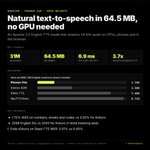




▲ Gradium just open-sourced Phonon, a 31M-parameter text-to-speech model that runs fully on your device, with no GPU and no cloud call.
The key idea is a tiny causal transformer that predicts 1 audio latent per 80 ms frame. A 1-step flow-matching head and a small Mimi decoder turn it into 24 kHz audio, streamed as it generates.
The numbers: 1.70% WER on 500 hard sentences (phone numbers, emails, codes) vs 3.50% for Kokoro-82M. First audio in 6.9 ms on a MacBook Air M5 CPU vs 517 ms for Kokoro. It is a trade-off though: on the easier Seed-TTS set, Phonon 31m scores 0.51% WER and Kokoro wins at 0.45%.
Phonon 31m is English-only, 64.5 MB, Apache 2.0, and runs 3.7x faster than real time on a Raspberry Pi 5. The 5-language 40m models are CC BY-NC......
Full analysis: marktechpost.com/2026/10/22/…
Model: huggingface.co/gradium/phono…
Repo: github.com/gradium-ai/xn-ptt…
Blog: gradium.ai/blog/release-phon…
@GradiumAI

▲ Marktechpost AI retweeted
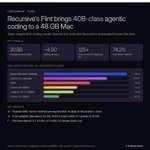
▲ Recursive releases Flint, an Apache 2.0 local coding MoE with 40B total and ~2.5B active params (74.2% SWE-bench Verified)
The key idea is sparsity tuned for local hardware. Flint has 39.8B parameters but activates only ~2.5B per token: a router picks 6 of 256 experts plus 1 shared expert. Recursive's Eureka Machine, an automated research system, searched the architecture, the 4-bit quantization recipe and the kernels.
Recursive reports 74.2% on SWE-bench Verified vs 73.4% for Qwen3.6-35B-A3B, and 125+ tok/s on an M4 Pro MacBook Pro (150+ on a 64 GB RTX Spark). It is a trade-off though: on Terminal-Bench 2.1 Flint scores 54.9%, while dense Qwen 3.8 hits 73.0%.
Weights are Apache 2.0. 4-bit builds take about 23 GB and need 48 GB of memory. rec, Recursive's local engine, targets M4 Pro and M5 Pro/Max......
Full analysis: marktechpost.com/2026/10/21/…
Model: huggingface.co/RecursiveSI/f…
Repo: github.com/recursive-oss/rec
Blog: recursive.com/updates/introd…
@Recursive_SI @RichardSocher @CaimingXiong @tydsh

▲ Marktechpost AI retweeted
▲ Perplexity and NVIDIA just released JOLT, a post-training method where one model is both teacher and student, and the teacher is trained to teach.
The key idea is simple. Self-distillation gives the model a verified answer and lets it score its own attempts. But a teacher holding the answer can take shortcuts the student cannot follow. JOLT trains the teacher with outcome reward plus a KL pull toward the student, so its feedback stays within reach.
On MATH (Qwen3-0.6B), JOLT matched GRPO's accuracy with 6.5x fewer processed training tokens, and about 13x fewer completion tokens. JOLT+ (adds student reward) beat GRPO by 9.9 points on AppWorld and hit 10.96% pass@1 on Terminal-Bench 2.1 vs 8.25%. It is a trade-off though: without student reward, JOLT trails GRPO on AppWorld (51.92% vs 62.20%).
It is a method, tested on Qwen3 0.6B to 30B-A3B and DeepSeek-V2-Lite.
Full analysis: marktechpost.com/2026/10/21/…
Paper: arxiv.org/abs/2610.10447
Blog: perplexity.ai/hub/blog/a-goo…
@perplexity_ai @AravSrinivas

▲ Marktechpost AI retweeted
▲ IBM just released Granite Speech 5.0 2B, an Apache 2.0 speech model that transcribes and translates speech in 1 model.
The key idea is a CTC Conformer encoder feeding a Granite 4.0 1B LLM through a q-former. Audio reaches the LLM at 10 Hz. Prompts switch between transcription, translation, language ID and keyword lists of up to 2,000 terms.
It ranks #2 among open-weight models on the Open ASR Leaderboard at 5.68% average English WER. Qwen3-ASR-1.7B leads at 5.40%. Cohere Transcribe sits at 5.77%. It is a trade-off though: on noisy FFASR audio it scores 14.80% vs Qwen3-ASR's 13.41%, and Japanese WER is 10.74%.
2B params, 6 ASR languages, Apache 2.0. Runs in Transformers, vLLM, llama.cpp and mlx-audio. IBM also updated Turbo CTC (19,870 RTFx, now 7 languages) and 4.1 2B Plus......
Full analysis: marktechpost.com/2026/10/22/…
Model: huggingface.co/ibm-granite/g…
Blog: huggingface.co/blog/ibm-gran…
Paper: arxiv.org/abs/2505.08699
@IBM @IBMwatsonx @IBMData @IBMResearch
▲ Perplexity and NVIDIA just released JOLT, a post-training method where one model is both teacher and student, and the teacher is trained to teach.
The key idea is simple. Self-distillation gives the model a verified answer and lets it score its own attempts. But a teacher holding the answer can take shortcuts the student cannot follow. JOLT trains the teacher with outcome reward plus a KL pull toward the student, so its feedback stays within reach.
On MATH (Qwen3-0.6B), JOLT matched GRPO's accuracy with 6.5x fewer processed training tokens, and about 13x fewer completion tokens. JOLT+ (adds student reward) beat GRPO by 9.9 points on AppWorld and hit 10.96% pass@1 on Terminal-Bench 2.1 vs 8.25%. It is a trade-off though: without student reward, JOLT trails GRPO on AppWorld (51.92% vs 62.20%).
It is a method, tested on Qwen3 0.6B to 30B-A3B and DeepSeek-V2-Lite.
Full analysis: marktechpost.com/2026/10/21/…
Paper: arxiv.org/abs/2610.10447
Blog: perplexity.ai/hub/blog/a-goo…
@perplexity_ai @AravSrinivas
▲ Recursive releases Flint, an Apache 2.0 local coding MoE with 40B total and ~2.5B active params (74.2% SWE-bench Verified)
The key idea is sparsity tuned for local hardware. Flint has 39.8B parameters but activates only ~2.5B per token: a router picks 6 of 256 experts plus 1 shared expert. Recursive's Eureka Machine, an automated research system, searched the architecture, the 4-bit quantization recipe and the kernels.
Recursive reports 74.2% on SWE-bench Verified vs 73.4% for Qwen3.6-35B-A3B, and 125+ tok/s on an M4 Pro MacBook Pro (150+ on a 64 GB RTX Spark). It is a trade-off though: on Terminal-Bench 2.1 Flint scores 54.9%, while dense Qwen 3.8 hits 73.0%.
Weights are Apache 2.0. 4-bit builds take about 23 GB and need 48 GB of memory. rec, Recursive's local engine, targets M4 Pro and M5 Pro/Max......
Full analysis: marktechpost.com/2026/10/21/…
Model: huggingface.co/RecursiveSI/f…
Repo: github.com/recursive-oss/rec
Blog: recursive.com/updates/introd…
@Recursive_SI @RichardSocher @CaimingXiong @tydsh
▲ Marktechpost AI retweeted
▲ Mistral AI just released Voxtral 3, a full voice stack: 3 transcription models, 1 TTS model and a voice agent SDK.
The key idea is 1 streaming pipeline. Realtime Transcribe 3 listens and detects end of turn. An LLM like Mistral Small 4 reasons and calls tools. Voxtral Speech 3 replies in the conversation's tone, with each turn under 1 second.
Voxtral Small Transcribe 3 scores 2.1% AA-WER, #3 on Artificial Analysis, ahead of Scribe v2 (2.2%). Diarization hits 18.4% cpWER vs 20.3% for MAI-Transcribe-2. It is a trade-off though: MAI-Transcribe-2 is about 4.7x faster, and the realtime model at 240 ms scores 7.4% WER vs 4.2% for Gemini 3.5 Realtime.
Public preview on the Mistral API (EU, US, global). Batch ASR from $0.0035/min, TTS $13 per 1M characters, voice agent API from $0.04/min. No open weights announced......
Full analysis: marktechpost.com/2026/10/20/…
Announcement: mistral.ai/news/voxtral-3
Docs: docs.mistral.ai/studio/audio…
@MistralAI @arthurmensch

▲ Marktechpost AI retweeted
▲ Google, Red Hat and IBM Devs just released llm-d 1.0, turning a fleet of vLLM and SGLang servers into one coordinated inference pool on Kubernetes.
The key idea is cache-aware routing. The router tracks which replica already holds each agent's prefix and sends the next step there. When GPU or TPU memory fills, KV cache spills to host RAM, SSD or Managed Lustre instead of being evicted.
Google reports Gemini's prefix cache hit rate doubled from 35% to 70%, and a 17,000-node GKE benchmark scaled throughput 2.9x. It is a trade-off though: every number is self-reported, and RL time-slicing still leaves roughly 30% of accelerator time idle.
Apache 2.0, CNCF Sandbox, runs on NVIDIA, AMD, Intel GPUs and Google TPUs......
Full analysis: marktechpost.com/2026/10/20/…
Repo: github.com/llm-d/llm-d
Docs: llm-d.ai
Technical details: cloud.google.com/blog/topics…
@GoogleAI @googleaidevs @RedHat @RedHat_AI @IBM @IBMData @IBMResearch

▲ Mistral AI just released Voxtral 3, a full voice stack: 3 transcription models, 1 TTS model and a voice agent SDK.
The key idea is 1 streaming pipeline. Realtime Transcribe 3 listens and detects end of turn. An LLM like Mistral Small 4 reasons and calls tools. Voxtral Speech 3 replies in the conversation's tone, with each turn under 1 second.
Voxtral Small Transcribe 3 scores 2.1% AA-WER, #3 on Artificial Analysis, ahead of Scribe v2 (2.2%). Diarization hits 18.4% cpWER vs 20.3% for MAI-Transcribe-2. It is a trade-off though: MAI-Transcribe-2 is about 4.7x faster, and the realtime model at 240 ms scores 7.4% WER vs 4.2% for Gemini 3.5 Realtime.
Public preview on the Mistral API (EU, US, global). Batch ASR from $0.0035/min, TTS $13 per 1M characters, voice agent API from $0.04/min. No open weights announced......
Full analysis: marktechpost.com/2026/10/20/…
Announcement: mistral.ai/news/voxtral-3
Docs: docs.mistral.ai/studio/audio…
@MistralAI @arthurmensch
▲ Google, Red Hat and IBM Devs just released llm-d 1.0, turning a fleet of vLLM and SGLang servers into one coordinated inference pool on Kubernetes.
The key idea is cache-aware routing. The router tracks which replica already holds each agent's prefix and sends the next step there. When GPU or TPU memory fills, KV cache spills to host RAM, SSD or Managed Lustre instead of being evicted.
Google reports Gemini's prefix cache hit rate doubled from 35% to 70%, and a 17,000-node GKE benchmark scaled throughput 2.9x. It is a trade-off though: every number is self-reported, and RL time-slicing still leaves roughly 30% of accelerator time idle.
Apache 2.0, CNCF Sandbox, runs on NVIDIA, AMD, Intel GPUs and Google TPUs......
Full analysis: marktechpost.com/2026/10/20/…
Repo: github.com/llm-d/llm-d
Docs: llm-d.ai
Technical details: cloud.google.com/blog/topics…
@GoogleAI @googleaidevs @RedHat @RedHat_AI @IBM @IBMData @IBMResearch
▲ Marktechpost AI retweeted
▲ DeepSeek just open-sourced DeepInfer, the inference engine that serves DeepSeek-V4.1-Flash in production.
The key idea is DSpark: a draft model proposes 5 tokens, and a Confidence Head predicts which ones will be accepted. The scheduler verifies only the most valuable prefix. Add Wide-EP decode, SWA bounded replay and async scheduling, and you get DeepSeek's real serving stack.
The numbers: above 25,000 decode tokens/s per GPU on 64 GPUs (EP64, 131K context). DSpark verifies about 30% fewer draft tokens with accepted length nearly flat (3.29 vs 3.20). It is a trade-off though: this release is offline only, with no KV cache store, P/D disaggregation or load balancer, and it supports 1 model.
Apache 2.0. Runs on NVIDIA SM100 GPUs and Huawei Ascend 950 NPUs. deepseek-recipe (MIT) ships alongside......
Full analysis: marktechpost.com/2026/10/20/…
Repo: github.com/deepseek-ai/DeepI…
Docs: github.com/deepseek-ai/DeepI…
Model: huggingface.co/deepseek-ai/D…
@deepseek_ai

▲ Marktechpost AI retweeted
▲ Google just open-sourced TorchTPU, a native PyTorch backend that makes Google TPUs an ordinary PyTorch device.
The key idea is PrivateUse1 registration. Tensors stay plain PyTorch tensors on torch.device("tpu"), with no JAX runtime. Code runs eager by default, then torch.compile lowers it through StableHLO to XLA.
The headline number: TorchTitan reached 52% MFU training Qwen 3 8B, with near-linear scaling up to 8,192 Ironwood TPUs. It is a trade-off though: out-of-box eager took 11.49s per step in Google's fine-tuning case, versus 2.78s after compile, kernels and sharding.
TorchTPU is co-developed with Meta, Apache 2.0, v0.2.0 on PyPI, and replaces PyTorch/XLA. vLLM, SGLang and Hugging Face Transformers v5 already run on it......
Full analysis: marktechpost.com/2026/10/20/…
Repo: github.com/google-pytorch/to…
Paper: arxiv.org/abs/2610.24161
Docs: docs.cloud.google.com/tpu/do…
@googlecloud @GoogleAI
▲ DeepSeek just open-sourced DeepInfer, the inference engine that serves DeepSeek-V4.1-Flash in production.
The key idea is DSpark: a draft model proposes 5 tokens, and a Confidence Head predicts which ones will be accepted. The scheduler verifies only the most valuable prefix. Add Wide-EP decode, SWA bounded replay and async scheduling, and you get DeepSeek's real serving stack.
The numbers: above 25,000 decode tokens/s per GPU on 64 GPUs (EP64, 131K context). DSpark verifies about 30% fewer draft tokens with accepted length nearly flat (3.29 vs 3.20). It is a trade-off though: this release is offline only, with no KV cache store, P/D disaggregation or load balancer, and it supports 1 model.
Apache 2.0. Runs on NVIDIA SM100 GPUs and Huawei Ascend 950 NPUs. deepseek-recipe (MIT) ships alongside......
Full analysis: marktechpost.com/2026/10/20/…
Repo: github.com/deepseek-ai/DeepI…
Docs: github.com/deepseek-ai/DeepI…
Model: huggingface.co/deepseek-ai/D…
@deepseek_ai
▲ Marktechpost AI retweeted
▲ Exa just released Exa 3.0, an upgrade to its web search API that makes agent search cheaper and more token-efficient.
The key idea is better retrieval plus leaner context. A larger embedding model finds candidates in Exa's own index. Dynamic Highlights then picks tokens across all results, using 95% fewer tokens than full pages.
In Exa's own harness, Exa 3.0 Auto leads Perplexity, Brave and Parallel on 8 benchmarks, including 75.5% vs 69.9% on WebCode and 42.0% vs 37.2% on ATLAS. It is a trade-off though: the BrowseComp lead is only 0.3 points (91.8% vs 91.5%), and every eval was run by Exa.
The new Exa Lite type costs $4 per 1K requests on the same index as Auto ($7 per 1K). Highlights and the expanded index carry no extra charge......
Full analysis: marktechpost.com/2026/10/20/…
Blog: exa.ai/blog/exa-3
Library: exa.ai/library
Docs: exa.ai/docs
@ExaAILabs

▲ Marktechpost AI retweeted
▲ Cloudflare just released Clairic in preview, a model that pulls typed values out of messy text and images instead of generating text.
The key idea is a System One extraction model. You send a state plus a schema of typed fields (text, number, date, duration, list, estimate, forecast). Clairic answers every field in 1 forward pass, with no output tokens, and attaches confidence, p_null and spans or 80% intervals.
In Cloudflare's claims pipeline (Clairic extract, Clef decide, GLM-5.3 reply), extraction took 0.46 s vs 16.1 s with GLM-5.3. The full run finished in 19.3 s vs 61.7 s and cost 49% less per million claims. It is a trade-off though: long arithmetic chains are unreliable, and 4 of 21 next-day TSA forecasts fell outside its 80% interval.
Available now on Workers AI as @cf/cloudflare/clairic at $0.10 per million input tokens, no output charge. Context window is 65,536 tokens. Open weights are promised but not out yet......
Full analysis: marktechpost.com/2026/10/20/…
Blog: blog.cloudflare.com/clairic-…
Docs: developers.cloudflare.com/wo…
@Cloudflare @michellechen @CloudflareDev

▲ Marktechpost AI retweeted
▲ Inception just released Mercury 3, a diffusion LLM that writes whole answers in parallel instead of token by token.
The key idea is diffusion for text. The model starts from a rough draft of the full answer and refines every position over a few passes. Fewer sequential steps means far more tokens per second on the same GPUs.
Inception reports 1,068 tok/s vs ~130 for GPT-6 Luna and ~240 for Claude Haiku 5.5. On its own table (medium settings), Mercury 3 leads 8 of 12 benchmarks, including SWE-Bench Atlas 51.08 vs 33.33 for Luna. It is a trade-off though: Haiku 5.5 still wins DeepSWE v1 (51.62 vs 46.31) and MRCR v2, and every score is self-reported.
1M context, 40x+ the size of Mercury 1, OpenAI-compatible API. $0.10 / $0.35 per 1M tokens at launch, $0.20 / $0.70 list......
Full analysis: marktechpost.com/2026/10/19/…
Blog: inceptionlabs.ai/blog/introd…
Docs: docs.inceptionlabs.ai
API: platform.inceptionlabs.ai
@_inception_ai @StefanoErmon @volokuleshov
▲ Marktechpost AI retweeted
▲ Nace AI just released Drex Max, a decision model that reads screens. Instead of writing text, it returns a calibrated probability for every option your agent could pick.
The key idea is one forward pass per decision. You send a state, up to 8 screenshots and typed questions (yes/no, choice or score). It can only answer with options you supply, so there is no JSON to repair.
Nace reports 67.59 on the public Decision Index 0.3.2, 6.9 points over Jev 1.14. On the vision suite it scores 74.5 vs 63.9 for GPT-6 Luna Decisions. A screenshot decision takes 174 ms vs 253 ms for Jev 1.14, and it accepts every screenshot size (Jev 1.14 rejects 15.9%). It is a trade-off though: Jev 1.14 still leads on MMLU-Pro (82.1 vs 72.5), the model size is undisclosed and every score is self-reported.
Priced at $0.06 per 1M input tokens with output free, it is API-only on Nace Console as drex-max......
Full analysis: marktechpost.com/2026/10/19/…
Docs: console.nace.ai/docs/drex/gu…
Product: nace.ai/drex
@NaceAI
