

Essential technology, done right™ Data Center & Cloud | Carrier | Enterprise
Santa Clara, CA
Joined August 2009
- Tweets5.5K
- Following493
- Followers18.8K
- Likes1.5K





We’re proud to share Marvell’s FY2026 Sustainability Report, highlighting our progress and the contributions of our employees around the world during FY26.
The report provides an overview of our activities and performance across our sustainability priorities, including climate action, ethics and compliance, talent development, and community engagement. A few highlights from FY26:
➡️ Named one of the World’s Most Ethical Companies® by Ethisphere, recognizing our commitment to ethics, compliance, sustainability and governance.
➡️ Procured 93% of our global electricity from renewable sources and reduced greenhouse gas emissions from our direct operations by 85% from our FY22 base year.
➡️ Invested in our people, with 67% of new directors and 69% of new senior directors promoted from within Marvell.
➡️ Reached 25% employee participation in philanthropy ahead of our FY27 goal, with more than 6,000 volunteer hours supporting 1,635 nonprofits globally.
➡️ Expanded our Technical Accelerator Program to the U.S., building on programs in Israel, India and Vietnam.
➡️ Expanded AI literacy across Marvell to support responsible AI use and awareness of our safeguards.
As AI and accelerated infrastructure continue to reshape our industry, we’re focused on delivering advanced semiconductor solutions that enable the next generation of data infrastructure. We continue to work closely with our customers to drive innovation, improve energy efficiency and create long-term value, while advancing our sustainability priorities across our operations and value chain.
Thank you to our employees and partners whose contributions helped make the progress highlighted in this year’s report possible. View the report here: mrvl.co/496TbFP

At #SC26, Marvell demonstrated technologies for scale-up, scale-out and scale-across architectures, including the Marvell® Photonic Fabric™ memory module, CXL memory solutions with the Marvell Structera™ add-in card, Teralynx® 10 and Teralynx T100 switch silicon, and Alaska® A AEC DSP-based 1.6T and 800G active electrical cables.
A major highlight was our strategic collaboration with @WeAre_Penguin, bringing together CXL-based memory expansion and photonic technology designed to enable high-bandwidth, low-latency memory sharing across multiple racks.
Marvell's Preet Virk, Senior Vice President and General Manager of the Photonic Fabric Business Unit, and Penguin Solutions’ Andy Mills, Vice President, Advanced Product Development, also took the stage for the Birds of a Feather panel, “Photonics for AI and HPC Clusters: Breaking the Bandwidth and Power Barrier.”
At Marvell, we’re advancing what’s possible for AI infrastructure. Because connectivity is how AI scales.


Marvell Technology retweeted

Yesterday at #SC26, we explored some of the biggest challenges and opportunities shaping the future of HPC and AI infrastructure.
Thank you to everyone who joined us for our engaging panel discussions:
☑️ Photonics for AI & HPC: Breaking the Bandwidth and Power Barrier featuring Phil Pokorny and Andy Mills
☑️ Unleashing Performance: How CXL and Disaggregated Memory Are Revolutionalizing HPC & AI featuring Phil Porkorny
☑️ GPUaaS: From Successful Deployment to Predictable Operations featuring Joe Castillo, with @Dell
A special thanks to our fellow panelists and industry partners @Marvelltech, @Microntech, @Intel, @SemiconDx and Olds Research for sharing their expertise and perspectives.
Together, we explored how emerging technologies are helping address memory and bandwidth constraints, improve performance and enable the next generation of HPC and AI infrastructure. #PenguinSC26 @supercomputing


Centralized HSMs can create the very bottlenecks that push teams toward risky security workarounds.
Every cryptographic operation in a centralized HSM requires a network roundtrip, which adds latency and widens the attack surface. To hit performance targets, teams often generate keys outside the HSM boundary or cache them locally, and that erodes trust.
Marvell, @Microsoft and @Oracle built Tessera Integrated HSM to remove that tradeoff. The local HSM sits on the tray next to the workload, so it delivers the isolation of a cloud HSM with lower latency and higher system performance. Tessera is FIPS 140-3 Level 3 certified and uses an open-silicon model.
Read the article from Craig Barner, Senior Distinguished Engineer at Marvell, to learn how Tessera helps teams have both performance and security: mrvl.co/4zzMW8n

2
29
1,717
One USB-compatible protocol can consolidate boot, configuration, recovery and runtime communication between host processors and baseboard management controllers.
See it in action at Marvell’s Booth 4003 at Supercomputing26. Marvell Infrastructure Management and Control (IMC) processors will run the OBMF (Open Boot Management Framework) ICP (Interface Consolidation Protocol) over USB across I2C, I3C, GPIO, UART and SPI interfaces. The live demo with NXP and other industry partners shows cross-vendor interoperability and the progress of open standards for data center management.
#SC26

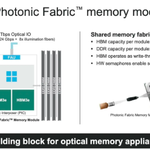
Marvell's Photonic Fabric™ technology, gained through the acquisition of Celestial AI, is heading into appliances that can share up to 16 TB of DRAM across as many as 16 systems.
@TheRegister covers how Marvell and @WeAre_Penguin are bringing it to market. Marvell provides the Photonic Fabric memory modules, and Penguin builds the appliance, power management and software. The technology is purpose-built for the emerging scale-up interconnect market, and the acquisition strengthens Marvell leadership in the optical interconnect technologies required for next-generation AI and cloud architectures. The approach is also positioned as an alternative to storage-based KV cache offload for AI inference.
Read the full article: mrvl.co/4C5Mtx6

Big AI challenges call for collaboration.
At #SC26, Marvell's Preet Virk and Ravi Mahatme and @WeAre_Penguin’s Andy Mills are highlighting how our teams are working together to address the growing memory demands of AI inference.
From server-level expansion using Marvell® Structera™ X memory-expansion controllers to planned multi-rack sharing enabled by Marvell® Photonic Fabric™ technology, the collaboration connects near-term capacity needs with a roadmap for more flexible AI infrastructure.

What if AI memory could move beyond the boundaries of a single server?
On display at Supercomputing 26: @WeAre_Penguin’s MemoryAI™ Photonic Memory Module, the world’s first silicon photonics memory module designed to deliver HBM-class performance, built on the Marvell® Photonic Fabric™ technology platform.
The module is a building block for Penguin Solutions’ MemoryAI™ Photonic Appliance, designed to enable transparent sharing of disaggregated high-bandwidth memory across multiple CPU- and GPU-based servers.
See the innovation taking shape at #SC26 in Chicago at Marvell booth 4003 or Penguin Solutions booth 1723.

Marvell Technology retweeted
Live from #SC26 in Chicago, Penguin Solutions is breaking the GPU memory wall for agentic AI.
We’ve unveiled the MemoryAI™ Photonic Appliance: the industry’s first photonics-based HBM-class memory appliance, alongside its underlying MemoryAI™ Photonic Memory Module, built on the @MarvellTech Photonic Fabric™ technology platform.
Today’s agentic AI workloads are hitting a brutal wall: GPUs can spend 70% of their time sitting idle, waiting for data transfers.
The physical constraint is clear. Ultra-fast HBM historically had to sit mere millimeters from the accelerator die, severely constraining memory capacity to package size. By replacing conventional copper with silicon photonics, this industry-first appliance extends HBM-class data rates across meters rather than millimeters. GPUs and CPUs can now transparently pool and access memory across a multi-rack cluster with zero data copying required.
Visiting #SC26? Stop by our booth #1723 to see it in action, and read the full product launch details here: ir.penguinsolutions.com/news…

HBM now takes roughly 30% of an AI accelerator die and, at 2026 memory prices, more than half of its cost.
Custom HBM can free up to 25% more die area for compute, depending on the XPU design. But moving logic into a custom base die also moves heat under the DRAM stack. Hsin-wei (Mark) Tseng, Director of Product Management for Custom Cloud Solutions at Marvell, explains why the base die, the die-to-die interface and the package thermals need to be designed together. The article also covers how the industry is tackling heat and how adaptive power management can cut interface power by up to 75% under normal workloads.
Read the full article: mrvl.co/4tp1SF3

Marvell Photonic Fabric™ technology enables up to 32TB of warm KV cache offload across multiple XPUs and racks up to 50 meters apart.
@TheFastMode Awards 2026 has recognized the technology as an AI Compute Gamechanger for Impact, naming Marvell a winner in the Data Center Solution Provider category. By loading KV cache from a shared memory tier instead of storage, Photonic Fabric helps increase inference throughput, support larger models and longer context lengths, and deliver up to 2 to 3x higher token throughput within existing data center footprints and power envelopes.
Read more about the award and the technology: mrvl.co/4zu4YJg

AI inference is scaling. Memory needs to keep up.
Marvell and @WeAre_Penguin, the AI Factory Platform Company, are collaborating to address one of AI infrastructure's growing challenges: memory capacity, bandwidth and latency.
The collaboration brings together Marvell® Structera™ X memory-expansion controllers, designed to extend server memory capacity by reusing existing DDR4 memory, and Marvell® Photonic Fabric™ optical interconnect technology, designed to enable high-bandwidth, low-latency memory sharing across multiple racks.
Together, these complementary technologies offer a roadmap from direct-attach memory expansion to disaggregated, multi-rack sharing, helping data centers scale memory as AI inference demands evolve.
Discover how Marvell and Penguin Solutions are advancing memory expansion from the server to the pod: mrvl.co/4eH5iN3

Marvell Technology retweeted

“This era of connectivity is going to unleash a whole new wave of innovation.” @MarvellTech CEO Matt Murphy opened Day 3 of the Six Five Summit with @PatrickMoorhead and @danielnewmanUV, and shared how optics could cut data center power 25%+ and a push past the memory wall. $MRVL
Silicon photonics could break the bandwidth and power barrier facing AI and HPC systems. What will it take to deploy it at scale?
Preet Virk, Senior Vice President and General Manager of the Photonic Fabric Business Unit at Marvell, will join a panel of experts at #SC26 to discuss the value of photonic interconnects today, the technical and operational challenges ahead and what the ecosystem must do to accelerate adoption.
Learn more: mrvl.co/4zGKi1q

As AI and HPC workloads grow, more compute and memory-intensive infrastructure is encountering both connectivity and memory bottlenecks that are causing significant underutilization.
At SC26, booth 4003, Marvell will showcase the technologies enabling the next generation of AI infrastructure across scale-up, scale-out and scale-across architectures, including technologies that scale memory and interconnect as a single system. Demonstrations include:
➡️Marvell® Photonic Fabric™ memory module
➡️CXL memory solutions with the Marvell Structera™ add-in card
➡️Multipath reliable connection (MRC) with Marvell Teralynx® 10 switch silicon
➡️Marvell Alaska® A AEC DSP-based 1.6T and 800G active electrical cables
Preet Virk, Senior Vice President and General Manager of the Photonic Fabric Business Unit at Marvell, will join the Birds of a Feather panel “Photonics for AI and HPC Clusters: Breaking the Bandwidth and Power Barrier” on Wednesday, November 18.
Read the press release: mrvl.co/4f9gdPN

Marvell Technology is proud to announce that Donna C. Morris, Douglas R. Bettinger, and Sasan K. Goodarzi have joined our board of directors. Read more in today's press release: mrvl.co/4zmWK5B
Since 2022, the Technical Leadership Mentoring Program has reached 63 senior technical leaders at Marvell across four cohorts, supported by more than 30 executive mentors.
The 12-month program, sponsored by Corporate Chief Technology Officer Noam Mizrahi, combines immersive workshops, a leadership 360 assessment and 1:1 mentoring with executives. Participants learn to shape strategy, lead cross-functional work and influence teams they don’t manage.
Distinguished Engineer Dan Scofield says the program changed how he thinks about his role, “not just as a technical resource, but as a connector and enabler for others.”
Learn how the program develops technical leaders: mrvl.co/4eYin4I


2
13
1,673